
This article gives you copy-ready, customizable review response templates plus the workflow rules to use them safely at scale. The approach is simple: start from a template, add one line of real personalization, and route anything sensitive or low-star to a human for approval before it goes public.
TL;DR:
- Response templates should be personalized with at least one specific detail from the review to appear authentic and build trust.
- Negative reviews involving safety, legal threats, or policy violations must be escalated for manual approval before public posting.
- Automated draft replies handle common thank-yous and praise, but sensitive or low-star reviews require a human review to avoid risks.
- Agencies should implement a scalable workflow with review-specific approval thresholds, a templates registry, and role-based permissions for consistency.
- Tracking metrics like response rate, response time, and star-rating trends helps evaluate the effectiveness of a review response program.
- ✓Personalised Google review reply drafts
- ✓On-brand responses for your team
- ✓Approval controls for sensitive reviews
- ✓Consistent replies across locations
Table of Contents
- Ready-to-use templates for every star rating
- Best practices that make templates sound human
- How to triage and respond to negative reviews
- Building a governance model that lets agencies scale
- Fast ways to personalize without losing speed
- Measuring whether your review responses are working
- Where automation helps and where it should not decide alone
- Try Local Review Reply for agency-scale replies
- FAQ
- Sources
Ready-to-use templates for every star rating
Templates save time, but they only work when they read like a person wrote them. Treat every template below as a starting point: fill in the bracketed detail, read it once out loud, and adjust the tone to match the client's brand before you post.

Positive review templates (4 and 5 stars)
A five-star review deserves more than "Thanks!" It is a chance to reinforce what the customer already loves and to show future readers what to expect.
- 5-star thank you: "Thank you, [ReviewerName], for the kind words about [Service/Product]. We're glad [TeamMember] could help, and we look forward to seeing you again."
- 5-star praise for a team member: "We'll be sure to pass this along to [TeamMember], [ReviewerName]. Comments like yours are exactly why they love what they do here."
- 4-star constructive praise reply: "Thanks for the feedback, [ReviewerName]. We're happy you enjoyed [Service], and we'd love the chance to earn that fifth star next time. Feel free to reach out directly at [contact] if there's anything we could have done better."
- Star-only response (no text left): "Thank you for the five-star rating, [ReviewerName]. We appreciate you taking the time to leave it."
Neutral and mixed templates (3 stars)
Three-star reviews are often the most useful ones for a business because they contain a specific, fixable complaint wrapped in otherwise fair feedback.
- Acknowledge the specific point they raised, even briefly.
- Thank them for the honest feedback rather than being defensive.
- Invite a private conversation to learn more or make it right.
A working example: "Thanks for sharing this, [ReviewerName]. We're glad the [positive detail] worked out, and we're sorry [specific issue] fell short. We'd like to hear more, if you're open to it, at [contact]."
Negative review templates (1 and 2 stars)
Negative reviews need a calmer, more careful structure: acknowledge, apologize where it is warranted, and move the conversation offline.
- Acknowledgment and apology: "We're sorry to hear about your experience, [ReviewerName]. This isn't the standard we hold ourselves to, and we'd like to understand what happened."
- Offer to resolve offline: "Could you reach out to us directly at [contact] so we can look into this and make it right?"
- Escalation wording for serious complaints: "We take this seriously and have shared your feedback with our [team/management]. Please contact us at [contact] so we can address this properly."
Never promise a specific outcome, a refund amount, or a guaranteed fix in a public reply. Keep the commitment limited to a conversation, and let the private channel handle specifics.
Specialized scenarios
Some reviews call for a slightly different angle than the standard positive, neutral, or negative structure.
- First-time customer: "Welcome, and thank you for trying us out, [ReviewerName]. We hope to see you again soon."
- Long-time client: "It means a lot to hear this from someone who's been with us for [timeframe], [ReviewerName]. Thank you for your continued trust."
- Appointment or installation-based service: "Thanks for the feedback on your [service type] on [Date], [ReviewerName]. We're glad the team could get it done to your satisfaction."
- Multi-location wording: "Thank you for visiting our [location name] team, [ReviewerName]. We've shared your comments with that location's staff."
Customization checklist before you post
Every template above includes variables that must be swapped out, never left as placeholders. At minimum, replace [ReviewerName], [Service], [TeamMember], [Date], and [contact] with real, accurate details, and add one sentence that responds to something specific the reviewer said. According to Shopify's guidance on review responses, personalizing a reply by referencing a specific detail, rather than relying on a repetitive generic phrase, is what signals authenticity to readers browsing a business profile.

Best practices that make templates sound human
A template is a skeleton. What makes a reply feel genuine, and what keeps it compliant, comes down to a handful of habits.
- Personalize every reply with at least one specific detail the reviewer mentioned, whether that's a product name, a staff member, or a particular visit, a practice Shopify's review response guidance identifies as the most effective single adjustment agencies can make.
- Keep replies concise and non-promotional. Google's guidance for managing customer reviews recommends professional, brief, helpful responses rather than marketing copy.
- Set realistic response-time targets and communicate them to clients. Google notes that replies are typically reviewed and published within about ten minutes, though more complex cases can take longer.
- Never include private or sensitive customer information in a public reply. Move account numbers, order details, or health and financial information to a private channel.
- Rotate your phrasing. If an agency manages dozens of locations, repeating the exact same sentence across profiles reads as robotic and can look inauthentic to anyone comparing reviews across branches.
Pro Tip: Keep a short list of five or six alternate opening lines for each template category so reviewers across different locations don't sound like they're reading from the same script.
How to triage and respond to negative reviews
Not every negative review deserves the same response speed or escalation path. A clear triage process keeps your team consistent and protects clients from avoidable legal or reputational risk.
- Assess severity. Separate a mild complaint about wait times from an allegation involving safety, discrimination, or fraud.
- Check credibility. Note whether the reviewer references a real transaction, date, or staff interaction, or whether the review reads as vague or potentially fake.
- Draft a public reply that acknowledges the issue, apologizes where appropriate, and offers a private channel and a concrete next step.
- Flag policy violations. If a review contains harassment, spam, or clearly false claims, use Google's review reporting tool to request removal, and document the policy reason, the review URL, and the date flagged.
- Log the outcome. Keep a record of the public reply, any private follow-up, and whether Google approved or denied an appeal.
Google's own appeal process can take days, and its reporting tool notes that flagged reviews are evaluated against platform policy before any removal, so agencies should set client expectations that not every unfair review will come down quickly.
Agencies also carry compliance exposure here. The FTC's consumer reviews and testimonials rule warns that businesses and the agencies working on their behalf can be held liable for creating or buying fake reviews, suppressing negative ones, or failing to disclose insider relationships. That means incentivized review programs and any pressure to selectively hide negative feedback are risks worth avoiding entirely, not just managing carefully.
Building a governance model that lets agencies scale
Templates and triage rules only hold up at scale if they live inside a repeatable workflow, not in someone's head or a scattered folder of documents.
- Build a templates registry with a variable cheat-sheet (ReviewerName, Service, TeamMember, Date, contact) and a one-page tone guide per client brand.
- Set approval thresholds. Define which star ratings or keywords (refund, lawsuit, injury) require manual sign-off before anything posts publicly.
- Use a draft-then-approve flow. An automated draft speeds up the first pass, but a human reviewer should confirm tone and accuracy on anything low-star or sensitive before it goes live.
- Pilot before rolling out. Test the workflow on a handful of clients or locations, gather feedback from the reviewers doing the approving, then expand.
This is the model Local Review Reply is built around: it drafts personalized, on-brand replies automatically, while keeping manual approval controls in place for sensitive or low-star reviews so a person still signs off before anything sensitive reaches a customer. Multi-location support and team roles let an agency apply the same governance consistently across every client account rather than managing each one by hand.
Pro Tip: Start your pilot with your most engaged client, not your largest one. Fast feedback from an attentive client surfaces tone problems before they reach fifty locations.
Fast ways to personalize without losing speed
Personalization does not have to mean writing from scratch every time. A short set of habits keeps replies quick and specific.
- Keep a live variable list ([ReviewerName], [Service], [Date], [TeamMember]) that your team updates in seconds, not minutes.
- Require one personalization sentence per reply that names the actual praise or issue the reviewer raised, not a generic acknowledgment.
- Reuse small, swappable phrases ("especially during [busy season]" or "on your visit to [location]") rather than rewriting whole templates.
- Avoid promising refunds, discounts, or specific outcomes in a public reply. These statements can create real obligations and should stay in private follow-up.
Measuring whether your review responses are working
Clients want to see the impact of a reply program, and a short set of metrics tells that story without overstating results.
- Response rate: the share of reviews that received a reply within a set window.
- Average response time: how long between a review posting and a reply going live.
- Star-rating trend: whether the average rating is moving over a quarter, not a single month.
- Resolution rate: the share of negative reviews that led to a private resolution or a follow-up update from the reviewer.
Report these monthly, and frame them around trust and sentiment improvements rather than promising ranking changes, since review replies are one input among many in how a business profile performs. For more on how consistent reputation management supports broader brand credibility, see this guide to building brand authority for local businesses.
Where automation helps and where it should not decide alone
Automation is genuinely useful for the first draft: it handles the repetitive thank-yous and frees up time for the replies that actually need judgment. But a low-star review involving a safety complaint or a legal threat is not the place to trust a template without a second set of eyes.
— Ryan
Try Local Review Reply for agency-scale replies
We built software to draft personalized, on-brand replies to Google Business Profile reviews quickly, while keeping approval controls in place for sensitive and low-star reviews so nothing risky posts without a human checking it first. Multi-location and team role support let an agency apply one consistent tone guide across accounts instead of training a new person on every brand voice.
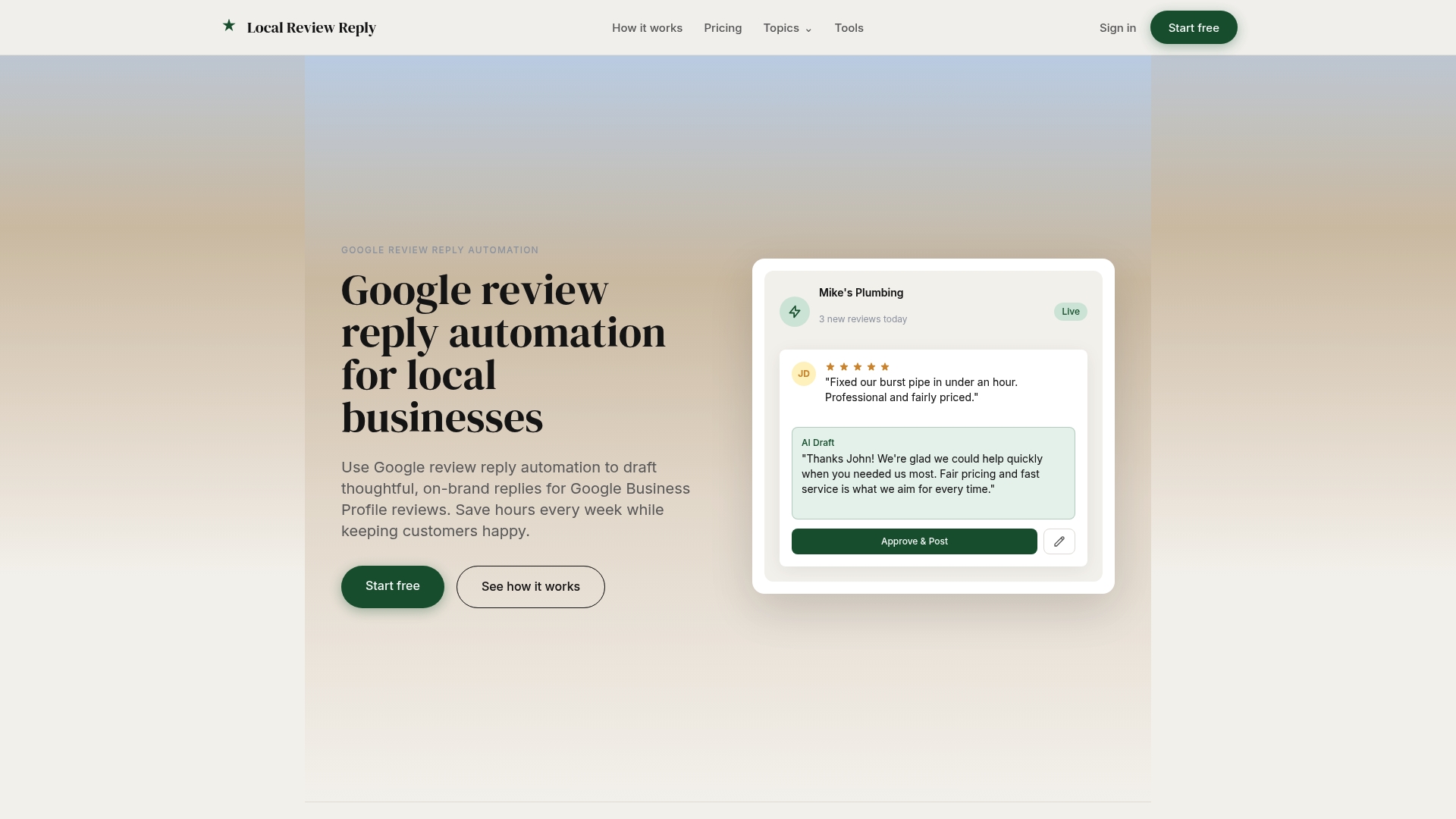
- We draft replies automatically, matching the tone you set for each client.
- Sensitive and low-star reviews route to manual approval before they go public.
- Multi-location and team permissions keep larger accounts organized as you scale.
Plans range from a Free tier to Starter, Growth, Scale, and Custom options, and you can compare what fits your agency's reply volume and location count on our pricing page. None of this changes what a review score ends up being. It just makes it easier to respond to every review consistently and on time.
FAQ
What should an agency include in a review response?
A good response acknowledges something specific the reviewer mentioned, stays brief and professional, and avoids sounding promotional. Google's guidance for managing reviews recommends keeping replies helpful and non-salesy, and moving any complex issue to a private channel.
How long does Google take to publish a review reply?
Google's help documentation notes that replies are typically reviewed and published quickly, often within about ten minutes, though some replies can take longer depending on review and content checks. Agencies should track submission and publish times separately when reporting to clients on response speed.
Can an agency get a fake or abusive review removed?
Yes, through Google's review reporting tool, which lets you flag reviews that violate platform policy and check the status of an appeal. Removal is not guaranteed and can take time, so document the review URL and the reason flagged for your records.
Is it legal to offer incentives for positive reviews?
No. The FTC's consumer reviews and testimonials rule prohibits creating or buying fake reviews, suppressing negative ones, and failing to disclose insider relationships, and agencies can share liability with the client if they run programs that violate it.
Does Local Review Reply post replies automatically without review?
Local Review Reply drafts personalized replies automatically but includes approval controls specifically so sensitive or low-star reviews require manual sign-off before publishing. That distinction between automated drafting and human approval is part of how the workflow is designed to work.