
Yes, AI can reliably draft on-brand Google review replies, but only if you teach it your voice and keep a human approval gate in place. Three moves make this work: define your tone in writing before you generate a single reply, set a response-time SLA that varies by star rating, and enforce a paste test on every draft before it goes live. Local Review Reply and Google Business Profile both play roles here: one drafts the reply, the other sets the rules for how it should sound.
TL;DR:
- AI can generate on-brand review replies only if you provide a detailed written tone guide and conduct a paste test on each draft.
- The system works best when reviews are categorized by risk level, with praise replies approved quickly and complaints reviewed by managers within one day.
- Confirmed success depends on monitoring response speed, paste-test pass rates, and escalation percentages to prevent generic or inappropriate responses.
- AI excels at creating consistent drafts across multiple replies but should not replace human judgment in handling legal, safety, or highly negative reviews.
- Pilot programs should include specific success criteria, feedback loops, and periodic tone guide updates to ensure scalable, effective multi-location deployment.
Table of Contents
- What AI Tone Matching for Reviews Actually Does
- Teaching the AI Your Brand Voice: The Paste Test Explained
- Who Approves What: Building Your Review Response Workflow
- Rolling Out Tone-Matching AI Across Multiple Locations
- Tracking Whether Your AI-Drafted Replies Are Working
- Where I Draw the Line on Automation
- How Local Review Reply Fits Into This Workflow
- Sources
- FAQ
What AI Tone Matching for Reviews Actually Does
When you feed a review into an AI drafting tool, the model is working with a fairly narrow set of inputs: the review text itself, sometimes a linked customer record from your CRM, and whatever brand voice guide you have given it. From that, it produces a reply that mimics your register, pulls in relevant vocabulary, and tries to sound like a person who works at your business, not a call center script.
The technology is genuinely good at a few things. It holds a consistent tone across hundreds of replies in a way that a rotating cast of front-desk staff never will. It calibrates formality up or down depending on the review's own tone. Done well, it weaves in location or service details naturally instead of stuffing them in like a keyword list.
It also has real limits worth watching for:
- Hallucinated specifics. The AI can invent a remedy, a policy, or a promise that doesn't exist, which is why AI drafts should never publish unchecked.
- Missing context. It doesn't know your refund policy changed last month or that a customer is a repeat complainer.
- Flat sarcasm detection. A dry, sarcastic one-star review can get a warm, oblivious reply that makes things worse.
- Uniform sentence rhythm. Left unedited, AI text tends to fall into a repetitive cadence that reads as obviously automated.
None of that makes the tool unusable. It just means the draft is a starting point, not a finished product.
Teaching the AI Your Brand Voice: The Paste Test Explained
A generic AI reply sounds like it could be pasted under any review, for any business, in any city. Fixing that starts with a written tone guide, not a vague verbal instruction to "sound friendly."
A usable tone guide covers five things: your formality level (first-name warmth versus polished professionalism), preferred vocabulary, a list of banned phrases, your emoji policy (most local service brands should skip emojis entirely in review replies), and two or three example replies that nail the voice. Feeding the AI 10 to 15 example replies pulled from your website copy, past replies, and social posts builds a workable profile fast, and pairing that sample set with the actual review text lets the AI surface a specific, real detail instead of a generic thank-you.
Once the tone guide exists, run every draft through the paste test:
- Read the draft without knowing which review it answers.
- Ask whether it could sit under a different, unrelated review without sounding out of place.
- If yes, it fails. Send it back for regeneration with a prompt that forces in a specific detail from the actual review.
- If it references a fix or a promise, flag it for the operations owner to confirm before anything publishes.
- Reread the final version out loud. Uneven sentence length is fine. Robotic repetition is not.
The paste test is deliberately binary. There's no partial credit, which is exactly why it works as a quality gate for a team that's publishing dozens of replies a week.
Pro Tip: Keep a running "banned phrases" list that grows every time a customer complains a reply sounded fake. That list becomes more valuable than the original tone guide within a few months.
Who Approves What: Building Your Review Response Workflow
Not every review carries the same risk, so not every reply should get the same level of human scrutiny. The stakes should set the workflow, not the star rating alone.
A workable routing matrix looks like this:
| Review type | AI role | Human role | Publish speed |
|---|---|---|---|
| Praise (4 to 5 stars) | Drafts reply | Spot-check, batch approve | Same-day batch |
| Fixable complaint (2 to 3 stars) | Drafts reply | Manager edits and approves individually | Within a reasonable business timeframe |
| False or defamatory claim | Drafts nothing or a holding statement | Legal or ownership review required | Hold until cleared |
Praise can move fast because the downside of a slightly generic thank-you is low. Complaints need a real person checking that any promised fix is something operations can actually deliver, since an AI reply should never invent a corrective action that nobody signed off on. Reviews touching legal exposure, safety incidents, or accusations that could be defamatory need to skip AI drafting for the public-facing text entirely and go straight to a manager or legal contact.
Set hard rules around this, not just guidelines:
- Batch-publish approved praise replies once or twice a day, not one at a time.
- Enforce a one-business-day response window on fixable complaints.
- Escalate anything mentioning injury, discrimination, or fraud immediately, no queue.
- Require a named approver for every reply that references a refund, discount, or specific policy change.
Practitioner guidance on this consistently lands on the same point: AI drafts at scale, but humans approve anything with legal or reputational weight attached to it.
Rolling Out Tone-Matching AI Across Multiple Locations
A single-location pilot beats a company-wide rollout every time. Here's a sequence that keeps risk low while you find out whether your tone guide actually works.
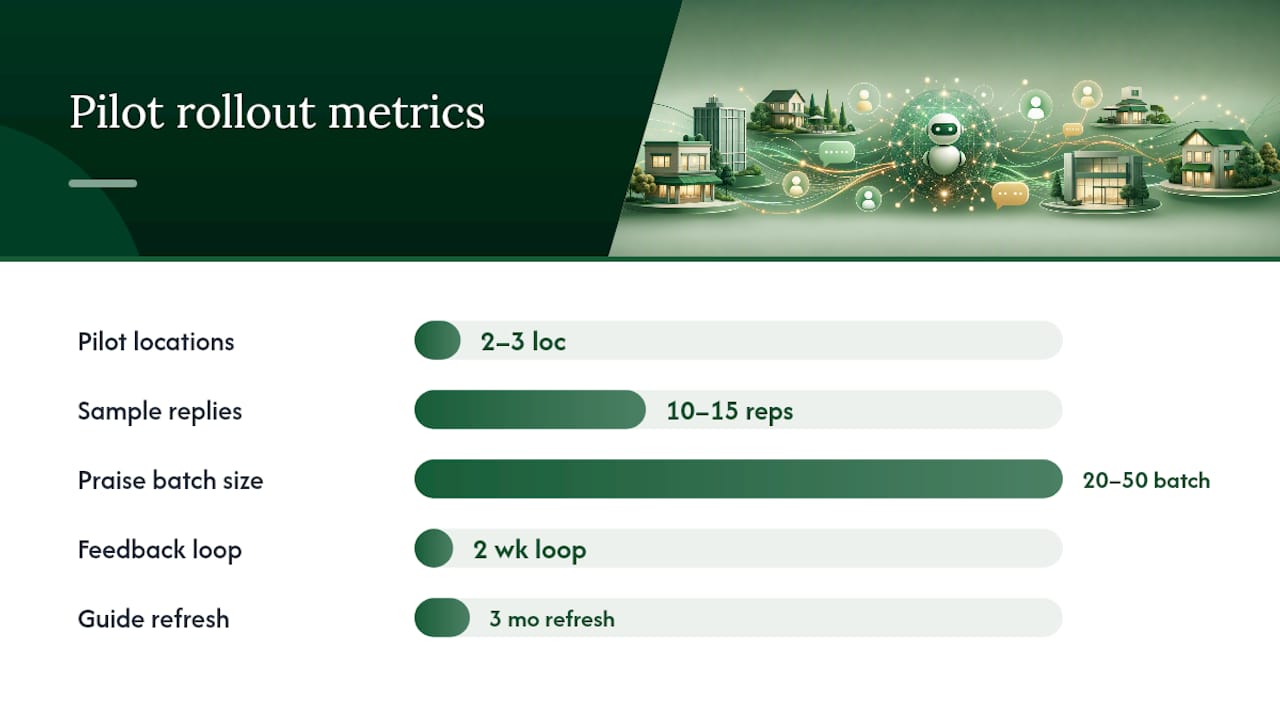
- Pick two or three pilot locations that represent your range, one high-volume urban site, one smaller market, one that gets more complaints than average.
- Draft the tone guide using site copy, social captions, and 10 to 15 of your best past replies as source material.
- Assign an approval owner at each pilot location, someone empowered to edit or reject drafts, not just rubber-stamp them.
- Set success criteria upfront: a target paste-test pass rate, a maximum time-to-publish, and a cap on manager edit time per reply.
- Run a two-week feedback loop where every rejected draft gets logged with the reason, then feed those patterns back into the tone guide.
- Refresh the tone guide quarterly, since language that felt fresh in January can start sounding stale by summer.
- Document the whole process before handing it to franchisees, including the routing matrix, the escalation triggers, and who owns the tone guide going forward.
When you're ready to scale past the pilot, batch praise replies in groups of 20 to 50 for a quick manager scan, but keep complaint replies gated one at a time. Multi-location brands and agencies managing several client accounts benefit from a shared white-label workflow that keeps each location's tone guide separate while standardizing the approval steps behind the scenes.
Pro Tip: Give new locations a shortened tone guide focused only on the three or four phrases that make your brand recognizable. A ten-page style manual gets skimmed once and ignored; a short list gets used.
Tracking Whether Your AI-Drafted Replies Are Working
Two categories of metrics matter here, and teams that only track one usually miss the bigger problem.
Operational KPIs tell you about speed and coverage: response rate across all reviews, median time-to-response, average approval time per draft, and the percentage of drafts escalated out of the automated flow. Quality metrics tell you whether the replies are actually good: paste-test pass rate, a random-sample human score pulled weekly, and whether customers who left a complaint ever follow up positively.
- Response rate and time-to-response show whether the workflow is keeping pace with review volume.
- Paste-test pass rate is your single best early-warning signal for bot voice creeping back in.
- Escalation percentage tells you whether your routing matrix thresholds are set correctly, too high and complaints slip through, too low and managers burn out on review triage.
Google itself recommends replies stay professional, polite, short, and conversational rather than promotional, and while the company hasn't published a precise ranking weight for review replies, that conversational standard is worth building into your quality score directly, alongside the paste test.
Where I Draw the Line on Automation
The trade-off nobody likes to admit: full automation is fastest, but the reviews that matter most, the angry ones, the ones threatening legal action, the ones from a customer who got hurt, are exactly the ones where speed should lose to a real person thinking it through. Franchises chasing brand consistency sometimes flatten every location's personality into one corporate voice, and that's a mistake. A shop in Austin and one in Portland can share tone principles without sounding identical. What AI genuinely does well is cool down the first draft on a heated complaint, giving a manager calmer language to start from rather than a blank page. Use it there. Don't use it to replace the judgment call on whether a promised refund is real.
— Ryan
How Local Review Reply Fits Into This Workflow
Local Review Reply is built around the exact routing problem this article walks through: it drafts replies calibrated to a documented brand voice profile, then routes anything below a set star threshold into an approval queue instead of publishing automatically. Locations can each carry their own tone settings while an agency or franchise owner manages permissions and escalation rules from one dashboard, which maps directly onto the praise-versus-complaint-versus-legal matrix covered above.
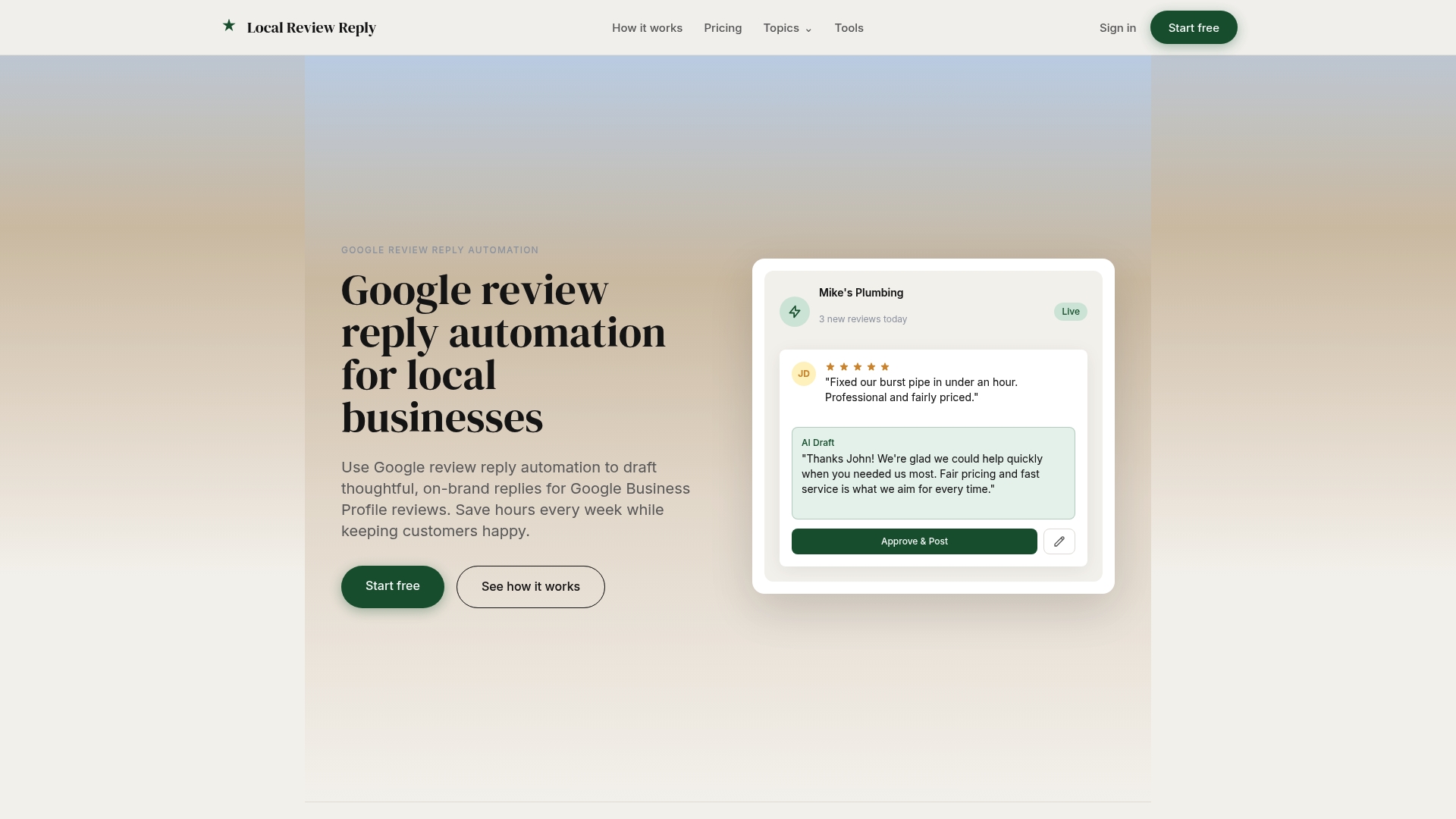
Multi-location teams and agencies managing several client accounts get analytics on response rate, approval time, and escalation volume without building a tracking spreadsheet by hand. If you're deciding whether AI tone matching for reviews is worth trialing at your business, start with the free AI review response generator to see how a draft reads against your own past replies, then explore the full feature set for tone profiles and approval controls before committing to a plan.
Sources
- AI-assisted review response: reputation at scale (2026 playbook) - Digital Applied
- AI review replies human — Faster
- How to Respond to Customer Reviews With AI (Without Sounding Like a Robot) - Yehonatan Saadia
- AI tone calibration: match your brand voice in review responses - Starworks
FAQ
Can AI Really Match a Specific Brand's Tone?
Yes, when it's given a written tone guide and 10 to 15 sample replies, AI can hold a consistent register across hundreds of responses, though every draft still needs a human check before publishing.
What Is the Paste Test for Review Replies?
It's a check where you ask whether a drafted reply could sit unchanged under a completely different review; if it could, the draft is too generic and needs to be regenerated with a specific detail added.
Which Reviews Should Never Get an Auto-Published AI Reply?
Reviews involving legal threats, safety incidents, or defamatory claims should always route to a manager or legal contact, never straight to publication.
How Fast Should a Business Respond to a Negative Review?
A one-business-day response window for fixable complaints is a reasonable standard, with immediate escalation for anything touching safety or legal exposure.
Does Local Review Reply Handle Multi-Location Approval Workflows?
Yes, Local Review Reply supports separate tone profiles per location alongside centralized approval controls, which fits franchise and agency structures managing several accounts at once.