
When you reply to a negative review, offer a short apology that names the specific issue, state one clear next step or an invitation to continue the conversation privately, and sign with a real name or role. Keep it brief: this combination reads as sincere rather than scripted, and it gives the next customer who reads it a reason to trust you.
TL;DR:
- An experiment with 1,062 participants found that public apologies increased trust and recommendation intent, although their effect on purchase intent was mixed.
- Reply within a day or two; detailed, verifiable complaints warrant specific public acknowledgment, while sensitive, legal, or complex cases should move offline.
- Pair an apology with a brief, truthful explanation and concrete remedy when appropriate, since research links that combination to stronger purchase intentions.
- Avoid conceding unverified fault or offering discounts upfront; give a direct private contact, and ask for review updates only after resolution without incentives.
- Use automation for routine replies only; a person should verify names, dates, and details, and approve responses involving refunds, safety, or legal concerns.
Table of Contents
- Why apologies in review replies work: research and platform signals
- Deciding when to apologize publicly: quick rules and red flags
- Step-by-step writing framework: exact components to include in a sincere apology reply
- Templates and example replies for common review scenarios
- Follow-up: moving the conversation offline, confirming resolution, and learning from reviews
- When automation helps, and how to keep AI-drafted apologies authentic
- What years of review replies taught me about apologizing well
- Let Local Review Reply handle consistent apologies at scale
- FAQ
- Sources
Why apologies in review replies work: research and platform signals
Apologizing publicly is not just good manners. It changes how the next customer reads your business. An experimental study of 1,062 participants across restaurant service-failure scenarios found that an online apology increased both affective and cognitive trust, and it raised recommendation intention, though the effect on purchase intent was mixed, according to research on apology and online reviews. In plain terms, people who see a business owner apologize tend to feel more favorably toward that business and are more willing to recommend it, even though they do not always buy immediately.
A well-placed apology measurably shifts trust, according to that same study, because potential customers treat your reply as a signal of how you would treat them if something went wrong on their visit. A review reply is rarely read by only the original reviewer. Anyone researching your business sees the exchange, and a calm, specific apology tells them you take responsibility rather than argue in public.
Other research backs this up from a different angle. Combining an explanation with some form of compensation tends to outperform responses that offer only one of those elements when it comes to improving future customers' purchase intentions, according to research on accommodative management responses. An apology alone helps, but an apology paired with a believable reason and a concrete remedy helps more.
Platform behavior matters too. Google documents that owner replies are posted publicly, may be checked against content policies, and can trigger a notification to the reviewer, who is then able to revise their original review after seeing your response, according to Google's guidance on managing reviews. That last point is worth sitting with: a thoughtful apology does not just protect your reputation with future readers, it sometimes earns you a better rating from the original reviewer.

Deciding when to apologize publicly: quick rules and red flags
Not every one-star review needs the same treatment, and reacting the same way to every complaint can backfire. Start by reading the review for specifics. A detailed account of what went wrong, something a staff member or manager could verify, usually calls for a public apology that acknowledges the issue directly. A vague or inflammatory review with no concrete detail often calls for a shorter, more neutral reply that still extends an invitation to talk.
A few cues help you decide quickly:
- Detailed, verifiable complaint: apologize publicly and specifically, since vague replies look evasive next to a specific grievance.
- High-visibility location or review: prioritize a prompt public apology, since more people will see it before you can resolve things privately.
- Sensitive, legal, or highly personal complaint: keep the public reply brief and move the specifics to a private channel.
- Repeated or complex dispute: acknowledge briefly in public and handle the substance offline, where you can ask questions and compare records.
Speed matters as much as wording, as explained in detail in how business reputation management works for owners. Faster replies tend to moderate the negative impression a review leaves on other readers, so aim to respond within a day or two rather than letting a complaint sit unanswered for a week. A fast, short public apology followed by an offline resolution usually beats a slow, lengthy public one, especially when the issue involves billing, a refund, or anything that requires pulling records before you can speak confidently about what happened.
Step-by-step writing framework: exact components to include in a sincere apology reply
A sincere apology reply follows a predictable shape. You do not need to reinvent the structure every time, you need to fill it in honestly with the details of the specific complaint.
- Acknowledge the reviewer and restate the issue. Use their name if the platform shows it, and repeat back, in a few words, what went wrong: "Thank you for flagging the delay with your order on Tuesday."
- Apologize in one clear sentence. Avoid hedging language like "we're sorry if you felt" and say plainly, "We're sorry your order took longer than it should have."
- Add a brief, honest explanation when you have one. Keep it factual and short: "We were short-staffed that evening," not a paragraph of excuses.
- State a remedy or a next step. Offer something concrete when you can (a refund, a redo, a discount on the next visit) or invite them to discuss resolution directly.
- Sign off with a real name or role and set an expectation. "Please reach out to me directly at [phone or email] so I can make this right. Jordan, General Manager."
Pro Tip: Write the apology sentence first, then add only what the reviewer's specific complaint requires. Skip extra apologies stacked on top of each other, since one sincere line beats three defensive ones.
A sincere, specific, and brief response that references the cited failure and carries an actual name signals personal accountability, while generic corporate phrasing tends to read as deflection no matter how polite it sounds. That means "We take all feedback seriously" should almost never appear in your reply, because it says nothing about what actually happened.
Keep explanations truthful and non-defensive. If the kitchen was backed up, say so plainly instead of implying the complaint was a misunderstanding. If your business was not at fault, you can still acknowledge the reviewer's experience without admitting an error you did not make: "We're sorry the wait felt longer than expected" works even when the delay was outside your control, as long as it does not misrepresent what happened.
Resist adding a promotion or discount code as your first move. Including an offer too early in the reply can look self-interested rather than corrective, so lead with the apology and the remedy, and let any goodwill gesture follow naturally rather than function as the headline.
Templates and example replies for common review scenarios
Templates save time, but they only work when you fill in the specifics: a date, a staff name, an order number, something that proves you actually read the review rather than pasted a form response.
Short templates for minor issues work well when the complaint is small and does not need an extended explanation.
- "We're sorry your visit on [date] didn't go as planned. We'd like to make it right, please call us at [number]. Thanks, [Name], [Role]."
- "Sorry to hear about the mix-up with your order. We've flagged this with the team and would like to follow up directly, [contact info]. [Name]."
- "That's not the experience we want for you. Please reach out so we can fix it, [contact info]. [Name], [Role]."
Full templates for service failures or billing errors need the extra structure of explanation plus remedy, since these complaints usually involve money or a specific operational breakdown.
- "Thank you for letting us know about the billing error on your [date] invoice. We're sorry for the confusion, a system update caused several accounts to be charged incorrectly that week. We've corrected the charge and issued a refund, please allow 3 to 5 business days for it to post. If you have questions, contact me directly at [email]. [Name], [Role]."
- "We're sorry your delivery arrived late on [date]. Our driver route was short-staffed that day, which isn't an excuse, just the reason. We'd like to credit your account for the inconvenience, please reach out at [contact info] so we can process that for you. [Name], [Role]."
- "We apologize for the service you received during your [date] visit. Based on what you've described, this fell short of what we expect from our team, and we'd like to discuss it with you directly. Please call [number] and ask for [Name], [Role]."
Franchise and multi-location variants need a shared tone across locations while still sounding like a specific person wrote them. A regional or corporate signature can work alongside a location tag: "We're sorry about your experience at our [City] location on [date].". Keep the core apology language consistent across all sites so customers comparing reviews between locations see the same standard of accountability, but let the location name, staff name, and specific detail change each time. A shared phrasing bank, a short list of approved apology sentences and remedy language, helps multi-location teams stay consistent without sounding robotic, as long as someone still edits each reply for the actual complaint.
The detail is what makes any of these templates read as sincere rather than copied. A reply that says "we're sorry for the wait on your order Tuesday" lands differently than one that says "we're sorry for your experience," even though both are short. Specificity is what separates an apology from a placeholder, so take the extra ten seconds to pull the date, the item, or the staff member's name before you post.
Follow-up: moving the conversation offline, confirming resolution, and learning from reviews
Posting the public apology is the first half of the job. The second half is closing the loop.
- Invite private contact clearly. Give a direct phone number, email, or a named contact rather than a generic "contact us" link, so the reviewer knows exactly where to go next.
- Document the interaction. Log the complaint, the reply, and the outcome somewhere your team can reference it, especially across multiple locations where the same issue might recur under a different manager.
- Ask for an updated review only after resolution, and only if it feels natural. A simple "if we were able to resolve this for you, we'd appreciate you updating your review" is fine; offering anything in exchange for a changed rating is not.
- Look for patterns across locations. If three different sites get the same complaint about wait times, that is an operational signal worth escalating internally, not just a string of unrelated apologies.
Pro Tip: Track how many review complaints repeat the same root cause over a quarter. A pattern across locations tells you where to fix the process, not just the reply.
When automation helps, and how to keep AI-drafted apologies authentic
Automation earns its place when a business has many reviews to answer consistently across multiple locations, not when it replaces judgment on a sensitive complaint. A tool that drafts a first version of a reply can keep tone and structure consistent across a franchise, but a draft still needs a human to check the specifics, the names, and the dates before it goes live. Low-star or sensitive reviews, the ones involving refunds, safety, or a legal concern, should always go through a manual approval step rather than posting automatically. Automation works best as a starting point for routine replies, with a person adjusting the wording so it reads like someone who actually read the complaint, not a template.
What years of review replies taught me about apologizing well
Speed and sincerity pull against each other more than people expect. The fastest reply is rarely the most thoughtful one, but a slow reply loses most of its value regardless of how well it's written. The businesses that handle this best treat phrasing as something to test and refine, tracking which apology structures lead to updated ratings or repeat visits, rather than writing once and never revisiting it. The other pattern worth copying: consistency. A customer who reads replies across five locations of the same franchise should see the same standard of accountability in each one, even when the specific words differ.
— Ryan
Let Local Review Reply handle consistent apologies at scale
Writing a sincere, specific apology for every review takes time, and that time multiplies fast once you're managing more than a handful of locations. There are AI-powered tools available that draft personalized, on-brand replies in seconds, allowing your team to spend less time starting from a blank page and more time checking the details that matter.
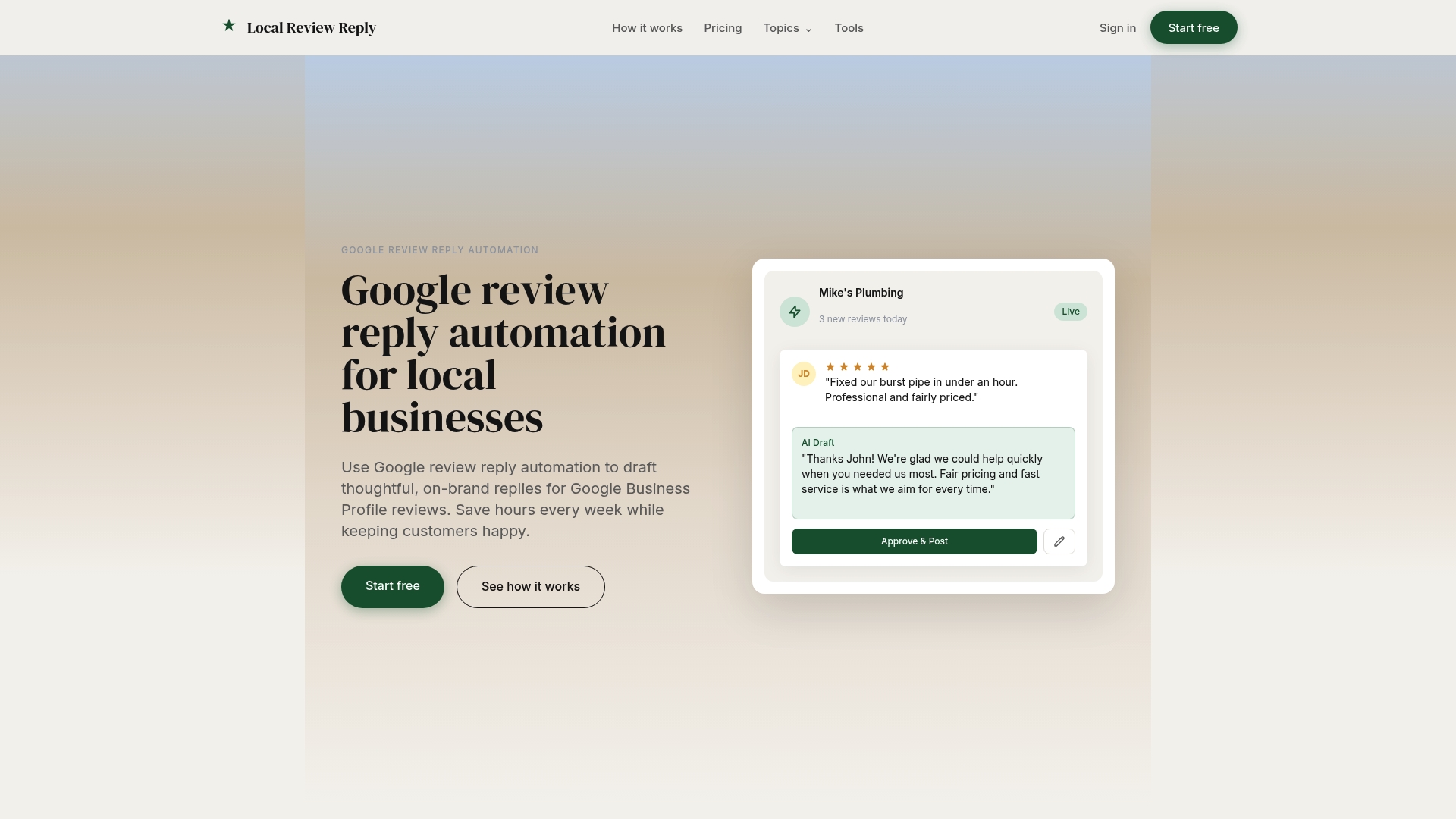
- Some platforms support approval controls for sensitive, low-star reviews, so nothing sensitive posts without a human sign-off first.
- Such tools are designed for local service businesses, franchises, multi-location operators, and marketing agencies that need consistent replies without losing brand voice.
- Pricing plans often scale with how many locations and replies you manage, including free tiers and paid options with varying features.
If you're managing reviews across several locations or client accounts, take a look at our pricing and plans to see which tier fits your team.
FAQ
How do I respond to a positive review?
Thank the reviewer by name, mention one specific detail from their review to show you read it, and keep the reply short. A line like "Thanks for the kind words about our team, we're glad your visit went well" does the job without sounding scripted.
How should I respond to review comments in general?
Reply to both positive and negative comments promptly, address the specific point raised rather than a generic thank-you, and keep the tone consistent with your brand voice. According to Google's guidance, replies are public and can be seen by anyone researching your business, so treat each one as a chance to demonstrate how you handle feedback.
How do I respond to "I'm sorry" professionally in a business context?
Accept the apology briefly and redirect to resolution: "No problem, let's get this sorted out" keeps the exchange moving without dwelling on fault. In a review reply specifically, this usually comes up when a customer apologizes for a misunderstanding, and a short, gracious acknowledgment is enough.
How do you say thank you for a review?
A simple, specific thank-you works best: name the detail they mentioned and keep it to one or two sentences. Avoid generic phrasing like "we appreciate all feedback," since a specific response signals you actually read what they wrote.
When should a business avoid apologizing in a review reply?
Skip a direct apology when the review contains no verifiable complaint, uses abusive language, or appears to violate platform content policies, and consider flagging it instead through Google's review management process. In those cases, a neutral, brief reply inviting private contact is safer than an apology that concedes fault you cannot confirm.
Sources
- How does apology matter? Responding to negative customer reviews on online-to-offline platforms | Electronic Commerce Research and Applications
- Reacting to negative online customer reviews: Effects of accommodative management responses on potential customers
- Manage customer reviews - Google Business Profile Help