
The right Birdeye alternative depends almost entirely on what you actually need: if Google review reply efficiency is the priority, Localreviewreply is the focused choice; for messaging-first workflows, look at Podium; for enterprise analytics and listings at scale, Reputation.com or Yext; for local SEO and citation management, BrightLocal; and for automated review acquisition, NiceJob or ReviewTrackers.
Here is a quick shortlist by operational fit:
- Google review reply workflows (single-location to franchise): Localreviewreply, best for teams that need fast, on-brand replies with approval controls and no bloated feature overhead
- Messaging-first platforms (inbound SMS, webchat, payments): Podium, suited to local service businesses where text is the primary customer channel
- Enterprise reputation and analytics suites (50+ locations, BI integration): Reputation.com, Vendasta, or Yext for operators who need deep data pipelines alongside listings
- Local SEO and listings specialists (citation management, geo-grid rank tracking): BrightLocal, strong for agencies and operators who pair reputation work with organic search
- Review acquisition specialists (automated collection, referral loops): NiceJob, ReviewTrackers, best for businesses actively building review volume across multiple platforms
Shortlisting here is based on operational workflow match, pricing shape (flat vs. per-location), and integration surface with Google Business Profile, Yelp, and common CRMs — not feature count.
Table of Contents
- Which Birdeye alternatives fit your workflow at a glance?
- How do the main platform categories actually compare?
- How do you choose the right Birdeye alternative for your business?
- What does switching from Birdeye actually look like?
- How do users actually rate these platforms?
- What does customer support look like across these alternatives?
- What do real-world outcomes look like for businesses that switched?
- Key Takeaways
- The platform-fit problem most buyers get wrong
- Localreviewreply handles the part most platforms treat as an afterthought
- Useful sources for further research
Which Birdeye alternatives fit your workflow at a glance?
Rows below represent platform categories, not every vendor in each. Categories were selected based on the primary job-to-be-done, pricing shape, and Google Business Profile integration depth.

| Category | Best for | Core features | Scale | Pricing & contract notes | GBP / Yelp / CRM integrations | AI / automation | Agency / white-label | Onboarding ease |
|---|---|---|---|---|---|---|---|---|
| Google review reply (Localreviewreply) | Local service businesses, franchises, agencies needing fast, consistent Google reply workflows | AI reply drafting, approval workflows, team roles, multi-location dashboard, analytics | Single-location to 50+ locations | Tiered flat SaaS; free trial; no long-term contract required | Google Business Profile native; Yelp coverage; CRM via API | AI drafts replies in seconds; human approval gate for low-star reviews | White-label agency support available | Self-serve; fast setup |
| Messaging-first platforms (e.g., Podium) | Local service businesses where inbound SMS and webchat drive revenue | SMS, webchat, payments, review requests, basic reputation monitoring | Single to mid-size multi-location | Pricing upon request; real bills often rise substantially after add-ons | GBP, Facebook; limited niche site coverage | Automated text workflows; basic reply suggestions | Limited white-label | Moderate; sales-led |
| Enterprise reputation suites (e.g., Reputation.com) | Large multi-location brands needing BI-level analytics and listings | Reviews, listings, surveys, social, analytics dashboards | Multi-location to enterprise (50+ locations) | Per-location pricing; annual contracts; hidden fee risk high | GBP, Yelp, major CRMs | AI sentiment analysis; automated workflows | Agency tiers available | Complex; implementation team required |
| Local SEO & listings tools (e.g., BrightLocal, Yext) | Agencies and operators prioritizing citation management and rank tracking | Citation building, geo-grid rank tracking, listings sync, review monitoring | Single to multi-location | Flat agency plans or per-location; Yext annual lock-in common | GBP, Yelp, 80+ directories | Limited reply automation | Strong agency/white-label | Moderate; self-serve options |
| Review acquisition specialists (e.g., NiceJob, ReviewTrackers) | Businesses actively growing review volume and referral loops | Automated review requests, referral campaigns, multi-platform monitoring | Single-location to mid-size | Flat plans from ~$75–$99/month; self-serve onboarding | GBP, Yelp, Facebook; some cover G2 and Capterra | Automated request sequences | Limited | Fast; self-serve |
| Agency / white-label platforms (e.g., Vendasta) | Marketing agencies reselling reputation services | White-label dashboard, multi-client management, reseller tools, listings | Agency-scale; many client locations | Reseller pricing; per-location or per-seat; contract terms vary | GBP, Yelp, broad directory coverage | Varies by module | Core product is white-label | Moderate; partner onboarding |
Pro Tip: The single most common contract trap is per-location linear scaling buried in the renewal clause. A platform that costs $200/month at 5 locations can quietly become $1,200/month at 30 locations — always ask for the per-location rate in writing before signing.
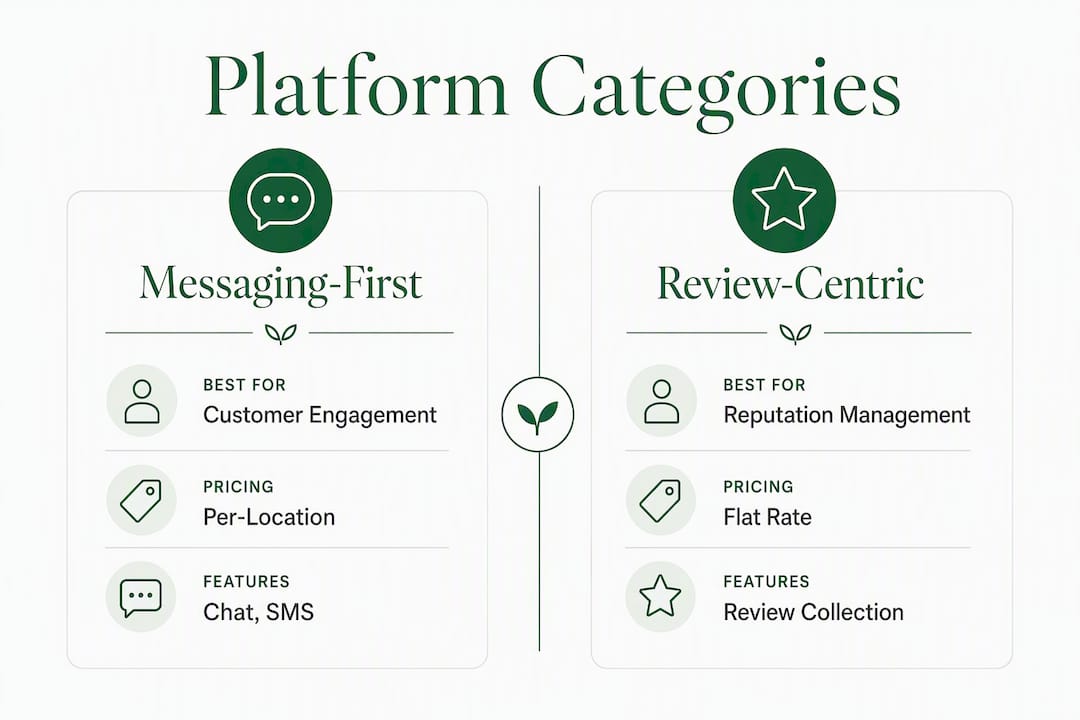
How do the main platform categories actually compare?

Messaging-first platforms
These tools, typified by Podium, are built around SMS and webchat as the primary customer channel. Review collection is a feature, not the core product.
- Strengths: Tight two-way texting, payment collection via text, webchat widget, and solid review request automation via SMS
- Limitations: Operational overhead is high when reputation monitoring is your main need; per-location costs compound fast; niche review site coverage is thin
- Best for: A single-location auto shop or home services business where the owner texts customers daily and wants reviews as a byproduct of that workflow
- Watch: G2 data shows Podium scores 9.1 on Live Chat but only 8.6 on Automatic Replies, meaning manual effort stays higher than on reply-focused platforms
Enterprise reputation suites
Reputation.com, and similar platforms, are designed for operators who need to connect review data to business intelligence tools and internal reporting systems.
- Strengths: Deep analytics, survey tools, social publishing, and listings management in one platform; strong for brands with dedicated CX teams
- Limitations: Per-location pricing and annual contracts make them expensive for groups under 25 locations; onboarding typically requires an implementation team and takes weeks
- Best for: A regional healthcare group or national franchise with a dedicated marketing operations team and a real need for BI-level sentiment data
- Watch: Enterprise contracts frequently include compounding "innovation" fees and auto-renew clauses that inflate the second-year bill
Local SEO and listings tools
BrightLocal and Yext sit in this category. Their core value is citation accuracy and rank tracking, not review response.
- Strengths: Geo-grid rank tracking, citation management across 80+ directories, and strong agency dashboards; BrightLocal specifically fills local SEO gaps that Birdeye leaves open
- Limitations: Reply automation is limited or absent; not built for high-volume review response workflows; Yext's annual listing-sync contracts create lock-in
- Best for: An agency managing local SEO for 10–50 clients who needs rank data and citation health alongside basic review monitoring
- Watch: Pairing a listings tool with a separate reply tool is common and often cheaper than buying an enterprise suite that does both poorly
Review acquisition specialists
NiceJob and ReviewTrackers focus on growing review volume through automated request sequences and referral loops.
- Strengths: Flat pricing from ~$75–$99/month, fast self-serve setup, strong automated request workflows, and referral campaign tools
- Limitations: Reply automation is basic; analytics are shallow compared to enterprise suites; B2B platform coverage (G2, Capterra) varies by vendor
- Best for: A single-location dentist or contractor who needs more Google reviews and wants a tool that runs itself after a one-hour setup
- Watch: If your strategy depends on niche B2B platforms like G2 or Capterra, verify integration coverage during the demo — not all acquisition tools cover them
Agency and white-label platforms
Vendasta and similar reseller platforms are built for agencies managing reputation across many clients, not for end-user businesses running their own reviews.
- Strengths: White-label dashboards, multi-client management, reseller pricing, and broad directory coverage
- Limitations: Feature depth per client location is often shallower than dedicated tools; pricing structures vary widely and can be opaque
- Best for: A digital marketing agency with 20+ local business clients who needs a single managed platform to resell reputation services
Pro Tip: A messaging-first platform is the wrong choice when your primary need is review monitoring. You end up paying for SMS infrastructure you barely use while the reply tools remain underpowered. Match the platform DNA to your actual daily workflow.
How do you choose the right Birdeye alternative for your business?
Start by identifying your primary workflow before you look at any vendor demo. The platform DNA mismatch — buying a messaging suite when you need reputation monitoring — is the most expensive mistake operators make.
Decision checklist
- Define your primary job-to-be-done. Is it reply efficiency (responding to existing reviews fast and consistently), review acquisition (getting more reviews), reputation monitoring (tracking sentiment across platforms), messaging and lead capture, or listings accuracy? Pick one primary, one secondary.
- Confirm your scale. Single location, 5–25 locations, or 50+? Per-location pricing hits hard above 10 locations on enterprise platforms.
- List required integrations. Google Business Profile is non-negotiable for most local businesses. Add Yelp, your CRM (Salesforce, HubSpot, ServiceTitan, etc.), and any booking or payment systems.
- Estimate internal operator capacity. A solo owner needs self-serve onboarding and a simple UI. A marketing team at a 20-location group can handle a more complex platform if the features justify it.
- Set a realistic budget range. Flat-rate tools start around $20–$99/month for basic automation. Enterprise suites with per-location pricing can reach $500–$800/month in real-world bills after add-ons.
Questions to ask vendors during a demo
- What is the per-location rate, and how does it scale at 10, 25, and 50 locations?
- What fees are not included in the headline price (onboarding, support tiers, API access, additional users)?
- What is the cancellation window, and does the contract auto-renew?
- Which review platforms do you actively manage (not just monitor)?
- What is the typical onboarding timeline for a business at my scale?
Pricing red flags
- Auto-renewing annual contracts with a 30–60 day written cancellation window
- Compounding "innovation" or "network" fees added at renewal
- Per-location linear scaling with no volume discount
- Mandatory add-on modules for features shown in the demo
- Headline pricing that excludes onboarding fees
Simple fit-scoring rubric
Rate each vendor 1–3 on these three dimensions during your demo:
- Workflow match (1 = poor fit, 3 = exact fit for your primary job-to-be-done)
- Pricing transparency (1 = pricing on request only, 3 = published flat pricing with itemized add-ons)
- Integration coverage (1 = Google only, 3 = GBP + Yelp + your CRM confirmed in writing)
Any vendor scoring below 6 total is worth dropping before a second call.
What does switching from Birdeye actually look like?
Migration is rarely as painful as vendors make it sound, but it does require a few deliberate steps to avoid gaps in coverage.
Migration checklist
- Export your data from Birdeye. Download review history, response logs, contact lists, and any survey data before your contract ends. Confirm what formats are available.
- Verify Google Business Profile ownership. Confirm that your GBP listings are owned by your Google account, not Birdeye's managed access. Reclaim ownership if needed before switching.
- Audit your review site coverage. List every platform Birdeye currently monitors. Confirm your new vendor covers the same set, especially any niche or industry-specific sites.
- Migrate SMS/email review request templates. Export or recreate your request sequences. Test them in the new platform before going live.
- Set up approval flows and user roles. For multi-location operators, configure team permissions and approval workflows for sensitive reviews before the first reply goes out. Localreviewreply's approval workflow controls are worth reviewing as a reference model for how this should work.
- Reconnect third-party integrations. CRMs, booking systems, and payment gateways each need to be re-authenticated. Build a short integration checklist and assign an owner for each connection.
- Schedule staff training. Even a simple platform needs a 30-minute walkthrough for the people who will use it daily.
Realistic timeline estimates
| Business size | Data export & GBP verification | Platform setup & integrations | Staff training | Total |
|---|---|---|---|---|
| 1 location | 1–2 days | 1–3 days | 1 hour | ~1 week |
| 5–25 locations | 3–5 days | 1–2 weeks | Half-day per team | 2–4 weeks |
| 50+ locations | 1–2 weeks | 3–6 weeks | Phased rollout | 6 weeks |
For franchise and multi-location operators, the GBP verification step is the most common delay. Start it first, in parallel with everything else.
Pro Tip: Before signing with any new vendor, request an itemized written quote listing every recurring line item, the renewal escalator, and the exact cancellation mechanics. A verbal "no hidden fees" promise means nothing at renewal.
How do users actually rate these platforms?
Gartner Peer Insights and G2 are the most reliable sources for verified user sentiment on reputation platforms, since both require authenticated reviews tied to real business accounts.
A few patterns stand out across the major alternatives. Yext consistently draws praise for its directory coverage and listings accuracy, but users frequently flag its annual contract structure and the cost of maintaining sync after the first year. BrightLocal earns strong marks from agencies for its rank-tracking depth and white-label reporting, with fewer complaints about pricing surprises. NiceJob users highlight ease of setup and the automated referral loop as genuine differentiators, though enterprise-scale operators note the analytics are thin.
On G2's Birdeye vs. Podium comparison, Birdeye scores higher on Automatic Replies (9.1 vs. 8.6) and Text Scheduler (8.8 vs. 8.4), while Podium leads on Live Chat (9.1 vs. 8.8) and Customization (9.1 vs. 8.8). That split tells you something useful: Birdeye's reply automation is genuinely stronger, which is why businesses switching away from it specifically for reply workflows should look for tools that match or exceed that score, not messaging platforms that treat replies as an afterthought.
ReviewTrackers and Vendasta draw mixed reviews depending on the buyer type. Agencies tend to rate Vendasta higher than end-user businesses do, which reflects the platform's reseller-first design. ReviewTrackers gets consistent credit for multi-platform monitoring breadth but less for reply quality.
What does customer support look like across these alternatives?
Support quality varies more than feature lists suggest, and it often determines whether a platform actually gets used after onboarding.
Enterprise suites like Reputation.com typically assign a dedicated customer success manager, which sounds good until you realize that manager is also your primary path to resolving billing disputes and contract changes. Self-serve tools like NiceJob and BrightLocal rely on documentation, chat support, and community forums. For most single-location operators, that is perfectly adequate. For a franchise with 50 locations and a time-sensitive review crisis, it is not.
Podium's support model is sales-led on the front end and support-ticket-led after signing. Users on Capterra and G2 report response times that vary significantly by account tier. Yext's support is similarly tiered, with faster access reserved for higher-spend accounts.
The practical test: before committing to any platform, submit a support ticket or chat request during your trial or demo period. Ask a specific, slightly technical question about your integration setup. How fast they respond, and how accurate the answer is, tells you more than any SLA document.
What do real-world outcomes look like for businesses that switched?
Published case studies from vendors in this space follow a predictable pattern: a business switched, response rates improved, and review volume grew. The specifics matter more than the headline.
BrightLocal publishes agency case studies showing citation accuracy improvements and rank movement for local service businesses after switching from broader platforms. The consistent finding is that businesses which had been using an enterprise suite primarily for listings saw faster results after moving to a dedicated listings tool, because the workflow was simpler and the team actually used it.
NiceJob's published examples focus on review volume growth for home services businesses, particularly contractors and cleaning companies, where automated post-job review requests drive the majority of new reviews. The referral loop feature, which prompts satisfied customers to share a referral link, is the differentiator that shows up most in their documented outcomes.
For local SEO and reputation work at the agency level, the pattern that emerges is that consistent, on-brand review responses correlate with improved local pack visibility over time. The mechanism is not guaranteed, but the operational discipline of responding to every review, which tools like Localreviewreply make practical at scale, is documented as a best practice by Google's own guidance on Business Profile management.
Vendasta's case studies are agency-focused and emphasize reseller revenue growth rather than end-client outcomes, which is worth noting when evaluating their materials.
Key Takeaways
The most important decision when choosing among Birdeye alternatives is matching the platform's core design to your actual daily workflow, not buying the longest feature list.
| Point | Details |
|---|---|
| Match platform DNA to your workflow | Messaging-first tools cost more and underperform when your primary need is review reply or monitoring. |
| Watch per-location pricing | Linear per-location scaling can multiply your bill 4–6x as you grow; always get the rate in writing. |
| Verify GBP and Yelp coverage | Confirm Google Business Profile and Yelp integration are native, not just monitored, before signing. |
| Demand itemized written quotes | Require every recurring fee and renewal escalator in writing; verbal "no hidden fees" promises do not hold at renewal. |
| Localreviewreply for reply workflows | Best fit for businesses that need fast, consistent Google review replies with approval controls and multi-location team management. |
The platform-fit problem most buyers get wrong
Most operators shopping for a Birdeye alternative are solving a specific, narrow problem: they want faster, more consistent Google review responses without paying for a platform that also handles SMS campaigns, payment processing, and social publishing they will never use.
The conventional advice is to buy the most comprehensive platform you can afford. That is usually wrong for businesses under 25 locations. A unified enterprise CX suite sounds like a safe choice, but the operational reality is that most of the features go unused, the per-location costs compound, and the team defaults back to manual replies because the platform is too complex to use consistently.
The smarter approach is to audit what you actually do today. If 80% of your reputation work is responding to Google reviews, buy a tool that does that exceptionally well. Add a listings tool if citation accuracy is a separate gap. Add a messaging tool only if inbound SMS is genuinely driving revenue. Stacking purpose-built tools is often cheaper and more effective than one bloated suite.
When auditing a client's review stack, the most revealing test is simple: pull up their last 30 Google reviews and count how many have a response, how long the responses took, and whether the replies sound like the brand or like a template. That audit tells you more about operational fit than any vendor demo. If response rates are low and replies are generic, the problem is almost never the platform. It is that the platform is too complex or too slow for the team to use consistently. The fix is a simpler, faster tool with approval controls, not a more expensive suite.
Localreviewreply handles the part most platforms treat as an afterthought
Every platform in this comparison can collect reviews. Far fewer make it practical to respond to every single one, consistently, in your brand voice, without turning it into a part-time job.
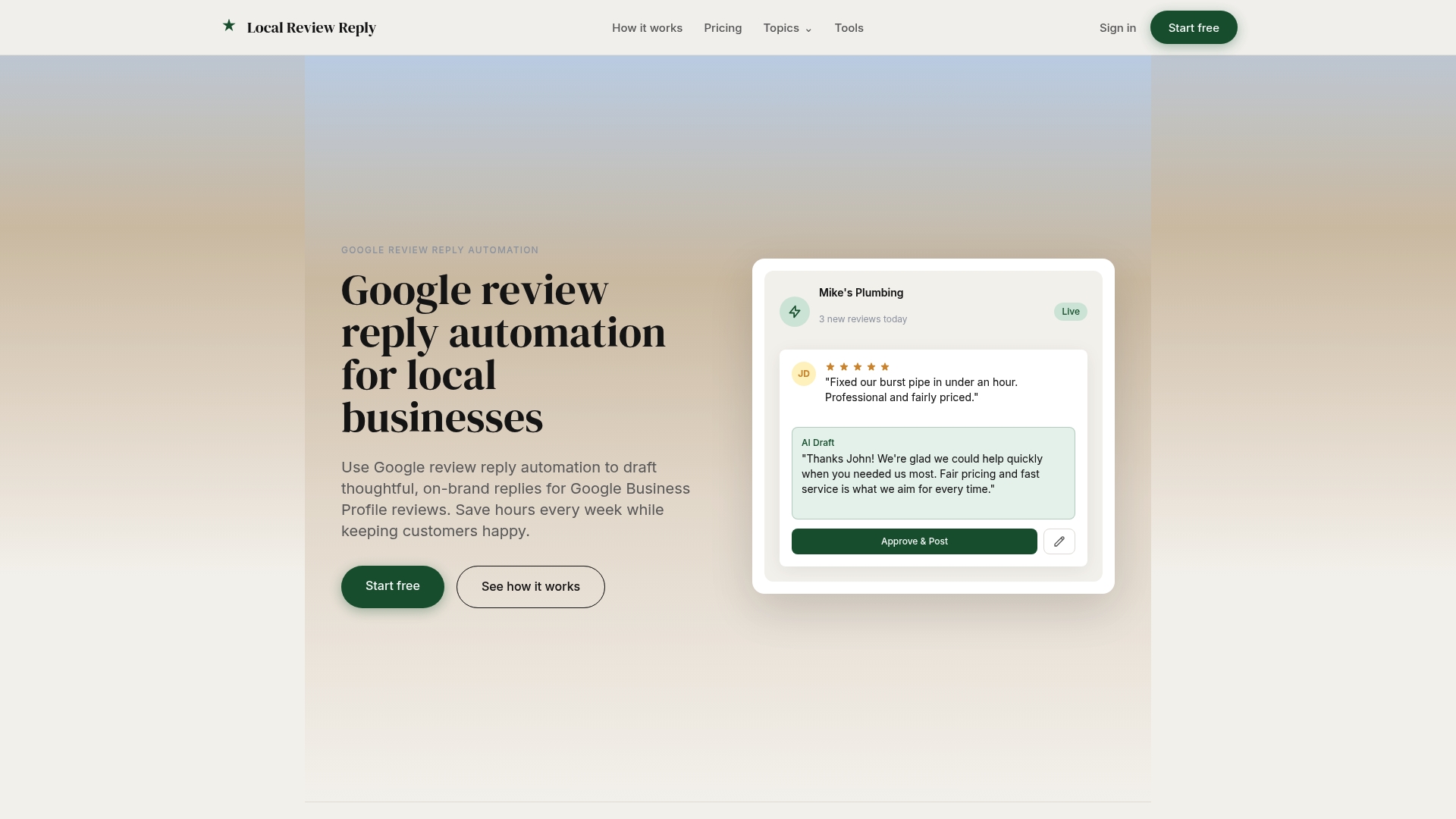
Localreviewreply is built specifically for that gap. It drafts personalized, on-brand Google review replies in seconds, routes sensitive low-star reviews through an approval workflow before anything goes public, and gives multi-location operators and franchises a single dashboard with team roles and permissions. There is no SMS module you will never use, no social publishing suite inflating your bill. Just fast, consistent Google review management at whatever scale you operate.
If you are switching from Birdeye specifically because reply workflows were slow, inconsistent, or too manual, Localreviewreply is the direct answer. Start with a free trial at localreviewreply.com or explore the full feature set to see how approval controls and multi-location management work in practice.
Useful sources for further research
| Source | What it covers | Best for |
|---|---|---|
| Gartner Peer Insights: Birdeye alternatives | Verified user reviews and alternative rankings across enterprise reputation platforms | Buyers who need authenticated peer reviews before shortlisting |
| G2: Birdeye vs. Podium comparison | Feature-level scoring on Live Chat, Automatic Replies, Customization, and SMS | Operators comparing messaging vs. reply automation capabilities |
| Capterra: Birdeye vs. Podium | Side-by-side feature and pricing comparison with user ratings | Buyers who want a structured feature checklist |
| Localreviewreply vs. Birdeye comparison | Pricing models, contract terms, and workflow differences between the two platforms | Businesses actively switching from Birdeye |
| Localreviewreply vs. Podium comparison | Messaging vs. reply automation trade-offs | Operators evaluating Podium as a Birdeye replacement |
| Localreviewreply vs. Yext comparison | Listings and reviews trade-offs between the two platforms | Buyers weighing listings management against reply workflow needs |
| Google review approval workflow guide | How approval controls and team permissions work in practice | Multi-location operators setting up governance for review responses |
| White-label AI review replies for agencies | Agency reseller and white-label options for managed reputation services | Marketing agencies evaluating Vendasta alternatives |
| Free AI review response generator | Try AI-drafted Google review replies before committing to a paid plan | Any buyer who wants to test reply quality before signing up |