
Google's April 2026 review-policy updates ban staff quotas, requests for staff names, and other structured review-solicitation tactics. If your business runs any of these programs, stop them today and start an audit.
The headline changes are specific and enforceable immediately: Google now explicitly bans directing employees to hit a specific number of review requests, asking customers to mention a staff member's name or particular content in a review, running on-premises kiosks or tablets that pressure customers in person, and the long-standing prohibitions on incentivized reviews and review gating remain fully in force. Google paired these rules with heavier enforcement. The company's April 2026 Maps announcement disclosed that it blocked or removed a very large number of policy-violating reviews in 2025 using Gemini-powered detection models, and that scale of automated screening means violations get caught faster and with less human review than before.
Here's a five-item checklist to run right now, before you read another paragraph:
- Stop any staff quota or contest tied to review counts, immediately.
- Physically remove on-premises review kiosks, tablets, or QR stations tied to in-person requests.
- End any discount, freebie, or perk offered in exchange for a review.
- Kill scripts that tell staff to ask customers to "mention my name" or reference specific services.
- Replace targeted requests with an open-ended ask sent equally to every customer, regardless of how the interaction went.
Pro Tip: If you manage more than one location, don't assume corporate policy is what's actually happening on the ground. Pull up the last 20 review requests sent from two different locations and compare the wording. Local teams improvise, and that improvisation is exactly what trips the new rules.
Key Takeaways
Compliance with Google's 2026 review policy requires removing quota, kiosk, and incentive programs immediately, then rebuilding request and response workflows around open-ended, equally distributed customer asks.
| Point | Details |
|---|---|
| Stop banned solicitation tactics | Eliminate staff quotas, name/content requests, kiosks, and incentives immediately, no phased rollout. |
| Run a full channel audit | Map every request channel and sample real messages sent in the last 30 days to catch scripted violations. |
| Rewrite request templates | Use open-ended wording sent equally to all customers within one to two weeks of the audit. |
| Build ongoing governance | Set non-incentive KPIs and recurring audits monthly, since Google's policy language keeps evolving. |
| Add approval controls at scale | Local Review Reply supports human approval workflows for sensitive replies so multi-location teams stay consistent and compliant. |
Table of Contents
- What Changed in Google's 2026 Review Policy
- How Does Google Enforce Its Review Policy?
- What Are the Legal Risks Under U.S. Law?
- How Do You Audit Your Review Process for Violations?
- How Should You Ask for Reviews Now?
- What If Your Reviews Get Removed or You're Hit With Fakes?
- Is Faster Review Growth Worth the Compliance Risk?
- How Local Review Reply Helps You Stay Compliant at Scale
- Where Can You Verify These Policy Changes Yourself?
- Frequently Asked Questions
- Sources
What Changed in Google's 2026 Review Policy
Google's Maps contribution policy has always prohibited fake and manipulated content. What changed in April 2026 is specificity: Google closed loopholes that let businesses run structured solicitation programs while technically avoiding the word "incentive."
Staff review quotas. Telling employees to generate a set number of reviews per week or month is now explicitly banned, not just discouraged. This was common in service industries where managers tracked review counts as a performance metric alongside sales numbers; plumber review workflows exemplify these practices in home services, as explained in plumber review workflows and consumer expectations. Google now treats quota-driven solicitation as a manipulation signal because it produces review volume detached from genuine customer sentiment.
Requests for staff names or specific content. Asking a customer to "mention Dave" or "talk about how fast we fixed your AC" is now a named violation. This rule targets the scripted "ask" that many businesses trained staff to deliver at checkout. It's a subtle but important shift: the problem isn't that staff exist in reviews, it's that businesses were engineering the review's content rather than letting the customer describe their experience unprompted.
On-premises pressure and kiosks. Shared tablets at a register, laminated cards with a QR code and a hovering employee, or any in-person ask made before the customer has left the location falls into this category. Google's concern is coercion, not location. A review requested while a customer is still standing in front of you, especially on a shared device, produces different response patterns than one requested later by email or text.
Incentivized reviews. This one isn't new, but Google restated it explicitly in the 2026 update: payment, discounts, free goods, or any perk offered in exchange for a review remains banned, regardless of whether the business asks for a positive review specifically or just "a review."
Review gating. Segmenting customers by likely sentiment, sending happy customers to Google and routing unhappy ones to a private feedback form, still violates the policy. Google wants every customer offered the same path to leave public feedback.
Multiple accounts and shared devices. Posting reviews from multiple accounts at one person's direction, or having several employees post from the same tablet or IP address, triggers the same coordinated-manipulation signals Google has flagged for years.
| Practice | Status | Why |
|---|---|---|
| Staff review quotas | Banned | Detaches review volume from genuine sentiment |
| Requesting staff names/content | Banned | Businesses scripting review content, not customers |
| On-premises kiosks/pressure | Banned | Coercion risk from in-person, in-the-moment asks |
| Incentivized reviews | Banned | Payment or perks bias the review's honesty |
| Review gating | Banned | Filters out negative sentiment before it's public |
| Open-ended email/SMS requests sent to all customers | Allowed | No content prompt, no selection bias |
| Printed receipt with neutral QR link | Allowed | Passive, equal access, no in-person pressure |
| General thank-you asking for "your honest feedback" | Allowed | No incentive, no content direction |
Google didn't publish a formal glossary alongside these changes, but the practical effect introduces a working distinction between solicitation (asking someone to leave a review) and direction (telling them what to say or how many to produce). The first remains fine. The second is what got banned.
Pro Tip: If a script or policy document at your business tells staff what a review should say, mention, or how many to collect, that document is now a liability. Rewrite it before an auditor, or Google's own detection system, finds it first.
How Does Google Enforce Its Review Policy?
Google no longer relies primarily on user reports and manual review. The 2026 Maps enforcement update describes Gemini-powered models running proactive detection across profiles, flagging patterns like sudden review spikes, repeated phrasing across supposedly unrelated reviewers, coordinated posting from overlapping devices or IP ranges, and language that matches known solicitation scripts.
Detection typically follows this sequence:
- Automated flagging. Machine-learning models scan incoming reviews and profile activity for manipulation signals, often before a suspicious review is even fully visible to the public.
- Proactive protection. Google may pause new contributions on a profile or display a banner warning users that a profile has irregular activity, sometimes before removing anything.
- Content removal. Reviews identified as fake, incentivized, or policy-violating get removed, often in batches tied to a single detected pattern rather than one at a time.
- Account or feature restrictions. Repeat violations can trigger posting restrictions on the business profile itself, not just removal of individual reviews.
- Appeals. Businesses can dispute a removal or restriction through Google Business Profile support channels, though Google's own policy documentation notes that automated actions often happen without prior notice.
292 million. That's how many policy-violating reviews Google says it blocked or removed in 2025 alone, using detection tools it has since expanded with Gemini models in 2026. At that volume, enforcement is not a manual, case-by-case process. It's closer to a spam filter operating continuously in the background of every profile.
| Stage | What happens | Typical business experience |
|---|---|---|
| Detection | ML models flag anomalous patterns | No visible change yet |
| Proactive alert | Profile banner or pause on new reviews | Business notices reduced review flow |
| Removal | Flagged reviews disappear | Star rating or count shifts suddenly |
| Restriction | Posting features limited on profile | New reviews blocked or delayed |
| Appeal | Business disputes via support channels | Resolution timelines vary and aren't guaranteed |
Sudden spikes are one of the clearest triggers. A location that jumps from three reviews a month to thirty in a week, especially if the language is similar across them, reads as manufactured rather than organic, even if every review is technically genuine.
What Are the Legal Risks Under U.S. Law?
Google's policy operates independently of federal law, but the two increasingly overlap. The FTC's Consumer Reviews and Testimonials Rule, effective October 21, 2024, gives the agency civil penalty authority for knowing violations involving fake or deceptive reviews and testimonials. That's a meaningful shift: before this rule, the FTC largely relied on broader deceptive-practices authority. Now there's a rule written specifically for reviews.
The core prohibitions that matter for local businesses:
- Writing, buying, or facilitating fake reviews, including reviews from people with no real experience with the product or service.
- Offering compensation for reviews without requiring disclosure of that compensation.
- Suppressing or manipulating the visibility of genuine negative reviews.
- Failing to disclose a material connection, such as a free product, discount, or family relationship, between the business and the reviewer.
The overlap with Google's rules is direct. An incentivized review that violates Google's contribution policy is very likely also an undisclosed material connection under FTC rules. A business running both risks isn't looking at one enforcement action, it's looking at two separate regulators with two separate remedies.
Any material connection between a business and a reviewer, including free products, discounts, or payment, must be clearly and conspicuously disclosed. Failing to disclose that connection is treated as deceptive under the FTC Act, independent of whether the review itself is favorable or accurate.
That standard comes straight from the FTC's guidance for marketers on soliciting and paying for reviews, and it applies whether the "payment" is cash, a discount code, or a free service.
Businesses in healthcare, supplements, financial services, and other regulated categories face extra scrutiny. Reviews in these industries often touch on outcomes or efficacy claims, and a deceptive review about a medical or financial product can trigger both FTC action and industry-specific regulatory attention.
Pro Tip: If you've ever offered a discount for a review, even informally, document when that practice stopped and update your written policies to reflect it. A paper trail showing you corrected course matters if a regulator ever asks questions.
This article provides general compliance information, not legal advice. Confirm your specific obligations with the FTC's published guidance or a qualified attorney before making major changes to review programs.
How Do You Audit Your Review Process for Violations?
Run this sequence across every location before you touch your request templates:
- Map every review-collection channel. List email flows, SMS tools, printed materials, in-store signage, and any point where a human asks a customer for a review.
- Pull staff training materials and scripts. Look for language that tells employees what to say when asking for reviews, and any documented targets or quotas tied to review counts.
- Inventory incentive programs. Check for discounts, giveaways, raffle entries, or perks tied to leaving a review, even ones framed as "thank you" gestures rather than explicit trades.
- Locate physical kiosks or shared devices. Any tablet, laptop, or shared login used for in-person review requests needs to come out of service.
- Sample the last 30 days of actual review requests. Pull real messages sent to customers and check whether they name staff, reference specific services, or pressure a response.
- Evaluate your moderation and approval workflow. Confirm someone reviews flagged or sensitive replies before they post, and that the process doesn't inadvertently filter out negative feedback before it reaches Google.
Watch for these signal indicators while you audit: a sudden spike in review volume at one location, multiple reviews mentioning the same staff member's name in similar phrasing, near-identical sentence structures across reviews supposedly written by different customers, and reviewer accounts that trace back to overlapping devices or IP ranges.
Pro Tip: Spot-check three transaction paths, email link, SMS request, and any on-premises ask, at two different locations if you're multi-site. That's usually enough to surface a systemic problem without auditing every single location.

Prioritize fixes on a realistic timeline: kill quotas, kiosks, and incentives immediately since those carry the highest enforcement risk. Rewrite scripts and templates within one to two weeks. Build a documented, recurring audit into your monthly operations within a month, so this doesn't become a one-time fire drill.
How Should You Ask for Reviews Now?
The safest review requests share four traits: they go out to every customer equally, they don't prompt for specific content, they don't happen under in-person pressure, and they never carry an incentive.
Safe channels to keep or build:
- Post-transaction email sent automatically, regardless of how the job or sale went.
- SMS text with a direct, open-ended ask and a link.
- Printed receipts or invoices with a neutral QR code, no staff prompting required.
What to remove entirely:
- Kiosk tablets or shared devices used for in-person requests.
- Scripts instructing staff to request a specific reviewer name mention.
- Any quota, contest, or leaderboard tied to review counts.
Here's compliant wording you can adapt directly:
- "Thanks for choosing us. If you have a minute, we'd appreciate your honest feedback on Google." [link]
- "We'd love to hear how your experience went. Leave us a review whenever you have a moment." [link]
- "Your feedback helps other customers find us. Share your experience on Google if you're able." [link]
Notice none of these mention a staff name, a specific service, or an incentive. That's deliberate; open-ended language is what keeps you inside the policy.
On automation: build your CRM or job-management system so review requests trigger for every completed transaction, not just the ones a manager flags as likely to go well. That equal-sending rule is itself a compliance safeguard, because selective sending is functionally the same as review gating even if no one calls it that internally. Keep audit logs of when requests went out and to whom, since that record is useful both for compliance and for later diagnosing why review volume changed. Local Review Reply's brand voice guidance covers how to keep automated messaging consistent without sounding scripted or gated.
What If Your Reviews Get Removed or You're Hit With Fakes?
If reviews disappear from your profile, or you suspect a competitor or bad actor is posting fake or abusive content, work through this sequence.
- Check your Google Business Profile dashboard to confirm which specific reviews were removed and roughly when.
- Collect internal evidence: transaction records, timestamps, and receipts that corroborate the removed reviews were genuine, if you plan to appeal.
- Use Google's built-in report and appeal flow within your Business Profile to flag fake reviews or dispute a wrongful removal.
- If the issue involves a coordinated attack, such as a burst of negative reviews from accounts with no purchase history, document the pattern before reporting it, since Google's contribution policy enforcement weighs pattern evidence heavily.
- Escalate to Google support directly if the standard appeal flow doesn't resolve the issue within a reasonable window, and consider an FTC complaint only if you have clear evidence of a competitor's deceptive practices, not for ordinary removals.
For public responses, keep it short and factual: "We take all feedback seriously and have reported this review for review by Google." Internally, notify staff quickly if a profile is restricted, so front-line employees aren't caught off guard by a customer asking why they can't find reviews.
Rebuilding after an enforcement action means:
- Pausing any active review-request campaign until you've confirmed it's compliant.
- Retraining staff on what they can and can't say when asking for reviews.
- Auditing your automation rules to confirm requests go out equally, with no gating.
- Documenting exactly what changed, in case a future flag requires you to show your remediation history.
Local Review Reply's approval workflow guidance is useful here for building a moderation process that catches sensitive replies before they post, without slowing down routine responses.
Is Faster Review Growth Worth the Compliance Risk?
The tempting math is obvious: a staff quota or a kiosk generates more reviews faster than an open-ended email ever will. But that math ignores what happens when Google's detection catches up, and in 2026, it catches up faster than most operators expect.
I'd rather see a business grow review volume slowly and keep every review than watch a multi-location operator lose a chunk of its review history overnight because one regional manager kept a quota spreadsheet nobody in corporate knew about. That's not a hypothetical risk profile, it's the exact pattern Google's Gemini-powered detection is built to catch: scripted behavior repeated across locations looks nothing like organic customer sentiment, even when every individual review technically comes from a real customer.
The trade-off is real, and it's worth naming plainly. Conservative programs mean slower review velocity. For a franchise or agency managing dozens of locations, that's a harder sell to a regional manager who's judged on review counts this quarter. But the alternative, a profile restriction or a batch removal that wipes out months of legitimate reviews, costs far more than the velocity you'd gain from a quota system.

For multi-location operators, the fix isn't just a policy memo. It's governance: centralized approval workflows so no single location can improvise a script that violates the rules, non-incentive KPIs that measure things like response time and reply quality instead of raw review counts, and a recurring audit, not a one-time compliance sprint, because Google's policy language will keep evolving. Marketing agencies managing multiple client profiles have the added burden of applying this consistently across brands with different risk tolerances; a white-label workflow built around approval controls handles that better than a shared spreadsheet of dos and don'ts.
How Local Review Reply Helps You Stay Compliant at Scale
Local Review Reply is the practical answer to the operational half of this problem: once you've stopped the banned solicitation tactics, you still have to respond to every incoming review, consistently, on-brand, and without accidentally reintroducing risk through sloppy or scripted replies.
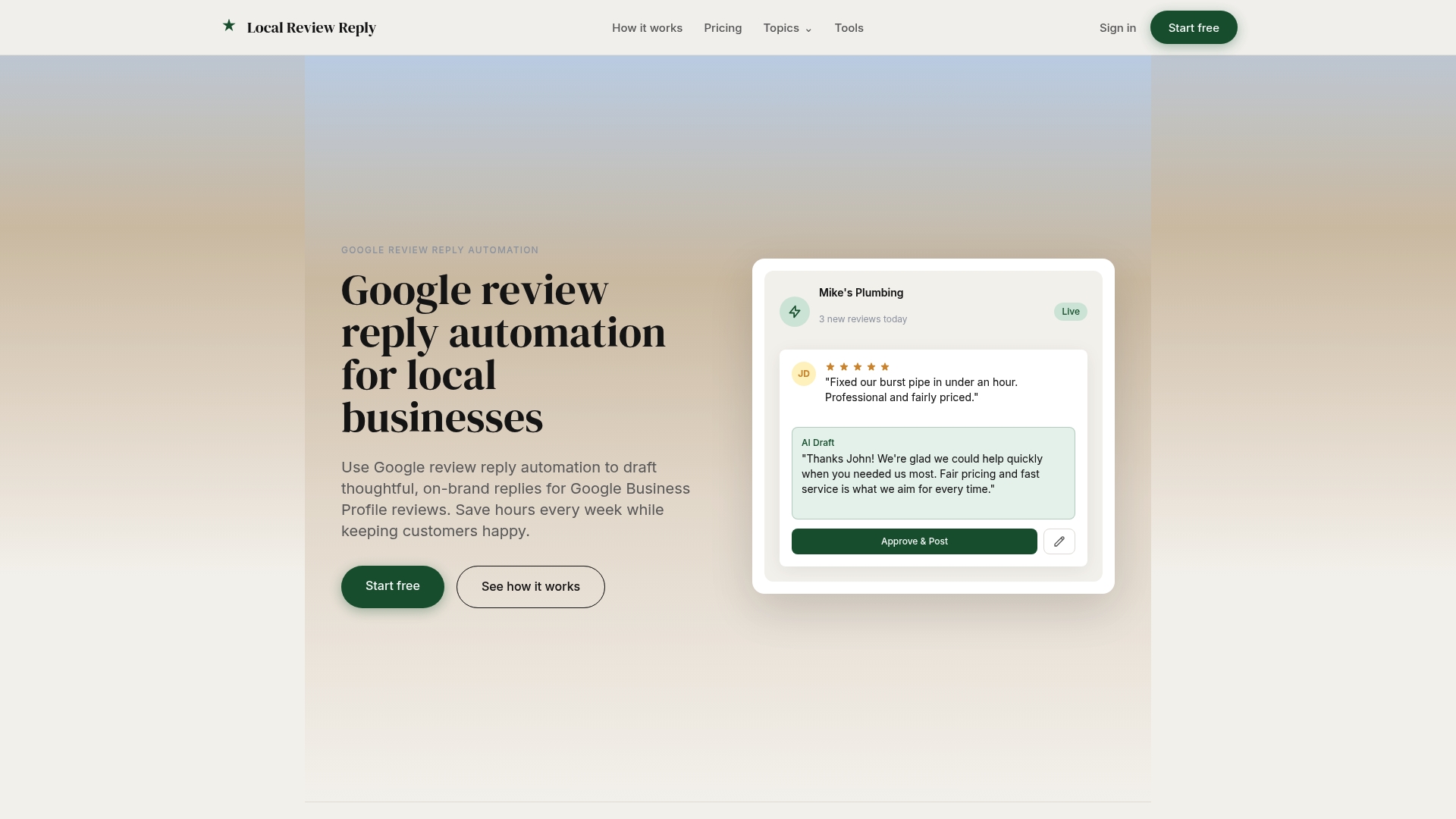
The software drafts personalized, on-brand replies to Google Business Profile reviews in seconds, but drafting is never the final step. Approval workflows let a manager or owner review and sign off on sensitive or low-star replies before anything posts publicly, which matters more than ever now that Google is watching for patterns, not just individual reviews. For multi-location operators and franchises, that means one location's response tone doesn't drift from another's, and a regional manager can't quietly reintroduce a scripted phrase that trips a policy flag. Templates preserve open-ended, non-solicitation language by default rather than leaving wording up to whoever's on shift. Marketing agencies managing several client profiles get the same controls across every account without duplicating the setup work.
If you're managing reviews across more than a couple of locations right now, start with the Google review management software page to see how the approval and multi-location controls fit your current workflow, or explore the free review tools if you want a lower-commitment way to see how automated drafting works before adopting it fully.
Where Can You Verify These Policy Changes Yourself?
292 million. That's the number of policy-violating reviews Google says it blocked or removed in 2025 alone, and it's worth bookmarking the primary sources behind every claim in this guide rather than relying on secondhand summaries.
- Google's Maps protections announcement covers the April 2026 enforcement update, Gemini-powered detection, and the 2025 removal statistics.
- Google's Fake & Misleading Content policy defines what counts as fake, biased, or manipulated review content across Google's platforms.
- Google's Incentivized or Biased Reviews page spells out exactly what counts as an incentive and why those reviews get removed.
- The FTC's Consumer Reviews and Testimonials Rule Q&A explains the federal rule's scope, effective date, and civil penalty authority.
- The FTC's marketer guidance on soliciting and paying for reviews details disclosure requirements for material connections between businesses and reviewers.
Frequently Asked Questions
What is Google's review policy for 2026, in one sentence? Google's 2026 review policy bans staff review quotas, requests for staff names or specific content in reviews, and on-premises pressure tactics, while keeping its existing bans on incentivized reviews and review gating fully in effect.
When did the 2026 Google review policy changes take effect? Industry reporting places the core solicitation bans, staff quotas and content/name requests, as rolling out on April 17, 2026, alongside enforcement tooling announced the day before.
Can I still ask customers for reviews at all? Yes. Open-ended requests sent equally to every customer through email, SMS, or a neutral printed link remain fully compliant, as long as you don't prompt for specific content, names, or offer an incentive.
What happens if Google catches a violation on my profile? Consequences range from removal of specific flagged reviews to posting restrictions, profile banners, or feature suspensions, depending on the scale and pattern of the violation detected.
Does the FTC's review rule apply to small local businesses, not just big brands? Yes. The FTC's Consumer Reviews and Testimonials Rule applies broadly to any business soliciting or displaying consumer reviews, and civil penalties apply to knowing violations regardless of company size.
How is Local Review Reply different from just writing replies myself? Local Review Reply drafts personalized replies automatically, but approval workflows let you or a manager review sensitive replies before they post, keeping human oversight over anything that carries reputational or compliance risk.
This article is general information, not a substitute for advice from a qualified lawyer. Consult a qualified legal professional about your own circumstances before acting on anything here.
Sources
- New ways we’re protecting businesses on Maps | Google
- Fake & Misleading Content & Behavior - Contribution Policy Help | Google Support
- The Consumer Reviews and Testimonials Rule: Questions and Answers | Federal Trade Commission
- Incentivized or Biased Reviews - Maps UGC Policy Help | Google Support
- Ppc