
Reply to every patient review with this one rule: never confirm or deny that the reviewer is a patient, and never reference any detail that could identify them as one. That single test covers most of what HIPAA requires in a public reply.
Here is a copy-paste safe public reply your practice can use right now:
Run this test on every draft before you publish: Would someone with zero context about this person learn anything about their care, their visit, or their identity from reading this reply? If the answer is yes, rewrite before posting. That single question is the core of HIPAA in review replies.
Three things to check in every public reply:
- Never confirm patient status. Phrases like "we're sorry your visit didn't meet expectations" tell the world this person came to your practice.
- Never reference clinical details. No conditions, treatments, medications, dates, or billing information.
- Always move specifics offline. Provide a phone number or secure portal link and invite the reviewer to continue privately.
Table of Contents
- What can you safely say (and what must you move offline)?
- How should your team handle a review from triage to publish?
- What do compliant replies actually look like?
- What are the real penalties for disclosing PHI in a reply?
- What policies and controls does your practice need?
- How does approval-capable software reduce your HIPAA risk?
- Key Takeaways
- The part most practices get wrong
- Localreviewreply keeps your replies compliant at scale
- Useful sources
What can you safely say (and what must you move offline)?
AMA guidance confirms that physicians are free to respond to online reviews. The constraint is not whether you reply but what you say publicly. Think of your public reply as a statement about your practice's values, not a response to a specific person.
Safe language for public replies
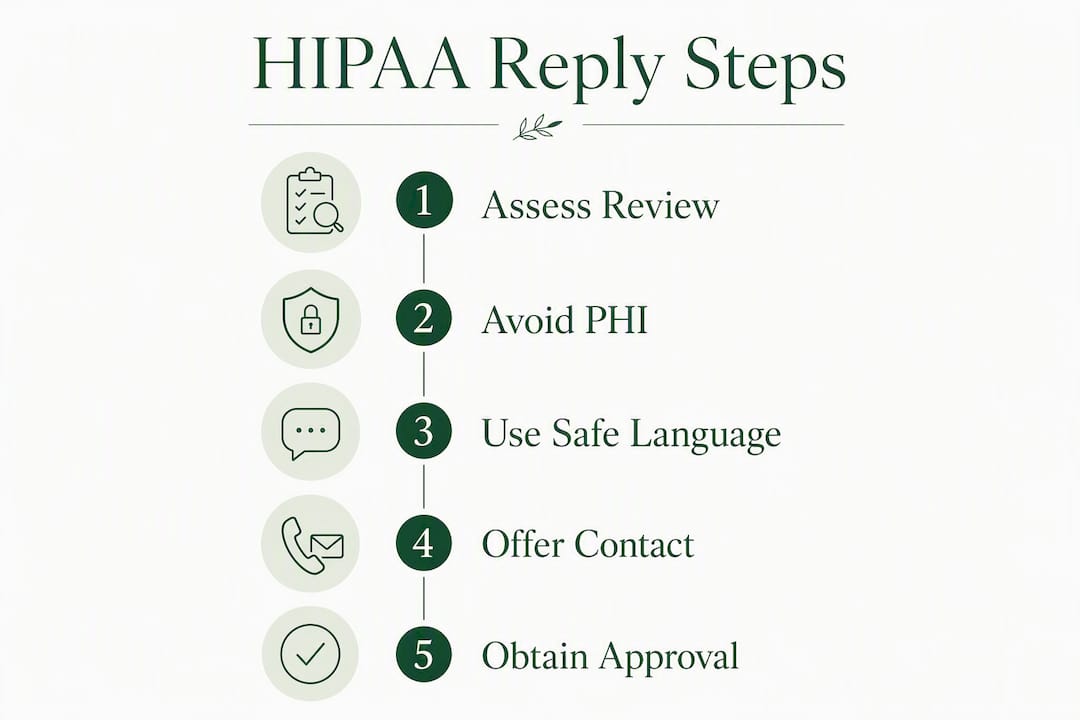
Use practice-level statements that could apply to any member of the public, not just a patient. Phrases like "our office strives to provide compassionate care" or "we encourage anyone with concerns to reach out directly" work because they confirm nothing about the reviewer's relationship with your practice.
Providing a secure contact channel is not just good practice. It is the mechanism that keeps the conversation HIPAA-safe. A phone number, a patient portal link, or a HIPAA-compliant messaging system all work. Avoid directing people to email unless your email system is encrypted and covered under a Business Associate Agreement.
Phrases that create legal exposure
Legal guidance from Holt Law flags a counterintuitive hazard: even sympathetic language can trigger a violation. The phrase "sorry you had this experience during your visit" implies a patient relationship. So does "we understand your frustration with our billing team." Both confirm that the reviewer interacted with your practice in a clinical or administrative capacity.
Avoid any of these patterns:
- "We're sorry your appointment didn't go as expected."
- "We'll look into what happened during your procedure."
- "Thank you for being a patient with us."
- "We're glad we could help with your treatment."
Replace them with office-level language: "We welcome all feedback and take every concern seriously. Please call us at [number] to speak with our team."
One more rule that surprises many administrators: if a reviewer posts their own PHI publicly, that does not give you permission to reference it in your reply. Providers remain bound by HIPAA even when patients disclose their own details. Responding in kind is a documented enforcement trigger.
Pro Tip: If a review contains specific clinical allegations, billing disputes, or mentions of a named provider, do not post any public reply until your privacy officer has reviewed it. The escalation threshold is any detail that could identify the reviewer as a patient.
How should your team handle a review from triage to publish?
A repeatable workflow is what separates a defensible compliance program from a reactive one. The steps below give every role a clear lane and create the documentation trail OCR expects to see.
-
Triage the review. The first person to see a new review classifies it: positive/neutral with no PHI risk, or sensitive (negative, clinical detail, named provider, billing reference). Sensitive reviews go directly to the privacy officer or practice manager before anyone drafts a reply.
-
Draft using pre-approved templates. For non-sensitive reviews, the social manager or front-desk coordinator selects from a library of pre-approved, generic templates. No customization that references the reviewer's specific experience. Pre-approved templates and secondary approval for sensitive replies are the two controls practitioners cite most often for preventing impulsive disclosures.
-
Secondary review for sensitive items. Any reply flagged as sensitive requires sign-off from the compliance or privacy officer before it goes live. If the review contains a clinical allegation, loop in legal counsel before publishing anything.
-
Publish the generic public reply. The approved reply goes live. Keep it short. Acknowledge the feedback, state your commitment to care, and provide the private contact channel.
-
Initiate secure private follow-up. Separately, reach out to the reviewer through a HIPAA-compliant channel (phone or encrypted portal) to address the substance of their concern. Document that outreach.
-
Log everything. Record the review text, the draft(s) considered, who approved the final reply, the date published, and any private follow-up. Store this log where your compliance officer can retrieve it for an OCR inquiry.
-
Assess for breach. If the review contains PHI that was disclosed by your practice in a prior communication, or if your draft reply inadvertently disclosed PHI before being caught, treat it as a potential breach. Perform a risk assessment and consult your privacy officer on notification obligations.
Role summary: Social manager drafts; compliance/privacy officer approves sensitive items; practice manager owns the log; legal counsel reviews clinical allegations before any public response.
What do compliant replies actually look like?
The fastest way to train staff is to show the before and after side by side. Each pair below includes a short note on why the revision is safe.
Positive review
Non-compliant: "Thank you so much! We're so glad your knee surgery went smoothly and that Dr. Patel took great care of you."

Compliant: "Thank you for the kind words! Our team is dedicated to making every experience as positive as possible. We appreciate you taking the time to share your feedback."
Why it's safe: The compliant version confirms nothing about the type of care, the provider, or the reviewer's identity.
Neutral or question-based review
Non-compliant: "Hi Sarah, we see you had questions about your insurance coverage after your visit last Tuesday. Please call us and we'll sort out the billing."
Compliant: "Thank you for your feedback. For any questions about your experience, please contact our office directly at [phone number] and our team will be happy to assist."
Why it's safe: No name, no date, no reference to billing or insurance as it applies to this specific person.
Negative review (service or office experience)
Non-compliant: "We're sorry your wait time was so long during your appointment. We've been short-staffed and are working to improve."
Compliant: "We appreciate you sharing your experience. We take all feedback seriously and are always working to improve the care we provide. Please reach out to us directly at [phone number] so we can learn more."
Why it's safe: Acknowledges the feedback without confirming a visit occurred.
Negative review with PHI details (clinical allegation)
Non-compliant: "We're sorry to hear you felt the diagnosis was incorrect. Dr. Smith reviewed your case thoroughly and followed all standard protocols."
Compliant: "We take all concerns about our care very seriously. Due to privacy requirements, we're unable to discuss specific situations publicly. Please contact our office at [phone number] or through our patient portal so we can address this directly."
Why it's safe: Confirms nothing, references privacy requirements as the reason, and moves the conversation to a secure channel.
This template works across billing disputes, clinical complaints, and any review that contains details you cannot safely acknowledge publicly. Keep it in your approved template library.
What are the real penalties for disclosing PHI in a reply?
The consequences go well beyond a warning letter. OCR enforcement records include a $30,000 settlement against a psychiatric practice in 2023 and a $50,000 settlement against a dental practice, both tied to public review responses that disclosed patient interaction details. These are not outliers. They are the documented result of a single reply that confirmed patient status or referenced clinical information.
| Violation type | Documented penalty range | Common corrective actions required |
|---|---|---|
| PHI disclosed in public reply (dental) | $50,000 settlement | Revised policies, staff training, two-year monitoring |
| PHI disclosed in public reply (psychiatric, 2023) | $30,000 settlement | Risk analysis, corrective action plan, OCR reporting |
| General HIPAA privacy violations | Varies by tier | Breach notification, risk assessment, policy overhaul |
Beyond the fine, a public reply that discloses PHI can trigger a formal breach investigation. That process typically requires a risk assessment, individual notification to affected patients, and a report to OCR. The administrative burden alone, staff time, legal fees, and two-year corrective action monitoring, often exceeds the settlement amount.
$50,000. That is what a single non-compliant reply cost one dental practice in an OCR settlement. The reply confirmed a patient's interaction with the office in response to a negative Google review.
OCR corrective action plans following these settlements commonly require documented staff training, revised written policies, and performance reporting for up to two years. This is not a one-time fix. It is an ongoing compliance commitment that consumes real administrative capacity.
What policies and controls does your practice need?
Policy language for staff manuals
Add a paragraph like this to your social media and communications policy:
"No staff member may post a public reply to an online review that confirms or implies a reviewer's status as a patient, references any clinical, billing, or scheduling detail specific to that individual, or discloses any protected health information. All public replies must use pre-approved, practice-level language. Sensitive or negative reviews require approval from the privacy officer before any reply is published."
Role matrix and approval thresholds
| Review type | Who drafts | Who approves | Who documents |
|---|---|---|---|
| Positive, no PHI risk | Social manager / front desk | Self-approve with template | Social manager logs date and reply |
| Neutral or mixed | Social manager | Practice manager | Practice manager signs off |
| Negative, no clinical detail | Social manager | Privacy officer | Privacy officer logs decision |
| Negative with clinical detail or PHI | Privacy officer | Privacy officer + legal | Legal documents review |
| Review containing breach risk | Privacy officer | Privacy officer + legal | Formal breach assessment initiated |
Audit checklist (run monthly)
- Spot-check 10% of published replies against the PHI test (does this confirm patient status or reveal any clinical detail?).
- Confirm all sensitive replies have a documented approval in the log.
- Verify that private follow-up outreach was completed and logged for every escalated review.
- Review staff training records: every team member who drafts or approves replies should complete HIPAA communications training at least annually.
- Check platform settings: on Google Business Profile, you cannot delete reviews, but you can flag reviews that contain your practice's PHI for Google's review. On Yelp, use the "Report" function for similar concerns.
For teams building approval workflows across multiple locations, centralizing policy enforcement through a single platform prevents individual location managers from improvising replies that bypass compliance controls.
How does approval-capable software reduce your HIPAA risk?
The biggest source of non-compliant replies is not ignorance of the rules. It is the instinct to personalize, the same instinct that works perfectly for a restaurant or a retail shop. Healthcare staff who respond to reviews the way a retail business would, with warmth and specificity, are the most common source of violations.

Software that enforces pre-approved templates and requires a second approval for flagged replies removes that instinct from the equation. The value of an audit trail created by approval-capable software is concrete: during an OCR review or internal audit, you can show exactly who drafted, who approved, and when each reply was published.
Features worth requiring in any review-reply platform for healthcare:
- Pre-approved template library with healthcare-specific, PHI-safe language that staff cannot override without escalation.
- Sensitivity scoring or red-flag detection that routes negative or clinically detailed reviews to a compliance approver automatically.
- Mandatory secondary approval for any reply flagged as sensitive, with a documented approval record.
- Audit log showing draft history, approver identity, timestamps, and final published text.
- Secure contact handoff that surfaces the practice's private contact channel in every reply without requiring staff to add it manually.
For multi-location groups and franchise operators, centralized approval controls matter even more. A single location manager posting an impulsive reply at 9 PM on a Friday can create liability for the entire organization. Software that routes sensitive replies to a central compliance team, regardless of which location received the review, keeps policy enforcement consistent.
Pro Tip: Automate the draft, but never automate the approval for sensitive reviews. AI-drafted replies save time on positive and neutral reviews; human review is non-negotiable when a reply touches anything that could confirm patient status or clinical detail.
Localreviewreply's approval workflow controls are built for exactly this split: automated drafting for routine replies, mandatory human sign-off before any sensitive reply goes live.
Key Takeaways
Every HIPAA-safe public reply passes one test: a stranger reading it learns nothing about the reviewer's care, identity, or relationship with your practice.
| Point | Details |
|---|---|
| The one-sentence rule | Never confirm or deny patient status in any public reply, regardless of what the reviewer posted. |
| PHI from the patient is still PHI | Even if a reviewer discloses their own clinical details, you cannot reference or confirm those details publicly. |
| Penalties are real and documented | OCR settlements for non-compliant replies have reached $50,000; corrective action plans often run two years. |
| Approval workflows are the control | Every sensitive reply needs a documented second approval before it goes live; log the draft, the approver, and the date. |
| Localreviewreply enforces the split | The platform automates drafts for routine replies and requires human approval for sensitive ones, creating an audit trail for OCR inquiries. |
The part most practices get wrong
The conventional advice on HIPAA and online reviews focuses on the obvious: don't share diagnoses, don't name conditions. That is true, but it misses the more common failure mode.
Most violations I see documented in OCR enforcement records were not caused by a provider sharing a diagnosis. They were caused by a well-meaning staff member trying to be helpful, writing something warm and specific, and inadvertently confirming that the reviewer was a patient. "We're sorry your experience with our scheduling team didn't meet your expectations" is a HIPAA risk. It sounds harmless. It is not.
The deeper problem is that healthcare practices are trained to personalize patient communication, and that training works against them in public forums. The instinct to acknowledge, to validate, to show you remember the person, is exactly what HIPAA prohibits in a public reply. The solution is not to suppress that instinct in general. It is to redirect it: be warm in your private follow-up, be generic in your public reply.
Secondary approvals are not bureaucratic friction. They are the mechanism that catches the reply a stressed front-desk coordinator wrote at the end of a long shift. Train your team on the templates, yes. But the approval step is what makes the system defensible when OCR comes asking.
One practical note: test your templates on positive reviews first, before you need them for a crisis. A positive review is low-stakes. It is the right place to confirm that your team knows how to use the approved language and that the workflow actually runs the way you designed it.
Localreviewreply keeps your replies compliant at scale
Drafting a HIPAA-safe reply from scratch every time is slower than it sounds, and the risk of a staff member going off-script compounds with every location you manage. Localreviewreply gives healthcare-adjacent practices a faster path: pre-built response templates that use practice-level language by default, plus approval workflows that route sensitive reviews to a compliance approver before anything goes live.
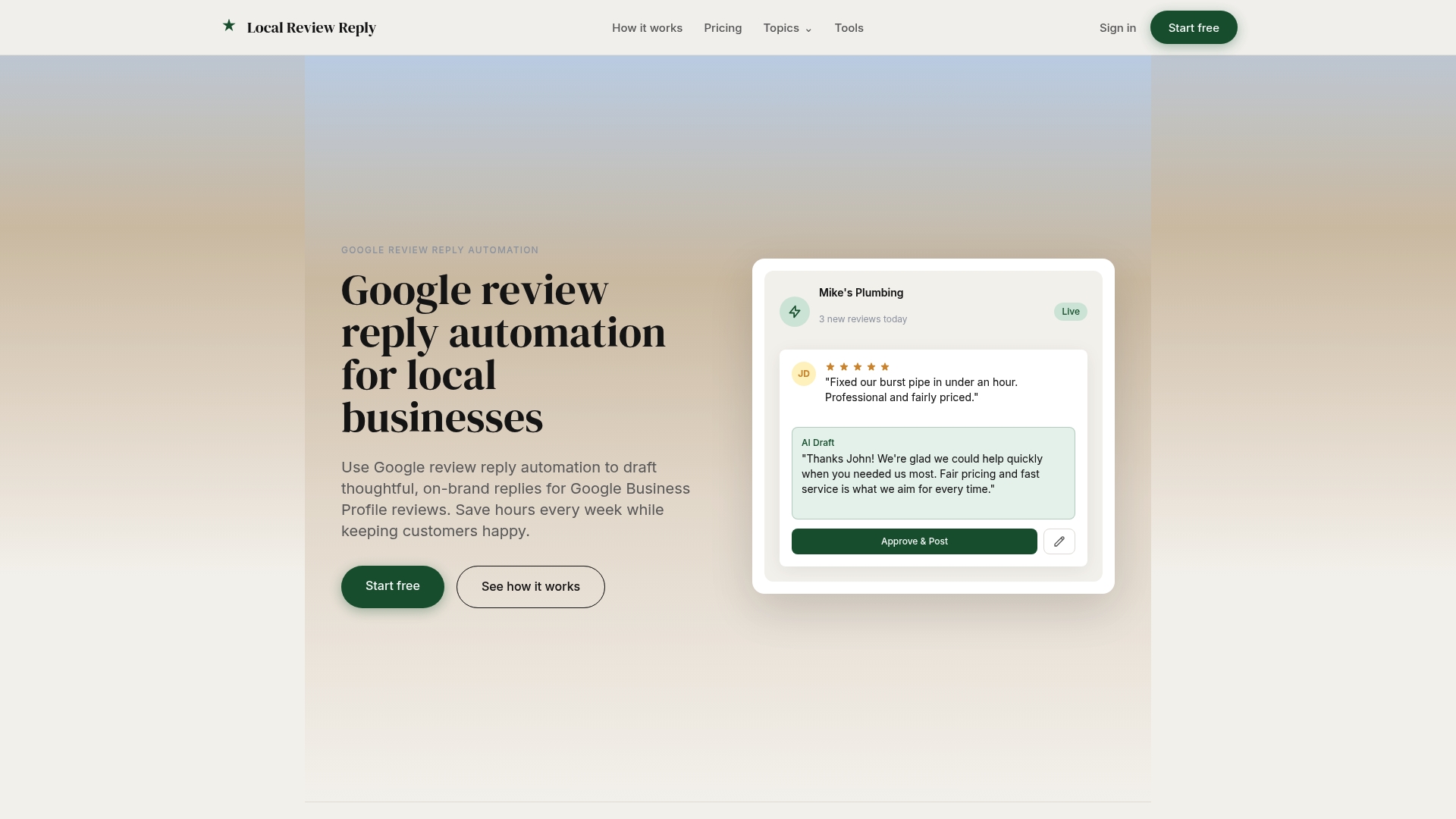
The platform's audit log captures every draft, every approval decision, and every published reply with timestamps. That record is what you hand to OCR if a complaint is ever filed. For multi-location groups, centralized approval controls mean one compliance officer can cover every location without relying on individual managers to remember the rules under pressure.
AI drafts the reply. A human approves it before it publishes. That distinction is the whole compliance model. Start a free trial at localreviewreply.com and run your first compliant reply workflow today.
Useful sources
-
HHS Office for Civil Rights — Compliance and Enforcement Agreements: The primary source for OCR settlement records, including the dental and psychiatric practice penalties cited in this article. Bookmark this page to track new enforcement actions.
-
HHS — HIPAA Privacy Rule: Laws and Regulations: The authoritative text of the Privacy Rule. Use this when your legal counsel needs the regulatory basis for your public reply policy.
-
American Medical Association — Are physicians prohibited from responding to online patient reviews?: Confirms that responding is permitted and explains the privacy constraints that apply. Useful for staff training and for countering the misconception that practices must stay silent.
-
Holt Law — Responding to negative Google reviews: HIPAA-compliant strategies: Practical legal analysis of phrase-level hazards, including why seemingly neutral language can confirm patient status. Useful for drafting your approved template library.
-
American Med Spa Association — Tips to respond to patient reviews without violating HIPAA: Practical guidance for aesthetic and wellness practices; the template logic applies broadly to any HIPAA-covered entity.