
Reply to every public review promptly, professionally, and with a consistent formula: thank the reviewer or acknowledge the concern, add a specific detail, and invite further conversation offline when needed. Be factual, never defensive, and never trade incentives for positive feedback. Follow FTC rules and NAR's Code of Ethics, and use templates plus an approval step to keep replies consistent as volume grows.
TL;DR:
- Responding within 24 to 48 hours to negative reviews is ideal, while positive reviews should be addressed within 24 to 72 hours for best impact.
- Use a consistent reply template that acknowledges the review, corrects any inaccuracies, and invites offline conversation, especially for negative feedback.
- Avoid offering discounts or incentives in review replies to stay compliant with FTC regulations and maintain authenticity.
- Keep a library of short, personalized reply templates for different review types to ensure quick and consistent team responses.
- Regularly track response rates, review volume, and trends across all platforms to identify recurring issues and improve overall reputation management.
Table of Contents
- Why responding to reviews matters for real estate agents
- How to reply to positive reviews
- How to reply to negative reviews
- Handling fake, inaccurate, or malicious reviews
- How quickly to reply and an approval workflow for teams
- How to get more reviews legally and ethically
- Managing and tracking reviews across platforms
- Templates and real examples
- What years of review patterns teach agents
- How Local Review Reply helps you manage this at scale
- FAQ
- Sources
Why responding to reviews matters for real estate agents
A public reply is rarely written for the person who left the review. It is written for the hundreds of prospective buyers and sellers who read it later while deciding whether to call you. A thoughtful, factual response does more for your reputation than the original five-star review ever could on its own, because it shows how you handle pressure.
Google Business Profile notifies reviewers when a business replies, and that reply posts publicly underneath the review for anyone to see. Silence on a negative review reads as confirmation; a calm, specific reply reads as professionalism. NAR's Code of Ethics also shapes how agents should communicate publicly: Article 12 requires truthful statements and prohibits deceptive manipulation of online content, which applies directly to how you word a reply.
Consistent replies pay off in several concrete ways:
- They influence undecided prospects reading your profile before they ever contact you.
- They signal to past and current clients that complaints get addressed, not ignored.
- They give you a factual public record if a dispute ever escalates further.
How to reply to positive reviews
A short formula works for almost any five-star review: thank the reviewer by name, mention one specific detail from the transaction, and close with a light invitation (a referral, a follow-up service, or simply staying in touch). This keeps replies personal without requiring a paragraph every time.
- Thank the reviewer and use their first name if the review included it.
- Reference a specific detail: the property type, a tight closing timeline, or a particular concern you solved.
- Add a brief next step: an offer to help friends or family, or a note about future availability.
Buyer agent example: "Thanks so much, Maria! We're glad we found a home that worked for your schedule and budget, and we loved helping you navigate the inspection concerns. Send anyone our way whose house hunting."
Seller/listing agent example: "Thank you, James. Pricing your listing right from day one made a real difference in how fast we moved to offer. Glad we got you to closing ahead of schedule."
Property management example: "We appreciate the kind words. Keeping maintenance requests on a quick turnaround is a priority for us, and it's great to hear that showed up in your experience."
Keep a soft call to action available but never offer a discount, gift, or future favor in exchange for the review itself: that crosses into incentivized review territory under FTC guidance. For scale, keep two or three short customizable fields (name, detail, next step) so a team can personalize replies fast without writing from scratch each time.
Pro Tip: Keep a shared document of three or four positive reply templates per transaction type so every agent on a team sounds consistent without sounding scripted.
How to reply to negative reviews
Not every negative review deserves the same response. Start by triaging what you're looking at: a legitimate complaint about service, a misunderstanding that can be cleared up publicly, or a review that looks fabricated or posted by someone who was never a client. Each path calls for a different tone, though the public reply formula stays similar across the first two categories.
- Acknowledge the reviewer's experience without admitting fault you haven't confirmed.
- Add a brief, factual note correcting any inaccuracy, without relitigating the dispute in public.
- Invite the person to continue the conversation privately, by phone or e-mail.
- Document the exchange and any resolution for your own records.
Realtor recommends drafting the reply in a separate app and waiting at least 24 hours before posting, since a reply written in the heat of the moment tends to escalate rather than resolve the issue. Having a colleague read a sensitive reply before it goes live catches tone problems you might miss yourself.
Communication failure example: "We're sorry to hear the closing timeline felt unclear. We want to understand what happened on our end. Please reach out to us directly so we can go over the details."
Fee or commission dispute example: "We take commission questions seriously and always aim to explain fees clearly before any agreement is signed. We'd like the chance to walk through this with you directly; please contact our office."
Mistaken identity or factual error example: "We don't have a record of working with you on a transaction matching this description. We'd welcome the chance to clarify, please reach out so we can look into this."
After the private conversation resolves anything, log what happened and what was agreed, even informally. That record protects you if the same complaint resurfaces or if a reviewer later disputes what was discussed.
Pro Tip: A reply that simply says "we hear you and want to help" often does more for your reputation than a lengthy public defense of your side of the story.
Handling fake, inaccurate, or malicious reviews
Some reviews aren't about a real transaction at all. Watch for details that don't match any client on your calendar, reviews posted from accounts with no history, or clusters of similar negative language appearing around the same time, often a sign of competitor interference or a disgruntled non-client. Screenshot the review immediately and check it against your transaction records before responding.
Each platform has its own report path:
- On Google Business Profile, you can flag a review as inappropriate through the profile's review management tools, and Google notes that flagged reviews may take anywhere from minutes to 30 days to be reviewed.
- On Facebook and niche real estate portals, look for a report or flag option attached to the specific review.
- Keep your own internal documentation (calendar entries, e-mail threads, MLS records) ready in case a platform asks for proof the reviewer was never a client.
The FTC's final rule, effective since October 2024, prohibits businesses from creating, buying, selling, or procuring fake reviews, and also restricts undisclosed insider reviews, meaning an agent cannot ask employees or family members to post glowing reviews without disclosing the connection. For a suspected fake review, a neutral public reply works best: "We have no record of working with this individual." For a structured approach to verifying reviews before you respond, Clareefai's compliance guide walks through a verification workflow built around the FTC rule.
How quickly to reply and an approval workflow for teams
Speed matters, but so does get the wording right. A reasonable target is replying to negative reviews within 24 to 48 hours and positive reviews within 24 to 72 hours, giving you enough time to draft thoughtfully without looking like you're ignoring feedback.
For teams and multi-agent brokerages, a simple workflow keeps replies consistent:
- A designated person or tool drafts the initial reply.
- Low-star or legally sensitive reviews route to a manager or broker for approval before posting.
- Approved replies post publicly, and the exchange gets logged for future reference.
- Routine five-star reviews can move faster through the queue since the risk of a misstep is lower.
Automation can draft a reply in seconds, but a human should still read and approve anything tied to a dispute, a legal concern, or a low rating before it goes live.
Pro Tip: Assign one person as the final approver for low-star replies so tone and wording stay consistent even when multiple agents are drafting.

How to get more reviews legally and ethically
The FTC rule draws a clear line: asking every client for honest feedback is fine, paying for reviews, gating negative ones, or making a review contingent on a reward is not. The safest approach is asking all clients at the same point in the process, regardless of how the transaction went.
- Ask right after closing, when the experience is still fresh and the relationship is still warm.
- Send the request through whichever channel the client actually uses, text, e-mail, or a printed card left at closing.
- Keep the language neutral: "We'd appreciate your honest feedback about your experience" rather than anything implying a specific rating.
- Make the process easy with a direct link to your Google Business Profile or review page rather than a multi-step form.
A steady stream of authentic reviews naturally dilutes the visibility of an occasional negative one, which is a better long-term strategy than trying to suppress or incentivize feedback.
Managing and tracking reviews across platforms
Google Business Profile carries the most weight for local search visibility, but reviews also land on Facebook, Zillow, and niche real estate portals, and missing one of those channels means missing part of the conversation prospects are having about you.
A few metrics are worth tracking consistently:
- Response rate: the share of reviews that received a public reply.
- Average rating and how it trends month over month.
- Time-to-reply, especially for negative reviews.
- Volume of new reviews per platform, to spot where most feedback originates.
For a solo agent, a monthly check across two or three platforms may be enough. For a brokerage or franchise with multiple locations, a shared dashboard with role-based access keeps replies from slipping through the cracks. If the same complaint (slow communication, unclear fees) keeps showing up across multiple reviews, that pattern is worth escalating to a training conversation rather than treating each review as an isolated incident.
Templates and real examples
Keeping a short library of templates by review type saves time without making replies feel robotic, as long as you swap in a real detail each time.
- Five-star, buyer: "Thank you, [Name]! We loved helping you find a home that checked every box on your list."
- Four-star with a minor note: "Thanks for the kind words and the honest feedback on [specific point]. We're always looking to improve and appreciate you sharing that."
- Neutral or misunderstanding: "We appreciate you sharing your experience. It sounds like there was a mix-up on [topic], we'd like to clear that up, please reach out directly."
- One or two stars: "We're sorry to hear this didn't go as expected. We'd like to understand what happened, please contact us directly so we can address it."
Quick personalization fields to keep on hand: reviewer's first name, property type or neighborhood, and one specific service detail (timeline, communication, negotiation). For more examples of professional tone under pressure, Sol Social Media's practical guide breaks down response structure for difficult public comments.
| Review type | Core formula | Tone |
|---|---|---|
| Five-star | Thank, personalize, invite referral | Warm, brief |
| Four-star | Thank, acknowledge note, no defensiveness | Appreciative |
| Neutral/misunderstanding | Acknowledge, correct fact, invite private talk | Calm, factual |
| One or two stars | Acknowledge, empathize, move offline | Measured, non-defensive |
What years of review patterns teach agents
The agents who handle reviews well aren't the ones who never get a bad one, they're the ones who reply the same calm way every time, whether the review is glowing or furious. Consistency beats cleverness, and a short checklist posted in your CRM works better than trying to improvise each time: pause before replying, identify the review type, use the matching template, correct facts without arguing, and move anything unresolved to a private channel.
— Ryan
How Local Review Reply helps you manage this at scale
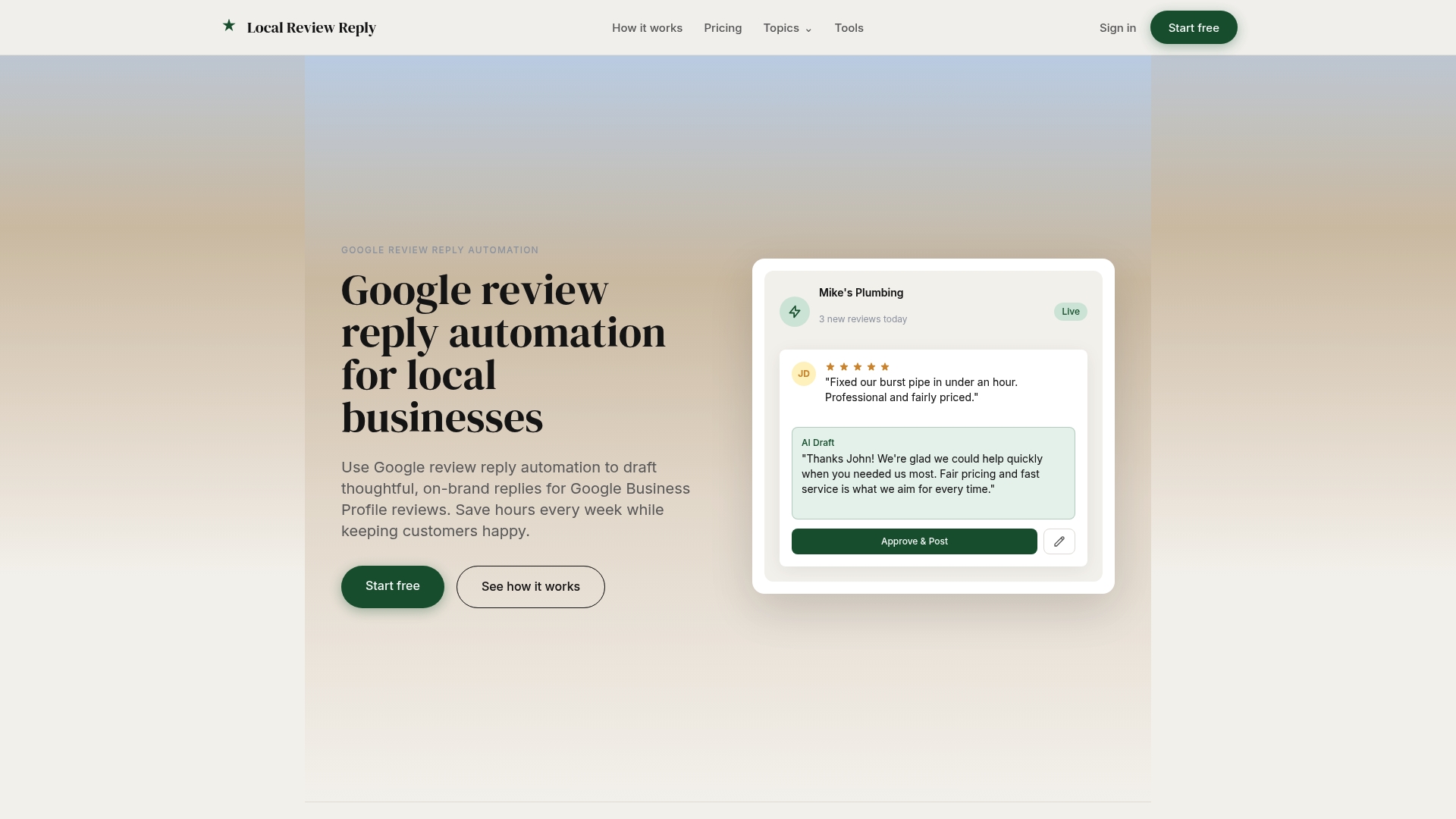
Running this process by hand works for one agent with a handful of reviews a month. It gets harder fast across a brokerage, franchise, or multiple locations, which is where we built Local Review Reply to help. Software can draft replies to Google Business Profile reviews quickly, so your team isn't starting from a blank page every time a review comes in.
Approval controls can be used for low-star or sensitive reviews, so a manager or broker reviews and signs off before anything posts publicly, matching the workflow described above. For multi-location operations, dashboards can keep replies consistent across every office or franchise location without losing each team's voice.
A few things we keep front and center:
- Drafting is automated, but final wording and compliance decisions stay with you.
- Sensitive and low-star replies route for human approval before they go live.
- Multi-location teams get consistent tone without losing local detail.
Check out plans and pricing to see which tier fits your team, including a free option to start.
FAQ
What is a good example of responding to a review?
A strong reply thanks the reviewer by name, references a specific detail from the transaction, and keeps the tone warm without sounding scripted. For a negative review, a good example acknowledges the concern, adds a brief factual note, and invites the person to continue the conversation privately.
What is the 3-3-3 rule in real estate?
The "3-3-3 rule" isn't a standardized industry term with one fixed definition tied to review responses, and definitions of it vary depending on the source. It's more commonly used elsewhere in real estate (such as home-buying budgeting) than as a formal review-response standard, so treat any specific version cautiously.
What to say in a good review for a realtor?
If you're the client writing a review, mention specific details like communication style, responsiveness, and how the agent handled challenges during the transaction. As the agent replying to that review, thank the client by name and reference the same specific detail they praised to keep the exchange genuine.
What is the best 5-star review reply?
The best reply is short, specific, and personal: thank the reviewer, mention one real detail about their transaction, and close with a light invitation for referrals or future contact. Avoid generic phrases that could apply to any client, since specificity is what makes the reply feel authentic to readers browsing your profile.