
The fastest, safest way to handle a refund complaint review is to personalize your reply, verify the transaction privately before promising anything, apologize where it fits without admitting unverified fault, offer a public path to resolution, and move the specifics offline. One guardrail matters above all else: never tie a refund or any incentive to a reviewer changing or removing their review, since that crosses into territory the FTC's Consumer Reviews and Testimonials Rule treats as deceptive.
TL;DR:
- Verify the transaction privately before publicly promising a refund to avoid promising on unconfirmed purchases and ensure accuracy.
- Never link refunds or incentives to review modifications, as doing so is considered deceptive under FTC rules and damages credibility.
- Use personalized, empathetic responses that acknowledge the specific issue and guide the reviewer to a private resolution channel.
- Respond within one day to minimize reviewer frustration, but prioritize fact-checking over speed to prevent errors.
- Always follow a consistent internal workflow for verifying, drafting, approving, and posting refund-related replies, especially at scale.
Table of Contents
- A step-by-step framework for responding to refund complaints
- Templates for common refund complaint scenarios
- How Google handles business replies and when to report instead
- Why you can't offer a refund in exchange for a better review
- Running refund replies safely at scale: a short SOP
- When to flag a review instead of replying to it
- Closing the loop publicly after a refund is resolved
- Why automated drafting still needs a human in the loop
- A faster way to draft replies without losing the human check
- FAQ
- Sources
A step-by-step framework for responding to refund complaints
Every strong reply to a refund complaint follows the same backbone, whether you run a single location or manage replies across fifty franchises. The order matters because each step protects you from the one before it going wrong.
- Personalize the reply. Use the reviewer's name if it is available and reference their specific issue, not a generic complaint. This shows you actually read what they wrote instead of pasting a boilerplate response.
- Verify before you promise anything. Check your order system, point-of-sale records, or CRM privately to confirm the transaction exists before you commit publicly to a refund. Promising money back on a purchase you cannot locate creates a second problem on top of the first.
- Empathize and apologize where it's warranted. An apology for the experience is not the same as admitting fault for something you have not yet confirmed; you can regret the frustration without conceding blame.
- Make a public offer at a high level. State the type of resolution available, a refund, a replacement, or next steps, without listing dollar amounts, order numbers, or payment details in public.
- Hand off to a private channel. Give an exact phone number, email address, or form, along with a realistic timeline for resolution.
Google's own guidance recommends addressing the reviewer by name, acknowledging the specific feedback, and signing off with a name or initials so the reply reads as a real person rather than a script. Google also notes that a constructive, well-handled reply can sometimes encourage a customer to update their review, but that outcome has to follow from genuinely resolving the problem, not from asking for it.
Speed matters too. A reviewer who feels ignored for a week is far angrier by the time you respond than one who hears from you within a day. That said, accuracy beats speed: a fast reply that gets the facts wrong does more damage than a reply that takes a few extra hours to verify first.
Pro Tip: Keep the public reply generic on anything transactional. Say "we've issued a refund" only after it has actually been initiated privately, and never publish order numbers, partial card digits, or email addresses in the reply itself.
Templates for common refund complaint scenarios
Different refund situations call for different wording. Below are five starting templates, each annotated with what to adjust and where the conversation needs to move offline.
- Clear refund-eligible case: "Hi [Name], thank you for flagging this, and we're sorry the order didn't meet expectations. We've located your purchase and a refund is being processed. Please check your email for confirmation, or reach us directly at [contact] if you don't see it within [timeframe]." Remove any reference to the exact amount; that detail belongs in the private confirmation.
- Partial refund, credit, or goodwill gesture: "Hi [Name], we appreciate you taking the time to share this. We've reviewed the order and would like to make it right with [a partial refund/store credit]. Please contact us at [contact] so we can confirm the details and get that started." Avoid stating the exact credit amount publicly since terms can vary case by case.
- Policy dispute where no refund is owed: "Hi [Name], we're sorry to hear this didn't go as expected. Based on our records, this falls outside our refund window, but we'd still like to look into what happened. Please reach us at [contact] so we can review the specifics together." This keeps the door open without conceding a refund you may not owe.
- Shipping or fulfillment issue: "Hi [Name], thank you for letting us know your order arrived damaged/incomplete. That's on us to fix. We're processing a refund/replacement now; please confirm your order details at [contact] so we can finalize it quickly." Fulfillment errors are usually the easiest to resolve quickly, which is worth stating plainly.
- Suspected fraudulent or abusive review: "Hi [Name], we take feedback seriously but we're unable to locate an order matching these details. If you can share your order number or the email used at [contact], we're happy to look into this further." Stay factual and calm; accusing a reviewer of lying publicly almost always backfires even when you're right.
Industry guidance from reputation-management writers generally recommends this same order: acknowledgment, apologize where appropriate, offer to make it right, move to a private channel, and follow up publicly once resolved. A standardized template bank, reviewed periodically for tone and compliance, cuts down on inconsistent replies across multiple staff members or locations.
Pro Tip: Build your template bank with placeholders for name, issue, and contact method only, never pre-filled dollar figures, so no one accidentally pastes a number that doesn't match the actual resolution.
How Google handles business replies and when to report instead
Google Business Profile has specific mechanics worth knowing before you hit "post."
- Replies are reviewed for policy compliance before they go live, which usually takes up to 10 minutes but can occasionally take as long as 30 days.
- The reviewer is notified when a business responds, which means your public reply is often the first thing that brings them back to check the thread.
- Not every negative review qualifies for removal; Google states that reviews are removable only if they violate content policies, such as spam, hate speech, or fake content, not simply because they're unflattering.
- A legitimate refund complaint, even an angry one, almost always belongs in the "respond publicly, resolve privately" category rather than the "report" category.
Because replies are subject to review and reviewers get notified, a short, accurate public reply that invites a private handoff tends to hold up better than a rushed promise you have to walk back later. If you're ever unsure whether a review crosses into reportable territory, a reputation management resource on removing Google reviews walks through the distinction between policy violations and ordinary complaints in more detail.
Why you can't offer a refund in exchange for a better review
The core legal boundary here comes from the FTC's Consumer Reviews and Testimonials Rule, which took effect in late 2024. The rule prohibits businesses from conditioning compensation, including refunds, on a reviewer leaving a positive review or removing a negative one. Offering money back specifically in exchange for an edited or deleted review risks being treated as deceptive review manipulation.
- A neutral, disclosed incentive (for example, inviting any customer to leave feedback, win or lose, with no sentiment attached) is a different thing from a conditional offer that says "update your review and we'll process your refund."
- Resolving the underlying complaint has to stand on its own, independent of what the reviewer eventually decides to do with their post.
- The safer practice: resolve the issue privately, document what you did, and then simply invite the reviewer to update their review if they feel it's warranted, without attaching any compensation to that choice.
This isn't just a legal technicality. If a pattern of conditioned refunds ever surfaces, it undermines the credibility of every review on your profile, not just the one in question.
Running refund replies safely at scale: a short SOP
For teams handling more than a handful of reviews a week, an informal approach breaks down fast. A simple internal workflow keeps replies consistent and compliant.
- Verify that the transaction and customer actually exist in your system before any public commitment is made.
- Decide the remedy internally, including who has authority to approve a refund and what evidence they need to see first.
- Draft the reply using your standardized template bank so tone and compliance stay consistent across staff.
- Route for approval on anything low-star or sensitive. A manager should confirm the transaction ID, customer identity, and refund authorization before the reply goes public.
- Post, notify, and document. Publish the public reply, handle the refund privately, and consider a short public follow-up once it's resolved.
Industry reporting on Google's reply policies notes that businesses should verify facts and use an approval step for sensitive replies, since replies are themselves subject to platform review and a reviewer sees the notification the moment you post. A workflow that routes financial-remediation replies through a verification step before anyone publishes anything avoids the common failure mode of promising a refund publicly and then having to retract it.
Pro Tip: Drafting and publishing are not the same action. Automation can draft a reply instantly, but a human should sign off before anything involving money or a low star rating goes live.
When to flag a review instead of replying to it
Most refund complaints deserve a public reply, not a report. Reserve flagging for the narrow set of cases where the content itself breaks platform rules.
- Flag reviews containing spam, hate speech, someone else's personal information, or other clear policy violations.
- Do not flag a review just because it's negative or the complaint seems unreasonable; respond and work toward resolution instead.
- Document the report (screenshot, date, and policy cited) before submitting it, and escalate to the platform if you suspect coordinated spam or review extortion.
Closing the loop publicly after a refund is resolved
Once a complaint is actually resolved, the thread shouldn't just sit there unanswered.
- Post a short public follow-up noting that the issue was resolved and thanking the reviewer for their patience, once the refund has actually gone through.
- Keep the wording simple: confirm resolution, skip the dollar amount, and never ask directly for a review edit or removal.
- For the longer term, use patterns across complaints to clarify policies, retrain staff on the specific gap that caused the issue, and keep soliciting reviews from satisfied customers so your overall rating reflects the full picture rather than just the loudest complaints.
Why automated drafting still needs a human in the loop
Template-based drafting speeds up the parts of this process that are repetitive: pulling the right opening, matching tone, making sure nothing obviously against policy slips through. What it cannot do is verify a transaction, judge whether an apology risks admitting fault, or decide that a review crosses into report territory. Those calls need a person who knows the account and the local context.
The practical trade-off is speed against judgment. Automation wins on speed and consistency across dozens of locations; a human wins on catching the one reply that shouldn't go out as drafted. The two aren't in competition, they're sequential steps, and treating drafting as a first pass rather than a final answer is what keeps a fast reply from becoming an expensive one.
— Ryan
A faster way to draft replies without losing the human check
We built Local Review Reply around exactly the trade-off described above: drafting speed without giving up a human checkpoint on the replies that matter most. The software drafts personalized, on-brand replies to Google Business Profile reviews in seconds, and for sensitive or low-star reviews, routes the draft through an approval step before it posts, so a team member signs off before anything about a refund goes live.
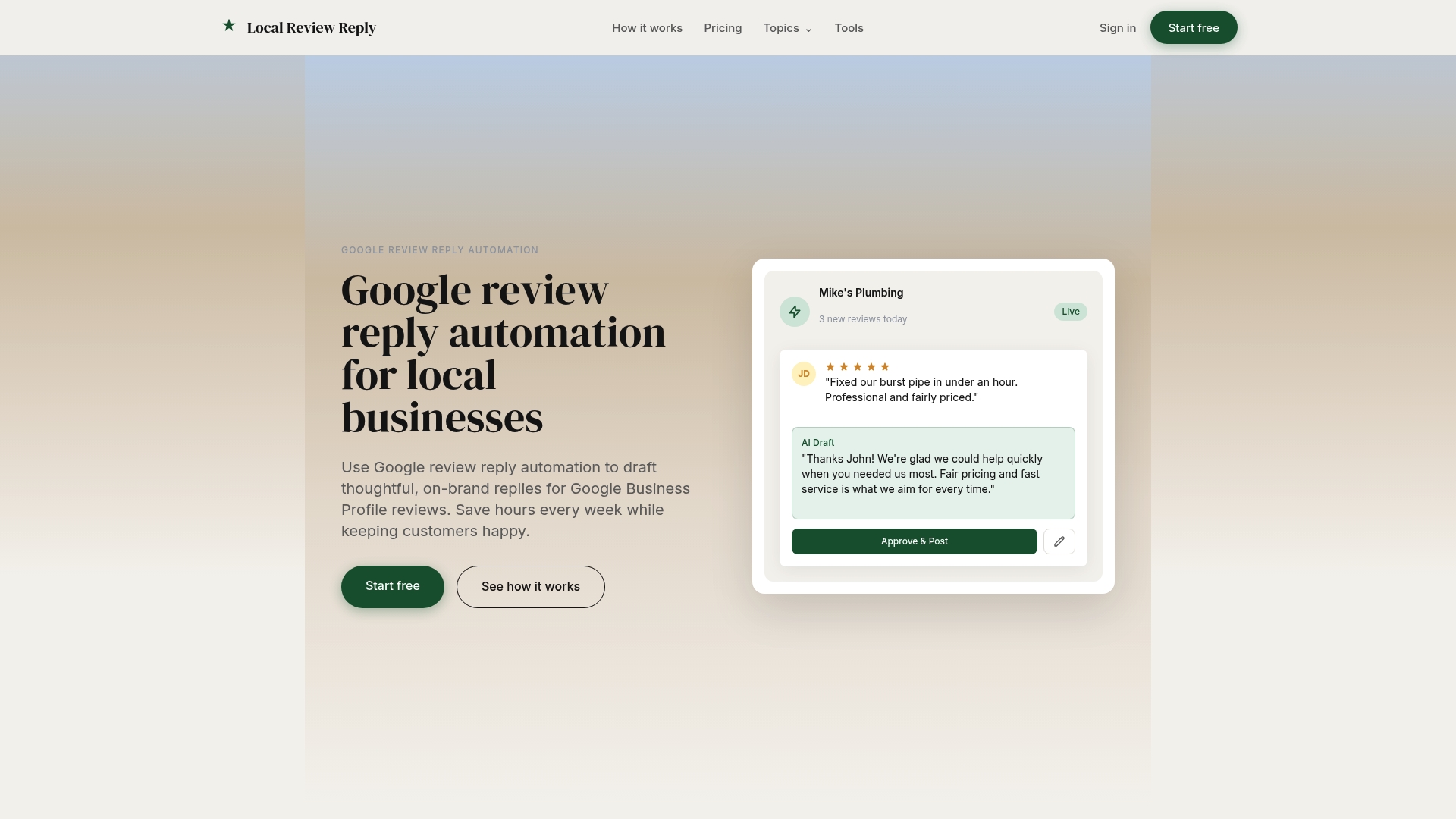
For operators managing several locations or marketing agencies handling reviews across multiple client accounts, the software supports team roles, permissions, and dashboard views so replies stay consistent without every draft funneling through one overworked manager. Drafting is never the same as publishing in the workflow: the tool gets you to a strong first draft fast, and the team still decides what actually goes out.
Plans range from a free tier for basic use up to Growth and Scale tiers built for higher volume and more locations, with full details on our pricing page.

FAQ
What is a good way to respond to a review with a complaint?
A good reply acknowledges the reviewer by name, references their specific complaint, and offers a clear path to resolution without disclosing private transaction details publicly. Google recommends personalizing the reply and signing off with a name so it reads as a genuine response rather than a script.
How should I respond to a complaint about a refund?
Verify the transaction privately first, then reply publicly with empathy and a high-level offer to resolve the issue, directing the reviewer to a private channel for specifics. Never state in public that a refund is being issued until the refund process has actually started internally.
What is a professional example of responding to a complaint?
A professional reply might read: "Hi [Name], thank you for letting us know, we're sorry this didn't meet expectations. We've located your order and would like to resolve this directly, please reach us at [contact] so we can take care of it." This format follows the acknowledge, apologize, and private handoff structure that reputation management guides commonly recommend.
Can I offer a refund in exchange for a reviewer updating their review?
No. The FTC's Consumer Reviews and Testimonials Rule prohibits conditioning compensation, including refunds, on a reviewer changing or removing a review. Resolve the complaint on its own merits, and if the reviewer chooses to update their post afterward, that has to be their own decision.
How long does it take for a reply to appear on Google?
Google typically reviews replies for policy compliance within about 10 minutes, though it can occasionally take up to 30 days. The reviewer is notified as soon as your reply is approved and published.