
Review response attribution is the practice of recording exactly who authored, approved, and posted every reply to a Google review, tied to a specific location, timestamp, and channel. For franchises and multi-location operators, the immediate action is simple: check whether your current process actually logs an actor and an approver for each reply, or whether that information disappears the moment someone hits "post."
Attribution matters because accountability, brand consistency, and audit trails all depend on it. When a reply goes sideways, whether it's tone-deaf, factually wrong, or breaks brand voice, someone needs to know who wrote it and who signed off. Without that record, you're guessing.
Start here:
- Confirm your review tool logs an author ID and approver ID, not just the reply text.
- Check whether timestamps and location tags attach automatically to each response.
- Verify low-star or sensitive replies pass through an approval step before publishing.
Key Takeaways
Review response attribution works because it ties every reply to a specific person, approval decision, and timestamp, turning reactive damage control into a system you can audit and improve.
| Point | Details |
|---|---|
| Define attribution clearly | Capture author ID, approver ID, role, timestamp, location ID, and channel for every reply. |
| Split HQ and location roles | Headquarters sets templates and escalation rules; locations personalize replies in their own voice. |
| Route risk through approval | Auto-send 1 to 3 star reviews into a manager approval queue before posting. |
| Pilot before scaling | Test the workflow in a handful of locations for four to six weeks and audit the logs. |
| Use Local Review Reply for attribution and controlled automation | The platform logs author and approver IDs, routes sensitive reviews for approval, and gives multi-location dashboards for coverage and response-time reporting. |
Table of Contents
- Why Review Response Attribution Matters for Franchises and Multi-Location Brands
- What Data Should You Capture for Every Review Reply?
- How Do You Roll Out an Attribution System Across Locations?
- How Should AI-Drafted Replies Fit Into Your Attribution Records?
- What Reports and KPIs Can You Build From Attribution Data?
- What Mistakes Undermine Review Response Attribution?
- How Local Review Reply Supports Attribution and Controlled Automation
- Sources
Why Review Response Attribution Matters for Franchises and Multi-Location Brands
One bad reply from one location can shape how customers see the entire brand, especially when review screenshots circulate on social media. Attribution ties that response back to a specific person and location instead of leaving it as an anonymous brand liability. That distinction becomes critical the moment a customer complaint escalates into a dispute or a franchisee performance review.
Attribution data does three concrete jobs:
- Dispute resolution. When a customer or franchisee disputes what was said, the log settles it.
- Coaching. Managers can spot which team members need training on tone or policy language.
- Compliance and legal review. If a reply touches on refunds, safety, or legal claims, you need a record of who wrote it and who approved it.
Attribution also feeds the operational numbers leadership actually watches: response rate, average response time, and how location-level ratings trend over time. Franchise systems that let headquarters set brand templates and escalation rules, while individual locations personalize replies in their own voice, tend to keep both consistency and accountability intact. Without attribution, you can't tell whether a rating drop at one location traces back to slow responses, poor reply quality, or something happening in the store itself.
What Data Should You Capture for Every Review Reply?
A usable attribution system needs a minimal schema, not a sprawling database. At minimum, log these fields for every single reply:
- Author ID — who typed or triggered the reply (a person or an AI draft source).
- Approver ID — who reviewed and authorized it, if approval was required.
- Role — location manager, regional lead, corporate marketing, agency staff.
- Posted timestamp — down to the minute, not just the date.
- Location ID — which Google Business Profile the reply belongs to.
- Channel or profile ID — in case a location manages more than one listing.
Two additional fields separate a basic log from a genuinely auditable one: edit history and template ID. Edit history captures what changed between a draft and the posted version, which matters when a manager tweaks an AI-drafted reply before sending it. Template ID tells you which base template was used, so you can trace a pattern of complaints back to a specific script that needs revision. Auditability depends on both an immutable record of what was posted and when, plus editable metadata like edit notes, so a manager can see the decision trail and not just the final text.
These fields map directly to real operational work. Training teams pull author and role data to identify who needs coaching. Escalation reviews pull approver ID and timestamps to check whether SLAs were met. Compliance audits pull edit history to see whether risky language was caught before publishing.
Pro Tip: Require a one-line edit note any time someone changes an AI-drafted or templated reply before posting. It takes five seconds and saves hours during a quarterly audit.
How Do You Roll Out an Attribution System Across Locations?
Rolling out attribution across dozens or hundreds of locations works best as a staged process, not a single mandate.
- Design the policy first. Define who can reply at each level (location staff, regional manager, corporate), what star ratings trigger mandatory approval, and how escalations route. A common rule: auto-route 1 to 3 star reviews to a manager queue before they can post.
- Configure the tools. Set up a centralized inbox that aggregates reviews across every profile, build assignment rules by location, and create approval queues for sensitive replies. Mobile access matters here. Tools that are clunky on a phone see lower adoption from location-level staff, which quietly kills your attribution data before it starts.
- Pilot before scaling. Run the new workflow in a handful of locations for four to six weeks. Audit the attribution logs weekly, check whether templates fit the actual complaints coming in, and adjust escalation thresholds based on real volume. A staged pilot with a hybrid headquarters and local model tends to reduce workload and improve response rates before a full rollout.
- Operationalize. Train every team on the workflow, set a clear SLA (a 24-hour initial reply is a reasonable baseline), and schedule recurring audits so attribution discipline doesn't decay after the initial rollout excitement fades.
Pro Tip: Pick your pilot locations for variety, not convenience. Include one high-volume site and one low-volume site so you see how the workflow holds up under different loads before you commit company-wide.
How Should AI-Drafted Replies Fit Into Your Attribution Records?
AI drafting speeds up response time, but it only works if your attribution records treat a draft differently from a posted, approved reply. The pattern that holds up operationally: automate straightforward five-star replies with minimal review, and use AI-drafted suggestions paired with mandatory human approval for anything with a low rating, a complaint, or legal exposure.
Logging this correctly means capturing more than just the final text:
- Record "AI draft" as the draft source, separate from the human author field.
- Log the final author (the person who approved or edited the draft) and the approver, even if they're the same person.
- Timestamp both the draft generation and the final posting.
- Retain edit history so you can see exactly what a human changed from the AI's suggestion.
Automation should be applied on purpose. Automating routine positive replies while preserving human judgment on low-star or policy-risk reviews is the pattern that scales without creating risk.
The value of an approval queue isn't slowing things down. It's making sure a sensitive reply never goes out without a human reading it first, and that the record shows exactly who that human was.
Local Review Reply's approval workflow reflects this model directly: AI drafts a personalized reply, but low-star or sensitive reviews route into an approval queue where a real person reviews, edits if needed, and approves before anything posts. Role-based permissions limit who can approve, which keeps brand voice consistent without removing human oversight.
What Reports and KPIs Can You Build From Attribution Data?
Once you're capturing attribution fields consistently, a handful of reports do most of the heavy lifting. A responder activity log shows who replied and how often, broken out per location. Response coverage tells you what percentage of reviews at each site actually got a reply within your SLA window.
- Average response time by role and location flags where bottlenecks live, whether it's a specific manager or an entire region.
- Approval ratio for sensitive replies shows whether low-star reviews are actually passing through review before posting, or slipping through unchecked.
- Trend analysis across locations surfaces systemic issues, like recurring wait-time complaints appearing at multiple sites, which points to an operational problem rather than a reply-quality problem.
| Report | What It Reveals |
|---|---|
| Responder activity log | Who replied, how often, at which location |
| Response coverage | Percentage of reviews answered within SLA, by site |
| Response time by role | Where bottlenecks form, by person or region |
| Approval ratio | Whether sensitive reviews get real human review before posting |
Centralized dashboards close a real blind spot here. Many franchise systems have no live view of which locations have gone quiet on reviews for weeks at a time, and a dashboard that aggregates every location's activity surfaces that gap before it becomes a pattern of complaints. Successful programs tend to track a small, consistent set of KPIs, response rate, average response time, escalation rate, and focus coaching on the locations that miss benchmarks rather than reviewing every single reply.
What Mistakes Undermine Review Response Attribution?
The most common failure is simple: no central log at all, with each location replying from its own device with no record of who did what. Close behind that is vague approval policy, where staff aren't sure which ratings actually require sign-off, so they skip the step entirely. Clunky mobile workflows and blind over-reliance on full automation round out the usual list.
Governance fixes are mostly about restraint, not new tools:
- Restrict who can view or export attribution logs to roles that need them.
- Set a retention policy for how long reply and approval data gets stored.
- Require a short edit note whenever someone changes a reply after it's drafted.
- Run a monthly audit instead of waiting for a complaint to trigger a review.
- Limit who has permission to edit or delete a reply once it's posted.
Pro Tip: Lock down edit permissions on posted replies to a small admin group. Letting anyone touch a live reply after the fact defeats the entire purpose of an audit trail.
Author perspective: why disciplined attribution saves brands
Working with review management systems across multi-location brands, I've seen the pattern repeat: a small pilot in one region surfaces gaps a full rollout would have missed entirely.
— Ryan
How Local Review Reply Supports Attribution and Controlled Automation
If you're weighing whether to build this internally or use a purpose-built platform, Local Review Reply is designed specifically for the accountability problem franchises and multi-location brands face: knowing exactly who touched every reply, without slowing down the team that handles routine reviews.
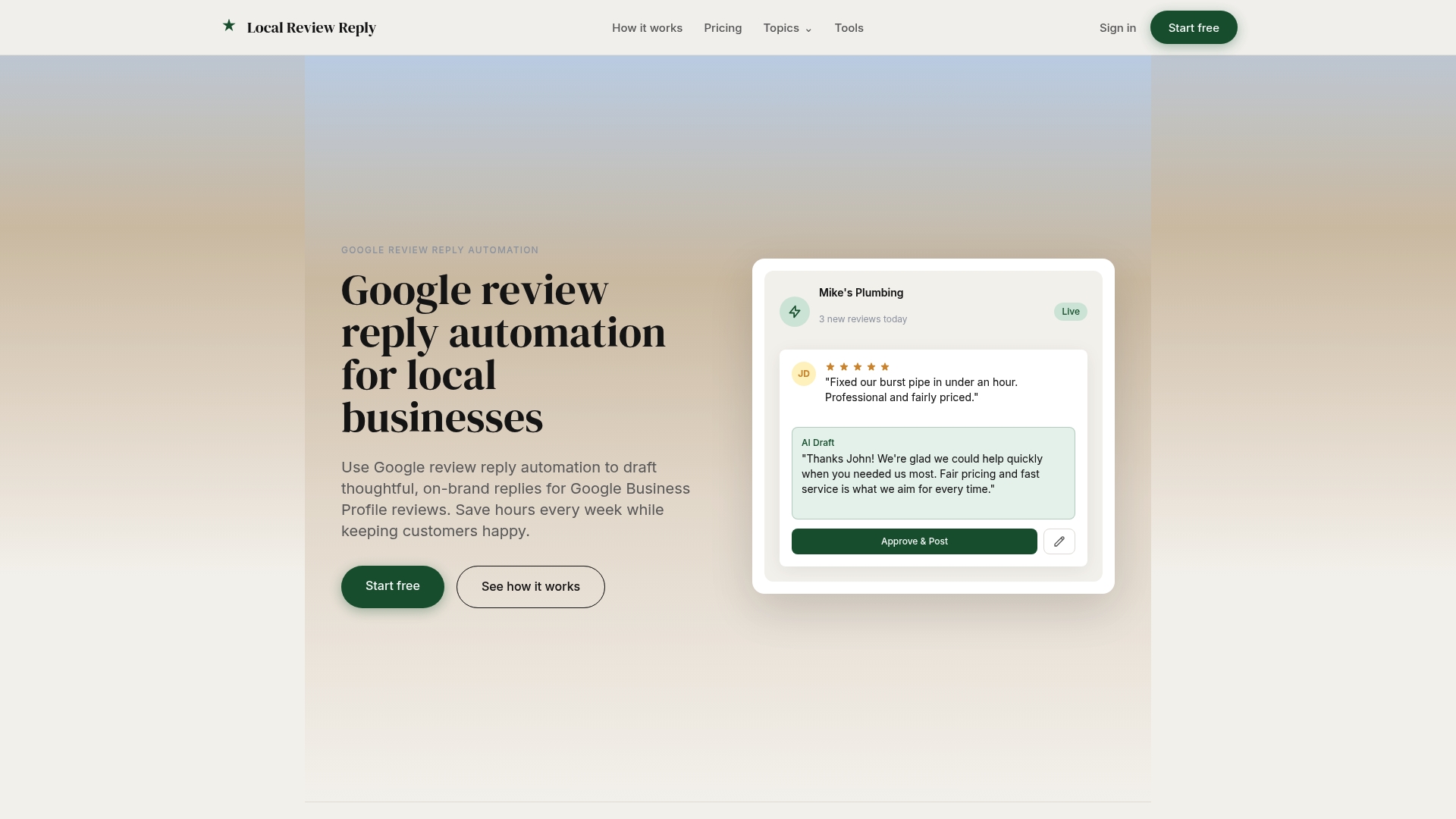
The platform captures author and approver IDs on every reply, routes low-star or flagged reviews into an approval queue before anything posts, and keeps edit history so managers can see what changed between an AI draft and the final published response. Multi-location dashboards give regional and corporate teams visibility into response coverage and activity across every profile without digging through individual accounts. You can review the full capability set on the features page or see how the workflow applies specifically to franchise structures on the multi-location review management page. The practical approach: let routine five-star replies move fast through automation, and keep a human in the loop on anything with reputational or legal weight. Start by checking your current setup against the Google review management software page to see where the gaps are.
Sources
For deeper background on franchise-specific review workflows, see Uberall's franchise review management guide and Maplift's multi-location playbook, both of which cover hybrid HQ/location models in more depth.
- Franchise review management
- Franchise Review Management: The Multi-Location Playbook That Scales
- Multi-Location Review Management: How One Dealer Cut Review Response Time to Under 16 Hours Across 43 Locations
- How franchises can manage Google reviews at scale