
Replying to reviews at scale typically costs several dollars per response once you count staff time, software, and oversight, with multi-location operators often spending a moderate to high amount per location monthly depending on volume and approval requirements. The fastest way to bring that number down is sentiment-based triage paired with AI-assisted drafting and a human approval step for sensitive replies, rather than cutting corners on volume or quality.
TL;DR:
- Manual review responses can cost several dollars each, with costs rising significantly at higher volumes and depending on approval requirements.
- Reducing reply time through AI-assisted drafting and sentiment-based triage can cut labor costs by up to 60 percent without sacrificing reply quality.
- Focusing personalized responses on positive reviews delivers better long-term ratings and financial results, while standardized replies to negatives save resources.
- A typical small business handling 20 reviews monthly spends around $83 in labor, whereas large operators may exceed $12,000 monthly in staffing costs alone.
- Building a short-term measurement and pilot program enables scalable cost reductions while maintaining review response quality and compliance safeguards.
Table of Contents
- What drives review response cost: a component breakdown
- How to estimate your total monthly and annual cost
- Practical ways to cut review response cost without hurting outcomes
- Trade-offs, risks, and governance when you cut costs
- A 90-day plan to measure and cut review response cost
- How Local Review Reply fits this approach
- FAQ
- Sources
What drives review response cost: a component breakdown
Before you can budget accurately, you need to separate the cost of responding to reviews into its actual parts. Most operators underestimate this because they only count the visible labor and skip the overhead that accumulates around it.
Monitoring time comes first: someone has to notice a new review exists, whether through an alert, a dashboard check, or a manual scan of Google Business Profile. Drafting time follows, and it varies enormously depending on whether a reply is templated or fully personalized. Approval time applies whenever a human needs to sign off before a reply posts, which Google Business Profile Help notes can matter because replies are processed by Google and may not appear immediately, sometimes taking up to 30 days.
The components that typically make up total cost:
- Monitoring and alerting: time spent checking for new reviews across platforms and locations.
- Drafting time: minutes per reply, which scales with personalization level and review complexity.
- Approval and escalation: extra minutes when a manager or legal contact must review sensitive replies before posting.
- Labor rate: the loaded hourly cost of whoever does the work, whether a frontline employee, a dedicated reputation manager, or an agency account team.
- Software and monitoring tools: subscription costs that typically scale per location or per seat.
- Overhead: training new staff, maintaining templates, and handling audits or compliance reviews.
Review volume multiplies every one of these line items. A single location with five reviews a month has a trivial cost footprint. A 50-location franchise generating 500 reviews a month multiplies drafting time, approval bottlenecks, and software seats simultaneously, which is why cost modeling has to happen at the portfolio level, not the single-location level.
How to estimate your total monthly and annual cost
A repeatable formula beats guesswork, and it fits in a single spreadsheet row. Use this structure:
- Calculate labor cost: (average minutes per reply × monthly review volume) ÷ 60, multiplied by your loaded hourly rate.
- Add software cost: your monthly subscription fee for monitoring or drafting tools, summed across locations or seats.
- Add overhead: a monthly allowance for training, template upkeep, and escalation handling, typically a fixed percentage of labor cost.
- Sum the three for your total monthly cost, then multiply by 12 for an annual figure.
For a single-location small business handling 20 reviews a month at 10 minutes each with a $25 loaded hourly rate, labor alone runs about $83 a month. A 10-location franchise handling 300 reviews a month at the same rate and time runs closer to $1,250 a month in labor, before software or overhead. An agency managing 100 locations with 3,000 monthly reviews sees labor costs scale past $12,000 a month unless average reply time drops significantly through templating or automation.
Sensitivity matters here: cutting average reply time from 10 minutes to 4 minutes through drafting assistance cuts labor cost by roughly 60% at any volume, while raising the approval rate (the share of replies needing manual sign-off) pushes costs back up because approval time stacks on top of drafting time.
Pro Tip: Measure your actual average minutes per reply for two weeks before building a budget. Most teams guess low.
Start by measuring three inputs: current review volume, average drafting time, and the percentage of replies that need manual approval. Those three numbers, tracked for even a short period, will reveal your real cost baseline faster than any industry benchmark.

Practical ways to cut review response cost without hurting outcomes
Cost reduction only works if it protects or improves the outcomes reviews are supposed to produce: trust, visibility, and repeat business. Cutting response volume or quality defeats the purpose.
Triage by sentiment first. Research from HKU Business School found that managers who prioritize personalized responses to positive reviews see stronger subsequent ratings and financial performance, while standardized, carefully worded replies to negative reviews limit short-term harm without requiring the same resource investment. That means your highest-value time goes toward personalizing replies to positive reviews, not toward over-engineering every negative one.
Other levers that reduce cost while preserving quality:
- Use AI-assisted drafting with human approval for low-star or sensitive reviews, so speed doesn't come at the expense of oversight.
- Batch replies by time block instead of responding one at a time throughout the day, which cuts context-switching.
- Assign role specialization, so one person handles drafting and another handles approval, rather than everyone doing both inconsistently.
- Outsource selectively for high-volume or legally sensitive locations, with clear service-level agreements and periodic quality audits. Reputation-management services, such as those LawSmiths offers for law firms, illustrate how specialized agencies price and structure this kind of work for regulated industries.
- Set monitoring thresholds so you're not manually checking every location every hour, which wastes time on low-impact reviews.
Pro Tip: Reserve manual drafting for one-star and two-star reviews with specific complaints. Everything else can start from a template and get personalized in under two minutes.
The combination of triage and drafting assistance is where most of the savings come from, because it cuts the single biggest cost driver, which is minutes per reply, without reducing the number of reviews you actually answer.
Trade-offs, risks, and governance when you cut costs
Cutting cost without guardrails creates new risks, and the two biggest are tone drift and compliance exposure.
Heavy reliance on templates or AI drafting without review can flatten your brand voice until replies sound generic or even robotic, which undermines the personalization that drives better outcomes in the first place. A written style guide and a lightweight approval step for anything off-template keeps this in check.
Reviews sometimes contain personal or sensitive customer information, and Google's own guidance recommends personalizing replies while protecting privacy and responding promptly, which means sensitive details should never be repeated or confirmed publicly. Key governance points:
- Require approval for any reply mentioning a specific incident, injury, billing dispute, or legal threat.
- Keep an audit trail of who drafted and who approved each sensitive reply.
- Plan for processing latency: Google notes replies can take anywhere from minutes to up to 30 days to post, so escalation timelines need buffer built in.
- Escalate privately when a public reply risks revealing customer information.
A 90-day plan to measure and cut review response cost
Start by measuring your baseline: current review volume, average drafting minutes, approval rate, and existing software spend. In the first month, pilot triage and AI-assisted drafting with approval on a handful of locations, not your whole portfolio. Run weekly audits of the pilot's output, adjust templates based on what gets flagged, and escalate exceptions instead of letting them stall. Track four numbers throughout: average reply time, reply rate, review volume, and rating trend. By day 90, you'll have enough data to decide whether to scale the approach across every location.
— Ryan
How Local Review Reply fits this approach
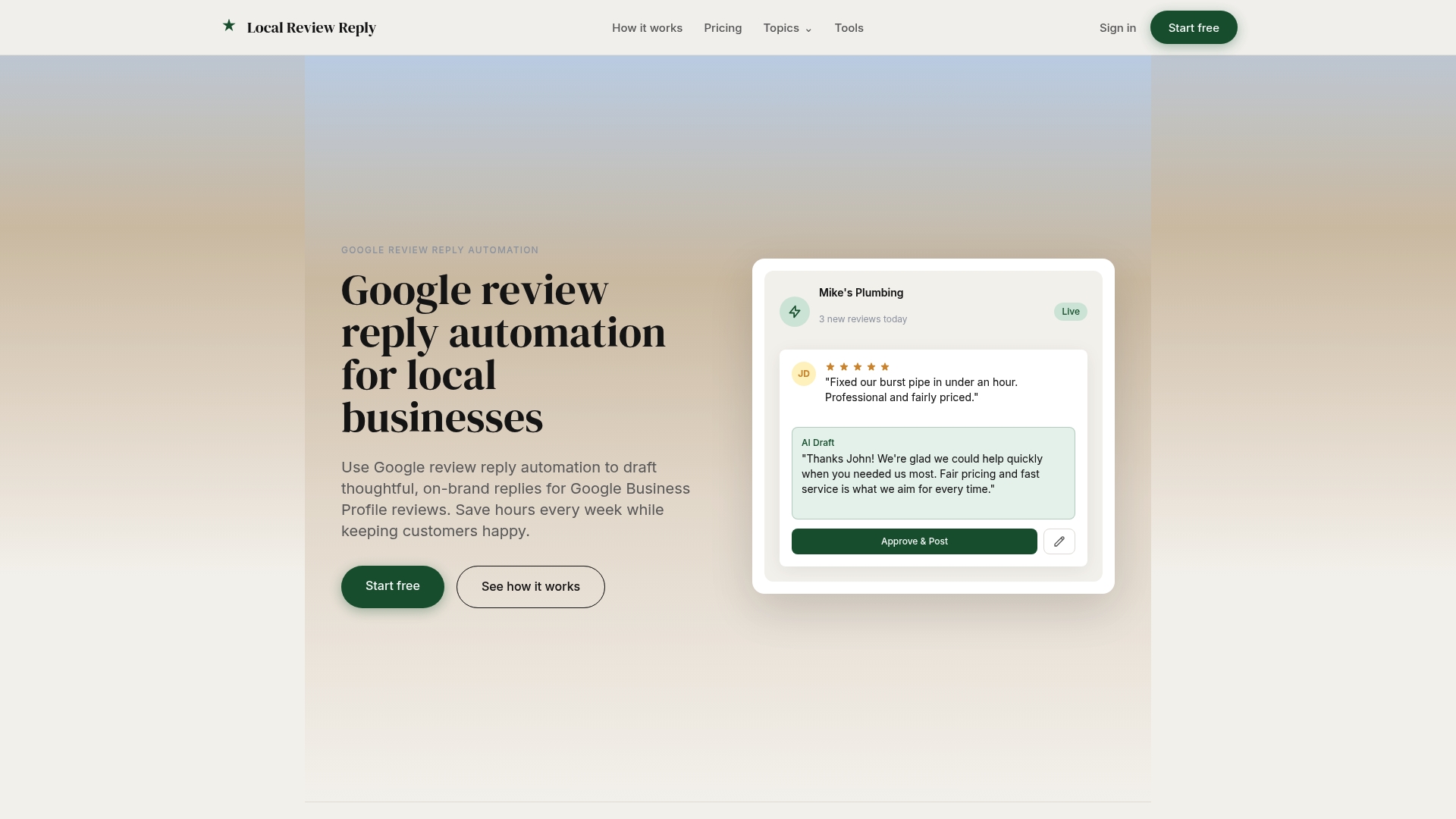
We built Local Review Reply around this model: AI-assisted drafting that proposes replies in seconds, paired with approval controls that keep a human in the loop for sensitive or low-star reviews. For multi-location operators and agencies, that combination addresses key cost drivers, drafting time and approval bottlenecks, while preserving oversight that protects brand voice.
What this looks like in practice:
- Drafts replies automatically so staff spend seconds reviewing instead of minutes writing from scratch.
- Routes sensitive or low-star reviews through an approval step before anything posts publicly.
- Manages multiple locations from one place, which matters once you're past a handful of sites.
We don't promise specific ranking or rating outcomes, since those depend on many factors outside any single tool. If you want to see how the drafting and approval workflow would fit your own volume and staffing model, our pricing page lists the Free, Starter, Growth, Scale, and Custom plans so you can compare based on your location count and reply volume.
FAQ
How much does it cost to respond to reviews at scale?
Costs typically range from a few dollars to over $20 per reply once you include labor, software, and approval time, with multi-location operators often spending a moderate to high amount per location monthly depending on volume. The exact figure depends heavily on average drafting time, approval requirements, and whether responses are templated or fully personalized.
What is the biggest cost driver in review response management?
Labor time, specifically the minutes spent drafting each reply, is usually the largest line item, and it multiplies directly with review volume.
Should we reply to every review or prioritize some?
Prioritizing positive reviews for personalized replies tends to produce stronger long-term ratings and financial results, based on findings from HKU Business School. Negative reviews still warrant a response, but standardized, carefully worded replies can limit resource drain without sacrificing outcomes.
Does responding to reviews actually affect business performance?
Research published on SSRN found that firms which start responding to reviews see roughly a 12% increase in review volume and a 0.12-star improvement in average rating. Those gains can help justify the time or software investment required to respond consistently, especially across multiple locations.
How long does it take for a review reply to post on Google?
Replies pass through Google's own processing and can take anywhere from a few minutes up to 30 days to appear publicly, according to Google Business Profile Help. Teams managing approval workflows should build that latency into their escalation timing so sensitive replies aren't delayed further by internal bottlenecks.
Sources
- Soothing the unsatisfied or pleasing the satisfied? The effects of managerial responses to positive versus negative reviews on customer ratings and financial performance - HKU Business School
- Management responses and online reputation (SSRN paper)
- Manage customer reviews - Google Business Profile Help