
Set a review response SLA aiming for same-day to 24 hours for negative reviews and within a few days for neutral or positive ones, then build severity tiers and routing rules so the target actually gets hit. Platform moderation on sites like Google Business Profile can delay when a reply appears publicly, so measure from the actual publish time, not just drafting time. Tools offering AI-assisted drafting and approval workflows can help draft replies quickly and route sensitive ones for approval.
TL;DR:
- Negative reviews, especially those mentioning safety or legal issues, should be responded to within the same day to prevent escalation or damage.
- Teams must assign dedicated owners and escalation triggers, such as alerts after four hours for urgent reviews, to ensure timely responses across locations.
- Tracking response times should focus on percentiles like the 90th percentile to identify slow cases, not just averages that hide outliers.
- Automated drafting tools require human approval for low-star reviews to maintain quality and avoid public relations risks.
- Staff to handle the busiest day based on the last 90 days' volume, not an average, to set realistic SLA expectations.
Table of Contents
- Recommended SLA targets and how to choose them
- Prioritization: severity tiers and what to answer first
- Implementation steps: staffing, ownership, and escalation
- Metrics and reporting: what proves the SLA is working
- Templates, personalization, and quality checks
- Automation guardrails and approval workflows
- Common gotchas and limitations to plan for
- SLAs as culture, not just a policy document
- How Local Review Reply helps enforce these SLAs at scale
- Sources
- FAQ
Recommended SLA targets and how to choose them
A review response SLA needs two separate clocks: first response and resolution. First response is how fast someone acknowledges the review publicly. Resolution is how long it takes to fully address the issue, sometimes through a follow-up reply or offline contact. Treating these as a single number hides where the process actually breaks.

Operational SLA guidance for review processes recommends responding within 24 hours and completing the loop within three days, a structure adapted from engineering incident response. Engineering review culture applies a similar logic: a one-business-day maximum for first responses keeps queues from stalling, even when full resolution takes longer.
For reviews, that translates to tighter windows on negative feedback and looser ones on routine positive reviews:
- Negative or one to two star reviews: first response same day, ideally within 24 hours.
- Neutral or three star reviews: first response within 48 hours.
- Positive or four to five star reviews: first response within 48 to 72 hours.
- High-volume locations: tighten negative-review targets further since backlog risk compounds faster.
Measure the clock from when the review posts publicly, not from when your team notices it. Google's guidance on managing reviews notes that replies go through a review process and can take a few minutes or, in some cases, considerably longer to appear, so build a buffer into your internal targets rather than promising a public-facing guarantee you cannot control.
Prioritization: severity tiers and what to answer first
Not every review deserves the same urgency, and treating them equally wastes staff time on low-impact replies while high-risk ones wait. A four-tier system keeps triage simple:
- P1, urgent: one-star reviews mentioning safety, billing disputes, or threats of legal or regulatory complaints; route to a manager within hours.
- P2, high priority: two-star or one-star reviews without urgent language; first response within 24 hours by a trained team member.
- P3, standard: three-star or neutral reviews with mixed feedback; respond within 48 hours, often with a template plus one personalized line.
- P4, low priority: four and five-star reviews; respond within 48 to 72 hours or batch a few times a week.
Selective, regular responses tend to outperform answering every single review in bulk. Research on review response behavior found that response speed and reply length improved subsequent review quality more than simply replying to everything, and that a selective, steady cadence beat bulk catch-up sessions. Some positive reviews without comments may not need a reply, whereas negative reviews with specific issues, such as naming an employee, merit prompt attention.
Implementation steps: staffing, ownership, and escalation
An SLA only works if someone owns it every day, including when that person is out. Start with these operational pieces:
- Assign a primary owner and a backup for review monitoring so coverage never depends on one person's schedule.
- Build a rotation for daily monitoring across locations or shifts, especially for multi-location operators.
- Set escalation triggers, such as any P1 review unanswered after four hours automatically alerting a manager.
- Create queues and tags in your review inbox so P1 and P2 items surface before routine five-star reviews.
- Design the approval step for sensitive replies so it adds minutes, not days, to the process.
Review SLA playbooks pair targets with rotations and escalation rules specifically to prevent the two most common failure modes: nobody owns the queue, or the one person who does gets buried.
Before tightening any target, staff to your actual load, not your average day.
Pro Tip: Pull your review volume for the last 90 days, find the 90th-percentile day (your busiest realistic day, not your worst outlier), and staff to handle that before you promise a faster SLA.
Metrics and reporting: what proves the SLA is working
Averages hide the problem you are trying to fix. If nine reviews get a reply in one hour and one waits five days, the average looks fine while a customer is publicly ignored. Track percentiles instead:
- Median first-response latency: the typical time to first reply, by tier.
- 90th percentile latency: how slow your worst realistic cases get, the number that predicts complaints about being ignored.
- Reply coverage: the share of reviews, especially P1 to P3, that get any response.
- Time-to-resolution: how long from first response to the issue being closed out.
- Escalation rate: how often reviews breach SLA and require manager intervention.
Academic and operational sources on response practices consistently point to percentile-based measurement over simple averages specifically because averages mask outliers. A practical cadence: real-time alerts for P1 breaches, a weekly scorecard for the operations team, and a monthly trend review for management to catch slow drift before it becomes a pattern.
Templates, personalization, and quality checks
Templates keep replies fast and consistent, but a template with no personalization reads as robotic and undermines the trust an SLA is supposed to build. Build four variants: positive, neutral, negative, and escalation, each with fields for the reviewer's name, the specific issue or compliment mentioned, and the location if you operate more than one.
- Positive template: thank the reviewer by name and reference something specific they mentioned.
- Neutral template: acknowledge the mixed experience and invite further contact.
- Negative template: apologize without over-promising, state a concrete next step, and move contact details offline.
- Escalation variant: used only after manager review, never auto-published.
A short approval rubric helps here: check tone, factual accuracy, a clear next step, and that no private details (names of other customers, account numbers) leak into a public reply. Home service template libraries and broader Google review response templates are useful starting points for building this structure.
Automation guardrails and approval workflows
AI drafting can meet tight SLA windows without forcing someone to write forty replies before lunch, but it works only with a human checkpoint on anything risky. A workable flow: AI drafts replies for routine three-to-five star reviews, and every one and two-star review routes to a person before it posts.
- Draft, don't auto-publish for any review below a set star threshold.
- Log reply states, drafted, pending, approved, rejected, so a delay is easy to diagnose.
- Disable automation temporarily during a PR issue or product recall until messaging is reviewed centrally.
Certain platforms draft personalized, on-brand replies and require manual approval for sensitive or low-star reviews before posting, which keeps drafting speed high while maintaining human judgment for riskier reviews.
Selective, well-timed responses tend to improve subsequent review quality more than blanket bulk replies do, according to research on review response behavior, which is the core argument for pairing fast drafting tools with disciplined approval rules rather than full auto-publishing.

Common gotchas and limitations to plan for
A few predictable problems break most review SLAs within the first month:
- Moderation delays: Google's own guidance notes replies can take longer than expected to appear publicly, so an internal SLA should track drafting and approval time separately from publish time.
- Approval bottlenecks: routing every reply through one manager creates a queue that defeats the SLA's purpose; add a backup approver.
- Setting targets from averages: this hides your worst cases and sets an SLA you cannot actually meet on a bad day.
- Privacy slips: never name other customers, employees' personal details, or account specifics in a public reply, regardless of how fast you need to respond.
SLAs as culture, not just a policy document
A review response SLA is not a document you write once. It is a habit that needs training, a visible dashboard, and someone who checks it weekly, not quarterly. Teams that treat percentile improvement as worth celebrating, not just a compliance number, tend to sustain the habit longer than teams chasing a single fast week.
— Ryan
How Local Review Reply helps enforce these SLAs at scale
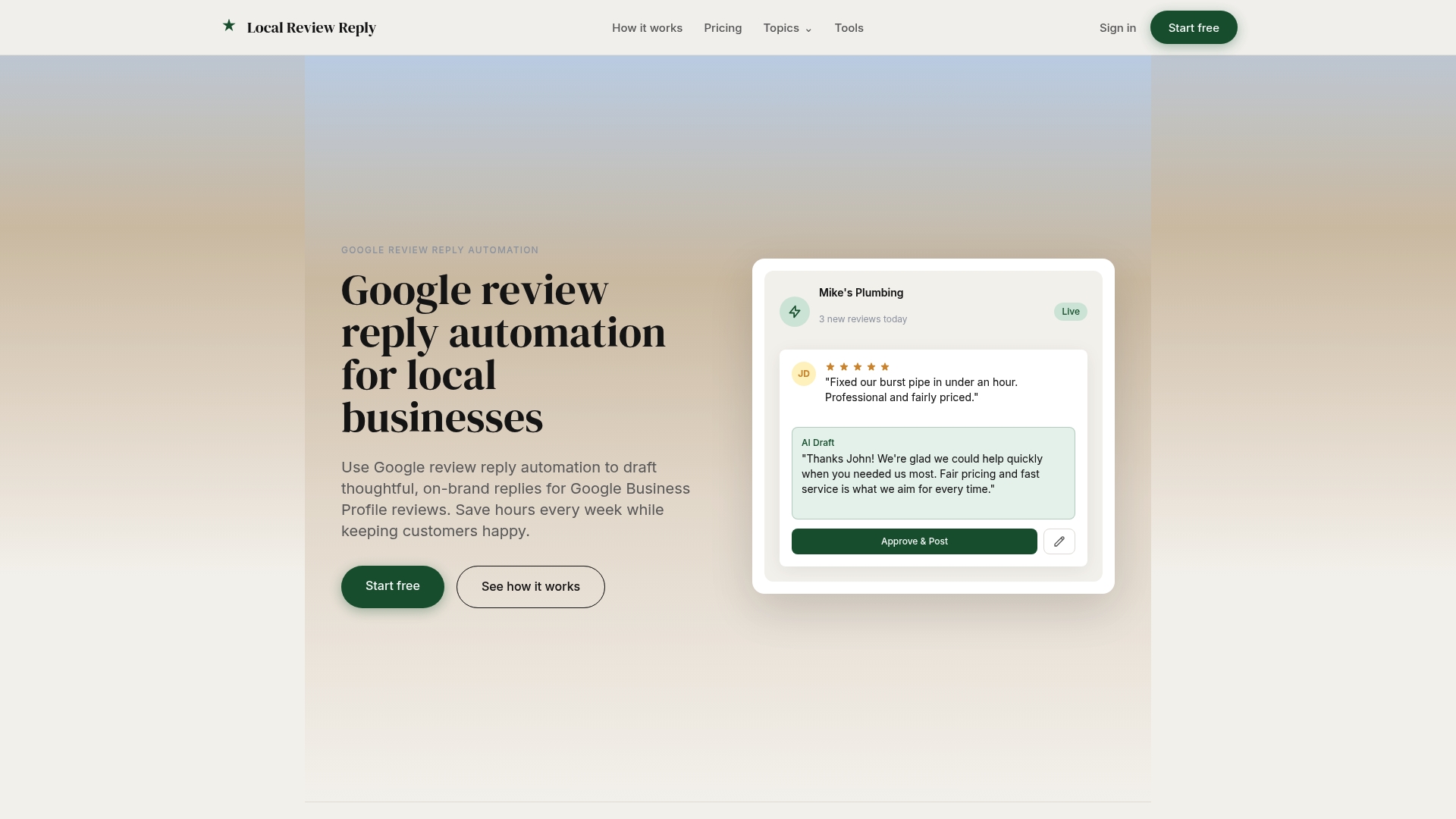
Meeting a same-day SLA across ten locations by hand is a staffing problem before it is a writing problem. Some software drafts personalized replies automatically, routes low-star reviews through approval steps, and provides franchises and agencies tools to apply consistent SLA targets across many locations with analytics to track adherence over time.
- Fits: franchises, multi-location operators, and agencies managing SLAs across dozens of profiles.
- Preserves: brand voice and human sign-off on sensitive replies.
- Scales: without adding headcount for routine positive and neutral reviews.
Plans range from a free tier for basic use up through Starter, Growth, Scale, and Custom options for larger teams. Check current pricing and plan details to find the right fit for your location count and reply volume.
Sources
- Responding to Customer Reviews (MA thesis, University of Twente)
- Manage customer reviews - Google Business Profile Help
- Review SLAs | minware
- Google engineering review practices
FAQ
What is a good SLA response time for reviews?
A practical baseline is same-day to 24 hours for negative reviews and 48 to 72 hours for neutral or positive ones. Tighter windows apply to higher-risk reviews, such as those mentioning safety or billing disputes, which should be escalated within hours rather than a full day.
What does "SLA response" mean?
An SLA response is the first acknowledgment a business makes to a customer within an agreed time window, separate from full resolution. In review management, it usually means the public reply, not necessarily that the underlying issue has been solved yet.
What is P1, P2, P3, P4 in an SLA?
These are severity tiers used to prioritize work: P1 is urgent (safety or legal concerns needing response within hours), P2 is high priority, P3 is standard, and P4 is low priority. Applied to reviews, a one-star complaint about a safety issue is P1, while a five-star review with no comment is P4.
What does "SLA review" mean?
An SLA review is the practice of regularly checking whether response times are meeting agreed targets, typically by tracking median and 90th percentile latency rather than averages. Teams often pair this with a periodic audit of escalation logs to catch process breakdowns early.
Does platform moderation affect review response SLAs?
Yes. Google's guidance notes that replies to reviews go through a review process before appearing publicly, which can add delay beyond your internal drafting time. SLA measurement should track both when a reply was drafted and when it actually posted.