
The best approach to review sentiment tagging combines an automated, aspect-aware pipeline with human review built into the workflow, not bolted on afterward. Pure lexicon tools miss sarcasm and mixed sentiment. Pure LLM pipelines cost too much at scale and can hallucinate justifications. The winning setup detects which part of the review the customer is talking about, scores polarity and intensity for that aspect, flags urgency, and routes anything uncertain to a human.
Prioritize these four elements when you build or evaluate a pipeline:
- Aspect detection — identify what the review is actually about (shipping, staff, price, product defect) rather than tagging the whole review with one label
- Sentiment polarity and intensity — capture not just positive/negative/neutral but how strong the sentiment is
- Priority and urgency tagging — flag reviews that need an immediate response versus ones that can wait for weekly analysis
- Human review for edge cases — route low-confidence, high-impact, or legally sensitive reviews to a person before any tag drives an automated action
The one-line verdict: automate the volume, but never automate the judgment calls on your worst reviews.
Key Takeaways
Review sentiment tagging works best as an aspect-aware, hybrid pipeline that automates volume while routing uncertain or high-stakes reviews to human reviewers before any action is taken.
| Point | Details |
|---|---|
| Tag at the aspect level | Document-level polarity misses mixed sentiment; aspect-based tagging separates what's good from what's broken in the same review. |
| Match method to volume and stakes | Use lexicon tools for prototypes, transformers for scale, and LLMs for nuance or justification on complex cases. |
| Build human review into the pipeline, not around it | Route low-confidence and high-urgency tags to a person before they trigger a public-facing action. |
| Measure with macro F1, not raw accuracy | Imbalanced review classes hide poor negative-class performance behind a high overall accuracy score. |
| Localreviewreply supports tag-driven reply workflows | It drafts on-brand replies with approval controls for sensitive or low-star reviews, keeping automation and human oversight working together. |
Table of Contents
- What Is Review Sentiment Tagging and What Taxonomy Should You Use?
- Why Does Sentiment Tagging Matter for Product and CX Teams?
- Which Methods Should You Use to Tag Review Sentiment?
- How Do You Build a Review Sentiment Tagging Pipeline?
- Which Tools and Platforms Handle Review Sentiment Tagging?
- How Do You Evaluate and Test a Sentiment Tagging Model?
- What Are the Biggest Pitfalls in Tagging Review Sentiment?
- How Should Sentiment Tags Drive Routing and Alerts?
- What Do Practitioners Say Actually Works at Scale?
- How Do Sentiment Tags Connect to Your Review Reply Workflow?
- Sources
What Is Review Sentiment Tagging and What Taxonomy Should You Use?
Review sentiment tagging is the process of attaching structured labels to review text that describe sentiment and related attributes, so the raw text becomes something a dashboard, an alert system, or a support queue can act on. It sits under the broader umbrella of sentiment analysis, and most teams building a production pipeline eventually converge on the same taxonomy regardless of which tool they choose.
A comprehensive review of sentiment analysis and emotion detection methods lays out the main categories teams still use today, and reviews text has its own quirks that make the taxonomy matter more than it might for, say, news articles.
Here's the practical breakdown:
- Document-level polarity — one label for the entire review (positive, negative, neutral). Fast to compute, but nearly useless once a review mentions three different things.
- Sentence-level polarity — sentiment scored per sentence, which starts to separate "the food was great" from "the wait was awful" in the same review.
- Aspect-based sentiment analysis (ABSA) — sentiment tied to a specific entity or feature (delivery, staff, price, cleanliness). This is the level most CX and product teams actually need.
- Intensity or score — a numeric or ordinal measure of how strong the sentiment is, not just its direction.
- Emotion labels — finer-grained tags like frustration, delight, or confusion, useful when polarity alone doesn't explain a spike in complaints.
- Multi-label/multi-aspect annotation — a single review carries several aspect-sentiment pairs simultaneously, which is the normal case for anything longer than a sentence.
A tagged example makes this concrete. Take a review that reads: "Food arrived cold and 40 minutes late, but the app made it easy to reorder." An aspect-based tagging pass would output something like: aspect = delivery, sentiment = negative, intensity = high; aspect = app usability, sentiment = positive, intensity = medium. One review, two aspects, two opposite sentiments. That's normal, and it's exactly the pattern document-level tagging destroys.
Most teams testing or training a tagging model lean on public benchmark corpora like Yelp, Amazon product reviews, and IMDb, since they're large, labeled, and domain-representative of what real review pipelines process. If you're evaluating a vendor or building in-house, ask what benchmark they validated against. It tells you a lot about whether their accuracy numbers will hold up on your review text.
Why Does Sentiment Tagging Matter for Product and CX Teams?
Sentiment tags turn a pile of unstructured reviews into something you can query. Without tags, "how is the new checkout flow performing" means someone reading reviews manually. With aspect-based tags, it means a filtered dashboard view.
Three use cases show up again and again in mature review programs:
- Trend monitoring — watching sentiment by aspect over time to catch a quality regression before it shows up in churn numbers
- Ops prioritization — routing high-urgency, high-intensity negative reviews to a response queue instead of a weekly digest
- Product and backlog input — feeding aspect-level negative sentiment straight into product management tools so recurring complaints about a feature get weighted alongside other backlog signals
Tags also answer specific business questions that raw star ratings can't. "Which product features drove negative sentiment this quarter?" is unanswerable from a 1 to 5 star average, but trivial from aspect-tagged data. Same with "did the sentiment on delivery time improve after we changed carriers." A tag-driven query answers that in minutes.
There's a workflow benefit too. Teams that tag urgency alongside sentiment can auto-route the worst reviews into a response queue with a service-level target, instead of waiting for someone to scroll through everything new that day. That distinction between "flagged for a human to review the tag" and "flagged for a human to write the actual reply" matters a lot once volume climbs past a few hundred reviews a week.

Which Methods Should You Use to Tag Review Sentiment?
Four broad approaches dominate review sentiment tagging, and each one trades accuracy, cost, and explainability differently. None of them is universally correct. The right pick depends on your volume, your tolerance for error, and whether you need the model to explain itself.
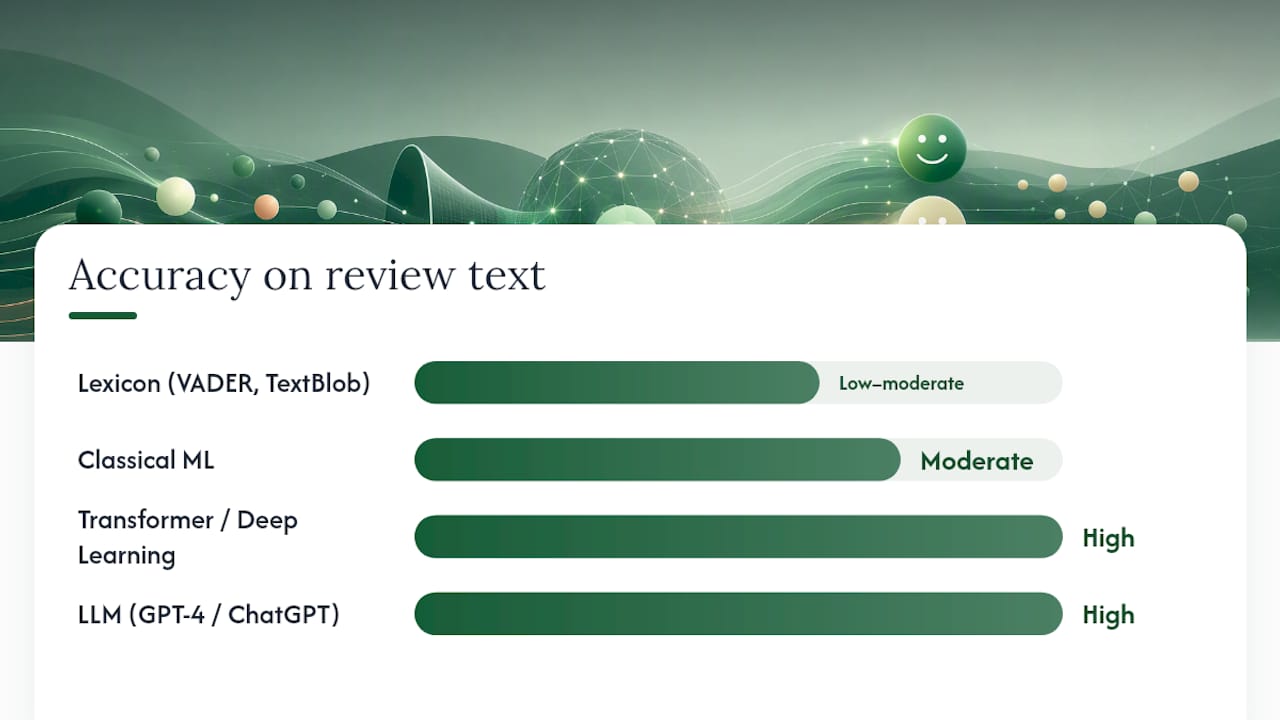
Lexicon-based tools like VADER and TextBlob score sentiment by matching words against a pre-built dictionary of positive and negative terms, adjusted for negation and intensifiers. They're fast, require no training data, and are fully interpretable since you can see exactly which words drove the score. Their weakness is exactly where reviews get interesting: sarcasm ("great, another broken zipper"), domain jargon, and mixed-aspect sentences all confuse a word-matching approach because it has no concept of context.
Classical machine learning (logistic regression, SVMs, or naive Bayes trained on engineered features like TF-IDF vectors) works well when you have a modest labeled dataset and need a model you can audit feature-by-feature. It beats lexicon tools on domain-specific language once trained on your own reviews, but it needs that labeled data to begin with, and it doesn't generalize to new phrasing the way deep learning does.
Transformer and deep-learning models, accessed through libraries like spaCy or Hugging Face Transformers, handle context and aspect-level nuance far better than either lexicon or classical ML approaches. A fine-tuned transformer can separate "the delivery was slow but the food was excellent" into two correctly opposed aspect sentiments, and most support multilingual review sets out of the box through multilingual pretrained checkpoints.
LLM-based approaches using GPT-4 or ChatGPT, either through prompting or fine-tuning, add something the other three can't: justification generation. The model can output not just "negative, aspect: staff" but a short explanation of why it classified the text that way, which is useful for spot-checking and for building trust with stakeholders who don't want a black box. The tradeoff is cost and latency at scale, plus the risk of confidently wrong explanations if you don't validate them.
| Method | Accuracy on review text | Explainability | Cost at scale | Best for |
|---|---|---|---|---|
| Lexicon (VADER, TextBlob) | Low to moderate; weak on sarcasm and jargon | High — word-level transparency | Very low | Prototypes, quick triage |
| Classical ML | Moderate; strong once trained on domain data | High — feature-level | Low | Smaller labeled datasets, regulated industries needing audit trails |
| Transformer/deep learning | High, especially aspect-level | Moderate | Moderate | High-volume, multilingual, aspect-heavy review sets |
| LLM (GPT-4/ChatGPT) | High, with strong nuance handling | High, when justification is requested | High per-call cost | Complex reviews, low-volume high-stakes queues, human-review support |
Pro Tip: If you're processing under a few thousand reviews a month, don't jump straight to an LLM pipeline. Run a transformer-based aspect model first, and reserve LLM calls for the subset flagged low-confidence or high-urgency. You get the nuance where it matters without paying LLM pricing on every routine five-star review.
One data point worth anchoring expectations to: a production sentiment analysis implementation reported 90.2% test accuracy with inference under 50 milliseconds per request, which is a reasonable target for a well-tuned transformer pipeline running at scale. If your prototype is nowhere near that, the gap is usually in preprocessing or domain fine-tuning, not the base model architecture.
How Do You Build a Review Sentiment Tagging Pipeline?
Building this in the right order saves you from retraining a model on badly labeled data six months in. Here's the sequence that holds up in practice.
-
Collect and canonicalize your data. Pull reviews from every channel (Google Business Profile, app stores, in-product surveys) into one schema. Dedupe cross-posted reviews, and map metadata consistently: star rating, product or location ID, timestamp, and language. Multilingual review sets need a language-detection step here, before anything else touches the text.
-
Preprocess the text. Clean HTML artifacts and encoding issues, normalize spelling variants (reviews are full of typos and abbreviations), and decide how you'll handle emoji, since they often carry sentiment a word-only model misses entirely. Flag rating-text mismatches (a 5-star review with clearly negative text, or vice versa) as a separate quality signal rather than silently trusting the star rating as ground truth.
-
Write annotation guidelines before you label anything. Vague label definitions produce inconsistent training data no model can fix later. Define each sentiment class with concrete examples, not abstractions. Build in an adjudication step where two annotators disagree, and route those disagreements to a third reviewer rather than a coin flip. Systematic reviews of sentiment analysis literature consistently recommend measuring inter-annotator agreement early, since low agreement on your own guidelines usually means the guidelines need revision, not the annotators.
-
Handle class imbalance deliberately. Review datasets skew heavily positive in most industries, which means negative and neutral classes are underrepresented in training data. Oversample minority classes, use class-weighted loss functions during training, or apply stratified sampling when building your evaluation set so rare labels don't get drowned out in the metrics.
-
Select your model based on volume and explainability needs. Match the method to the section above: lexicon for prototyping, classical ML for small labeled sets needing an audit trail, transformers for high-volume aspect-level accuracy, LLMs for the subset needing justification or handling unusually complex language. Many production pipelines run a hybrid: a fast transformer model handles the bulk, and low-confidence outputs get a second pass from an LLM before reaching a human.
-
Plan deployment around latency and privacy, not just accuracy. Decide batch versus streaming inference based on how fast tags need to reach your dashboard. A nightly batch job is fine for trend reporting; a support-routing use case needs near-real-time scoring. Strip or mask PII in review text before it hits any third-party API, since customer names, order numbers, and contact details show up in reviews more often than most teams expect.
-
Build the monitoring and feedback loop before launch, not after. Sample a percentage of tagged reviews for human review on an ongoing basis, watch for model drift as review language shifts (new product launches introduce new vocabulary fast), and schedule periodic re-annotation of a seed set to catch degradation before it shows up as a business problem.
Pro Tip: Keep a fixed seed set of 200 to 500 hand-labeled reviews that never gets used for training, only for testing. Every time you retrain or swap models, run that same seed set through and compare scores. It's the fastest way to catch silent regressions.
Which Tools and Platforms Handle Review Sentiment Tagging?
The tooling landscape splits cleanly into open-source libraries you run yourself and cloud APIs you call. Here's what each one is actually good for.
- VADER — a lexicon-and-rule-based tool tuned specifically for social media and short text. Free, fast, and interpretable, but weak on longer reviews with mixed sentiment or industry jargon. Best for a same-day prototype.
- TextBlob — another lexicon-based Python library, simpler than VADER, good for teaching a taxonomy or building a baseline before investing in anything heavier.
- spaCy — an industrial-strength NLP library that handles tokenization, entity recognition, and pipeline orchestration; it's frequently the backbone that connects preprocessing to a custom or pretrained sentiment model rather than a sentiment classifier on its own.
- Hugging Face Transformers — the standard library for accessing and fine-tuning pretrained transformer models for sentiment and aspect-based classification, with strong multilingual model support. Setup takes more engineering effort than a lexicon tool, but accuracy gains on real review text are substantial.
- OpenAI (GPT-4 / ChatGPT) — usable through prompting for zero-shot tagging or fine-tuned for a specific taxonomy, with the unique advantage of generating a justification alongside the tag. Best reserved for complex or ambiguous reviews rather than bulk processing, given per-call cost.
- AWS Comprehend — a managed API offering sentiment and entity detection with minimal setup, well suited to teams already inside the AWS ecosystem needing to scale without managing infrastructure.
- Google Cloud Natural Language — similar managed-API model to Comprehend, with solid multilingual coverage and straightforward integration for teams already on Google Cloud.
- Azure Text Analytics — Microsoft's equivalent managed offering, including opinion mining (aspect-based sentiment) as a built-in feature rather than an add-on, which is worth checking against your specific aspect-tagging needs.
- Thematic — a commercial platform that layers thematic extraction on top of sentiment analysis, surfacing topics alongside percent-negative and percent-positive metrics rather than requiring you to build that reporting layer yourself. Vendor documentation shows this pairing of theme detection with sentiment tagging is now a common pattern among commercial review analytics platforms, aimed at business users who need dashboards, not raw model output.
Integration usually follows one of two patterns: batch export, where reviews are pulled on a schedule and tagged offline, or a webhook/streaming setup, where each new review triggers a tagging call as it arrives. Batch is cheaper and simpler; streaming is necessary if you're routing high-urgency reviews to a live support queue. Whichever pattern you choose, confirm the tool's multilingual support matches your actual review language mix before committing. Managed cloud APIs generally cover more languages out of the box than a single fine-tuned open-source model trained only on English data.
How Do You Evaluate and Test a Sentiment Tagging Model?
Standard classification metrics apply here, but reviews add a wrinkle most generic NLP guides skip: class imbalance and aspect-level mismatches change how you should read those metrics.
Precision, recall, and F1 remain the core numbers. Precision tells you how many of your "negative" tags were actually negative; recall tells you how many true negatives you caught. For review data, recall on the negative class usually matters more than overall accuracy, since missing a genuinely angry review costs more than misclassifying a lukewarm one. Use macro-averaging, not micro-averaging, when your classes are imbalanced. Micro-averaging lets a huge positive class mask poor performance on the negative and neutral classes you actually care about most.
For intensity scores, check calibration, not just classification accuracy. A model that's directionally right but consistently overstates intensity will flood your urgent queue with reviews that don't deserve it.
| Testing stage | What it checks | Why it matters for reviews |
|---|---|---|
| Holdout set evaluation | Performance on unseen data | Confirms the model generalizes beyond training examples |
| Cross-validation | Stability across data splits | Catches overfitting to a specific review source or time period |
| Stratified sampling | Fair representation of rare labels | Prevents a rare "mixed sentiment" class from disappearing in metrics |
| Human validation / inter-annotator agreement | Agreement between model tags and human judgment | Confirms the taxonomy itself is being applied consistently |
| Shadow mode / A/B rollout | Real-world performance before full cutover | Surfaces production issues (latency, edge cases) invisible in offline testing |
A confusion matrix built for review data should separate two very different error types: polarity errors (calling a positive review negative) and aspect errors (correctly detecting negative sentiment but attaching it to the wrong aspect). A model can score well on aggregate accuracy while still misrouting complaints to the wrong team because it nailed the polarity and missed the aspect.
Before full deployment, run the model in shadow mode: score live reviews without acting on the tags, and compare output against your existing process for a few weeks. The SOUL study from EMNLP 2023 found a performance gap of up to 27% between current models and human performance on deeper sentiment-understanding tasks, and it's a useful reminder that strong benchmark accuracy on simple polarity doesn't guarantee the model reasons well about nuanced or layered reviews. That's the exact gap human validation is meant to catch before it reaches a customer-facing workflow.
What Are the Biggest Pitfalls in Tagging Review Sentiment?
Review text breaks sentiment models in a handful of predictable ways, and knowing the pattern in advance saves you from discovering it in production.
- Sarcasm and irony — "Love waiting 45 minutes for cold food" reads as positive to a lexicon model and often confuses even fine-tuned classifiers without domain-specific training examples.
- Mixed sentiment within one review — a customer praising the product while criticizing shipping needs aspect-level tagging, not a single document-level label, or you lose half the signal.
- Rating-text mismatch — a 5-star review with critical text (or a 1-star review that's mostly complimentary about one detail) signals either a labeling error upstream or a customer using stars loosely; treat these as a distinct quality flag rather than trusting either signal blindly.
- Domain-specific jargon and abbreviations — industry terms, product SKUs, and abbreviations specific to your business rarely appear in general-purpose training data, which drags down accuracy until the model sees domain examples.
- Short, terse reviews and emoji-only feedback — "meh 👎" carries real signal but almost no text for a lexicon or classical model to work with, so emoji handling needs to be an explicit design decision, not an afterthought.
Mitigation follows the same logic across all five: push tagging to the aspect level wherever possible, set conservative confidence thresholds so uncertain tags route to a human instead of getting auto-published or auto-actioned, and keep training on your own domain data rather than relying solely on a general-purpose pretrained model.
Pro Tip: Set a recurring weekly or biweekly slot to manually review a sample of low-confidence tags and any high-impact review that got a surprising label. Thirty minutes reviewing your model's worst calls teaches you more about where it's failing than a month of aggregate accuracy dashboards.
How Should Sentiment Tags Drive Routing and Alerts?
Tags only earn their keep once they trigger action. The routing logic matters as much as the tagging accuracy behind it.
-
Set routing rules tied to aspect and urgency together, not sentiment alone: a negative, high-urgency tag routes straight to a support queue with an SLA clock running; a negative tag on a specific product feature routes to the product backlog instead; a cluster of negative tags tied to one location in a short window triggers a regional ops alert rather than sitting in a weekly report.
-
Track a small set of dashboard metrics that actually get used, rather than every metric a tagging tool can produce: sentiment trend by aspect over time, volume-weighted sentiment (so one furious review doesn't skew a small sample), average intensity by category, and the percentage of items still requiring human review, which tells you whether your confidence thresholds need adjusting.
-
Build alerting around thresholds and anomalies, not just raw counts. A spike in negative sentiment on one aspect matters more than a static "10 negative reviews this week" number. Route these through whatever your team already uses for real-time notification, whether that's Slack, email, or a ticketing system.
Governance can't be an afterthought once tags start triggering public-facing actions. Role-based access should determine who can approve an automated reply drafted off a sentiment tag, particularly for anything tagged high-urgency or negative. Review platform documentation shows this kind of tag-driven organization is now standard practice, and moderation guidance from major review platforms reinforces the same point: tags that trigger customer-facing actions need an audit trail and an approval step, not just an automated pipeline running unsupervised.
What Do Practitioners Say Actually Works at Scale?
The pattern that shows up across mature review programs is less about picking the perfect model and more about combining automated tags with organizational structure. Automated sentiment and aspect tags handle volume; organizational tags (which team owns this, which SLA applies) and approval workflows handle judgment. Neither substitutes for the other.
A few rules of thumb hold up consistently:
- Start with two or three aspects that matter most to your business, not a sprawling taxonomy of twenty categories nobody can label consistently.
- Keep a labeled seed set from day one, and measure inter-annotator agreement on it regularly, not just during initial setup.
- Iterate monthly rather than treating the model as finished after launch. Review language shifts as your product, pricing, or customer base changes.
The clearest wins show up in two places: human-in-the-loop review catching a misclassified legal or safety complaint before it got auto-routed as routine negative feedback, and LLM-generated justifications cutting triage time because a support lead could see why a review was flagged, not just that it was.
A Practitioner's View on Automation Versus Oversight
Automating the tagging layer is the easy part. The hard part is deciding, in advance, which tag combinations are allowed to trigger an action without a human looking first. My honest recommendation: pilot on one product line or one location, keep every negative and high-intensity tag routed through a human for the first month, and only widen automated action once you've measured your actual false-negative rate on the reviews that matter most.
How Do Sentiment Tags Connect to Your Review Reply Workflow?
Tagging sentiment is only half the job. The other half is turning that tag into a fast, on-brand reply, and that's exactly the gap between a tagging pipeline and a working reply workflow. Once a review is tagged negative and high-urgency on a specific aspect, the natural next step is selecting a response approach that matches the tone and topic, not writing from scratch every time.
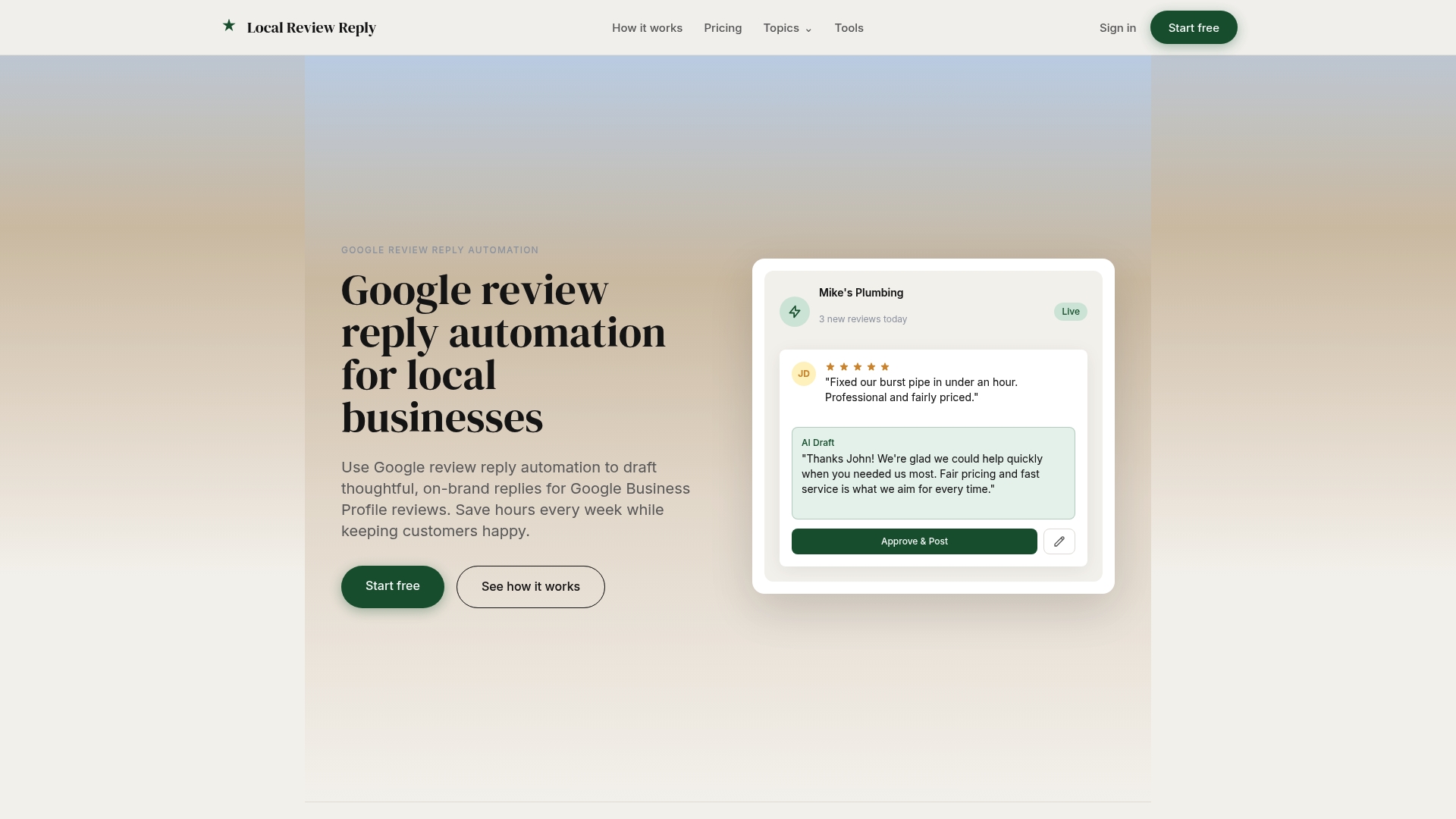
This is the layer Localreviewreply operates on. Instead of a generic auto-reply engine, it drafts personalized, on-brand replies to Google Business Profile reviews and lets you set approval controls specifically for sensitive or low-star reviews, so an automated draft never publishes without a human sign-off when you want that gate in place. For multi-location operators and franchises, that means a negative review flagged as high-urgency at one location can route to the right local manager for approval, while routine positive reviews move through faster with less oversight. You can start by browsing Google review response templates built around common sentiment and rating patterns, or look at the approval workflow features if governance across multiple approvers is your main concern. If you're managing several locations, the multi-location review reply setup is worth a direct look to see how tag-driven routing maps onto team roles.
Sources
- IberaSoft/sentiment-analysis-api
- A review on sentiment analysis and emotion detection from text
- Thematic on Capterra