
For Google Business Profile reviews and social messages, your target time to first response is within a couple of hours during business hours. Live chat aims for under a minute. Email has a goal ranging from one to a few hours, with one hour as ideal. Those three numbers are your Goldilocks SLA: fast enough to satisfy customers, realistic enough for a team managing multiple locations.
- Live chat: under 1 minute
- Social/review platforms (including Google reviews): 60–120 minutes
- Email: 1–4 hours (aim for 1 hour)
If you're managing Google reviews manually across several locations, hitting those targets consistently is where most teams struggle. AI-powered review-reply software like Localreviewreply exists specifically to close that gap.
Table of Contents
- What is first response time, and how do you calculate it?
- What are the right response time benchmarks by channel?
- Why does FRT matter for local businesses and franchises?
- Where does your team lose time? Common causes of slow FRT
- How does AI-powered review-reply software reduce FRT?
- How do you set a Goldilocks SLA and track it across locations?
- A practical 30/60/90-day plan to cut FRT
- How franchises use AI to speed replies: Homesafe Franchise
- Buyer checklist for review-reply software
- Key Takeaways
- What I'd prioritize first as a franchise owner
- Localreviewreply cuts reply time without cutting corners
- Sources and further reading
What is first response time, and how do you calculate it?
First response time (FRT) measures the gap between when a customer submits a message or review and when a human agent sends a substantive reply. The key word is human. Automated acknowledgments don't count — an auto-reply that says "Thanks, we'll be in touch!" stops no clock.
The formula:
Worked example: A Google Business Profile review arrives at 4:45 PM on a Friday. Your team works 9 AM–5 PM, Monday–Friday. The reviewer gets a substantive reply at 9:20 AM Monday. Elapsed calendar time is roughly 64 hours, but measured in business hours, the FRT is 35 minutes. That's the number that belongs in your report.
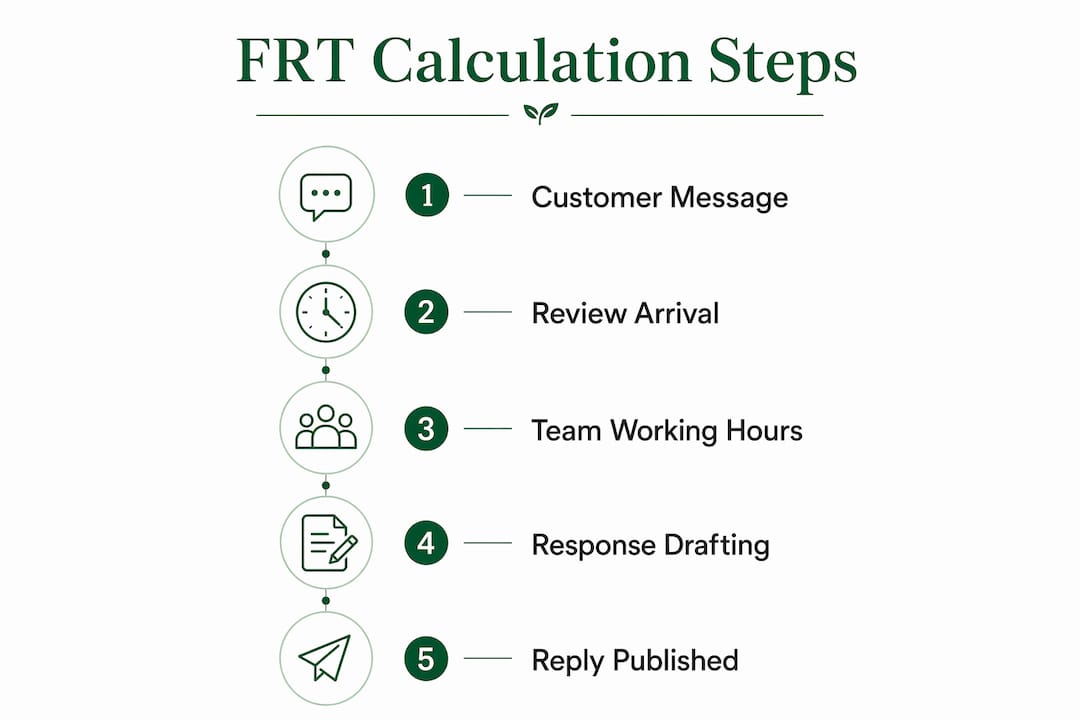
Measuring in business hours matters for any team without 24/7 coverage. Off-hours requests inflate elapsed-time averages and make performance look worse than it is.
What counts as a valid first response?
- Addresses the reviewer's specific comment (not a copy-paste template)
- Maintains your brand voice and tone
- Acknowledges the next step (resolution offered, follow-up invited)
- Sent by a human or approved by a human before publishing
One more reporting note: median FRT is often more useful than mean FRT. A single review that sat unanswered for three days can drag your average up and hide the fact that 90% of replies went out in under an hour.
What are the right response time benchmarks by channel?
Channel expectations vary significantly, and conflating them leads to SLAs that are either too lax for chat or unrealistically tight for email.

| Channel | Good | Better | Best |
|---|---|---|---|
| 1–4 hours (aim for 1 hour) | faster response recommended | prompt replies aimed for | |
| Social/Google reviews | 60–120 minutes | faster response recommended | prompt replies aimed for |
| Live chat | under 1 minute | faster response recommended | near-instant replies aimed for |
For most local businesses, Google reviews fall in the social/review category, where a 60–120 minute window during business hours is both defensible and achievable with the right tooling.
Business hours vs. elapsed time: Unless you staff nights and weekends, measure SLA compliance in business hours. A review posted at 11 PM should not count against your Monday morning team if your hours are clearly posted.
"Operational teams should define a 'Goldilocks Zone' for FRT that preserves quality and avoids agent burnout — and document it in SLAs." — Geckoboard KPI guidance
Three sample SLA phrasings for franchise contexts:
- Aggressive: "All Google reviews receive a human reply within 60 minutes during business hours."
- Balanced (Goldilocks): "All Google reviews receive a substantive reply within 2 hours during business hours; low-star reviews go through a two-step approval before posting."
- Conservative: "All Google reviews receive a reply within 4 business hours; escalated reviews within 24 hours."
Start with balanced. Tighten it once your team consistently hits the target.
Why does FRT matter for local businesses and franchises?
Speed of response is one of the clearest signals a customer uses to judge whether a business cares about them. Many consumers say they would switch to a competitor if a brand doesn't respond on social media or digital platforms. For a franchise with dozens of locations, even one location with a slow reply pattern can damage the brand's overall rating.
The KPIs FRT directly influences:
- Customer retention and repeat business
- Star rating trajectory (responded reviews trend higher over time)
- Franchise-wide consistency scores
- Local search visibility signals tied to review engagement
FRT alone doesn't tell the whole story. Pairing it with First Contact Resolution (FCR) prevents teams from chasing speed at the cost of quality. A fast reply that doesn't actually help the customer is worse than a slightly slower one that resolves the issue.
Key stat: 73% of consumers would switch providers if a brand fails to respond on digital channels.
Where does your team lose time? Common causes of slow FRT
The biggest hidden cost of slow FRT isn't agent speed. It's coordination overhead: the time spent figuring out who owns a review, gathering context, and waiting for approval.
Frequent failure modes:
- Fragmented tools: Reviews arrive in one inbox, context lives in another system, and approvals happen over email or Slack
- Manual triage: Someone has to read, categorize, and assign each review before anyone drafts a reply
- Unclear ownership: No one knows whether the location manager or the marketing team is responsible
- Approval bottlenecks: Low-star reviews sit in a queue waiting for a manager who checks it once a day
- Staffing gaps: Peak review volume (weekends, post-service) hits when fewest people are available
- Training gaps: Staff don't know what a valid first response looks like, so they delay or draft poorly
Pro Tip: Log the time each review spends in each state: received, assigned, drafted, approved, published. The step with the longest average time is your actual bottleneck — not necessarily your team's writing speed.
How does AI-powered review-reply software reduce FRT?
The core problem AI solves is the blank-page delay combined with manual triage. AI reduces coordination overhead by automatically assembling context and generating a draft so your team approves rather than creates from scratch.
Features that materially cut response time:
- Context aggregation: Pulls location history and review patterns so the draft is already relevant
- AI draft generation: Eliminates blank-page delay; your team edits and approves instead of writing
- Intelligent routing: Sends each review to the right person automatically, skipping manual triage
- Approval controls: Two-tier workflow for low-star reviews keeps speed high while protecting the brand
- Role-based permissions: Location managers handle routine replies; HQ reviews escalations
- SLA dashboards: Show avg FRT by location, approval queue depth, and % of SLAs met
- Multi-location templates: Consistent tone across every location without copy-paste errors
For field-service franchises, this kind of AI-driven workflow is especially useful because review volume spikes after job completion, often outside office hours.
Pro Tip: Require a two-tier approval workflow for any review with 1–2 stars. AI drafts the reply; a manager approves before it posts. This keeps FRT fast while giving your legal or PR team a checkpoint on sensitive replies.
The distinction matters: AI drafts the reply, a human approves it. That separation is what makes the speed gain sustainable without brand risk.
How do you set a Goldilocks SLA and track it across locations?
Setting an SLA that's too tight creates burnout and rushed replies. Too loose, and customers notice. The right target sits where your team can hit it 90%+ of the time on a normal staffing day.
Checklist for building your SLA:
- Define business hours consistently across all locations
- Decide what counts as a valid first response (see Section 2)
- Choose business-hour measurement for any location without 24/7 coverage
- Tier SLAs by location capability: Tier 1 (flagship/high-volume) gets the tightest target; Tier 2/3 gets a relaxed but consistent window
- Assign clear ownership: who drafts, who approves, who escalates
Dashboard fields to track:
| Metric | Why it matters |
|---|---|
| Avg FRT by channel | Baseline and trend |
| Median FRT | Outlier-resistant view of typical performance |
| % SLAs met by location | Identifies underperforming sites |
| Approval queue depth | Flags bottlenecks before they blow SLAs |
| Reply volume by location | Staffing and capacity planning |
Reporting note: Use median FRT alongside mean FRT. One unresolved review from a holiday weekend can skew your weekly average and mask solid day-to-day performance.
A practical 30/60/90-day plan to cut FRT
Days 1–30: Baseline and quick wins
- Pull your current average and median FRT by channel and location
- Identify the top two failure modes (use the time-in-state log from Section 5)
- Set up automated acknowledgments so customers know a reply is coming
- Define what counts as a valid first response and train all location staff
- Assign clear ownership per location
Days 31–60: Deploy AI drafts and approval workflows
- Connect your Google Business Profile locations to an AI review-reply platform
- Enable AI draft generation for standard review types (4–5 star, common complaints)
- Implement two-tier approval for 1–2 star reviews
- Set your Goldilocks SLA targets and start tracking in a dashboard
- Run a weekly SLA review meeting at franchise HQ
Days 61–90: Refine, coach, and measure FCR alongside FRT
- Tune AI templates per location based on review patterns
- Institute monthly coaching cycles: review flagged replies with location managers
- Add FCR tracking alongside FRT to catch quality regressions
- Adjust SLA tiers based on 60 days of real data
- Expand AI draft coverage to edge-case review types
| Phase | Owner | Success metric | Priority |
|---|---|---|---|
| 30-day baseline | Ops manager | FRT measured and logged | High |
| 60-day AI deploy | Marketing/IT | SLA dashboard live | High |
| 90-day refinement | Franchise HQ | FCR tracked alongside FRT | Medium |
Pro Tip: Don't wait for perfect data to set your first SLA. Pick a target based on the benchmarks in Section 3, run it for 30 days, then adjust. A rough SLA you actually measure beats a perfect one you never set.
How franchises use AI to speed replies: Homesafe Franchise
Localreviewreply's Homesafe Franchise case study documents how a multi-location franchise adopted AI-powered review reply workflows across its locations.
What changed operationally:
- Drafting time dropped because AI generated a contextually relevant reply before any human touched the review
- Tone stayed consistent across locations because templates were set at the franchise level
- Sensitive low-star reviews went through an approval step before posting, reducing brand risk
For field-service operators specifically, Google review management for franchises addresses the spike in review volume that follows job completion.
Buyer checklist for review-reply software
Before committing to any platform, verify it covers these capabilities:
- Omnichannel ingestion: Pulls reviews from Google Business Profile into one dashboard
- Location-aware context: Drafts reference the specific location's history, not a generic template
- AI draft quality: Replies sound on-brand, not robotic
- Approval controls for low-star reviews: Two-tier workflow, not just auto-publish
- SLA reporting: Shows avg and median FRT, % SLAs met, volume by location
- Multi-location roles: Location managers and HQ have different permissions
- Data export: You can pull FRT data into your own reporting tools
Speed vs. control trade-off: High-trust teams with trained staff can use lighter approval workflows for 4–5 star reviews. Any review with a complaint or a rating below 3 stars warrants a human checkpoint regardless of how good the AI draft is.
Localreviewreply covers all of the above. The features page details the approval workflow, multi-location permissions, and AI drafting capabilities. Agencies managing multiple clients can also explore white-label review reply options for branded client dashboards.
Pro Tip: Before your trial, map out who owns each step: who drafts, who approves, who escalates. Software can't fix an ownership gap — it just makes the gap more visible.
Key Takeaways
Hitting your FRT targets consistently requires the right SLA, a clear measurement method, and tooling that removes coordination overhead before it compounds.
| Point | Details |
|---|---|
| Channel SLA targets | Live chat under 1 minute; Google reviews 60–120 minutes; email 1–4 hours (aim for 1 hour). |
| Measure in business hours | Exclude off-hours to avoid distorted averages; use median alongside mean. |
| Biggest time drain | Coordination overhead (triage, tool-switching, unclear ownership) delays replies more than writing speed. |
| 30/60/90 priority | Baseline first, then AI drafts and approval workflows, then FCR tracking and coaching. |
| Localreviewreply | Drafts contextual Google review replies with approval controls and multi-location SLA dashboards. |
What I'd prioritize first as a franchise owner
Most franchise operators I see jump straight to tooling. That's the wrong order. The first thing to do is measure: pull your current FRT by location for the last 30 days and find the two or three locations where it's worst. Nine times out of ten, the problem isn't that staff are slow writers. It's that no one knows who's supposed to reply, or the review sat in a shared inbox no one checks on weekends.
Fix ownership before you fix software. Assign one named person per location as the reply owner, set a clear SLA, and start a weekly five-minute review at HQ. Once that's running, then layer in AI drafts. The speed gain from AI is real, but it compounds on a foundation of clear process. Without that foundation, you're just generating drafts that sit in a queue waiting for an approval that never comes.
One more thing: track FCR from day one alongside FRT. A fast reply that doesn't resolve anything is a missed opportunity. The goal is a reply that's fast and useful.
Localreviewreply cuts reply time without cutting corners
Every hour a Google review sits unanswered is an hour a potential customer is reading silence. Localreviewreply gives local businesses and franchise operators a faster path: AI drafts a personalized, on-brand reply in seconds, your team approves it, and it posts. No blank page, no manual triage, no missed reviews buried in a shared inbox.
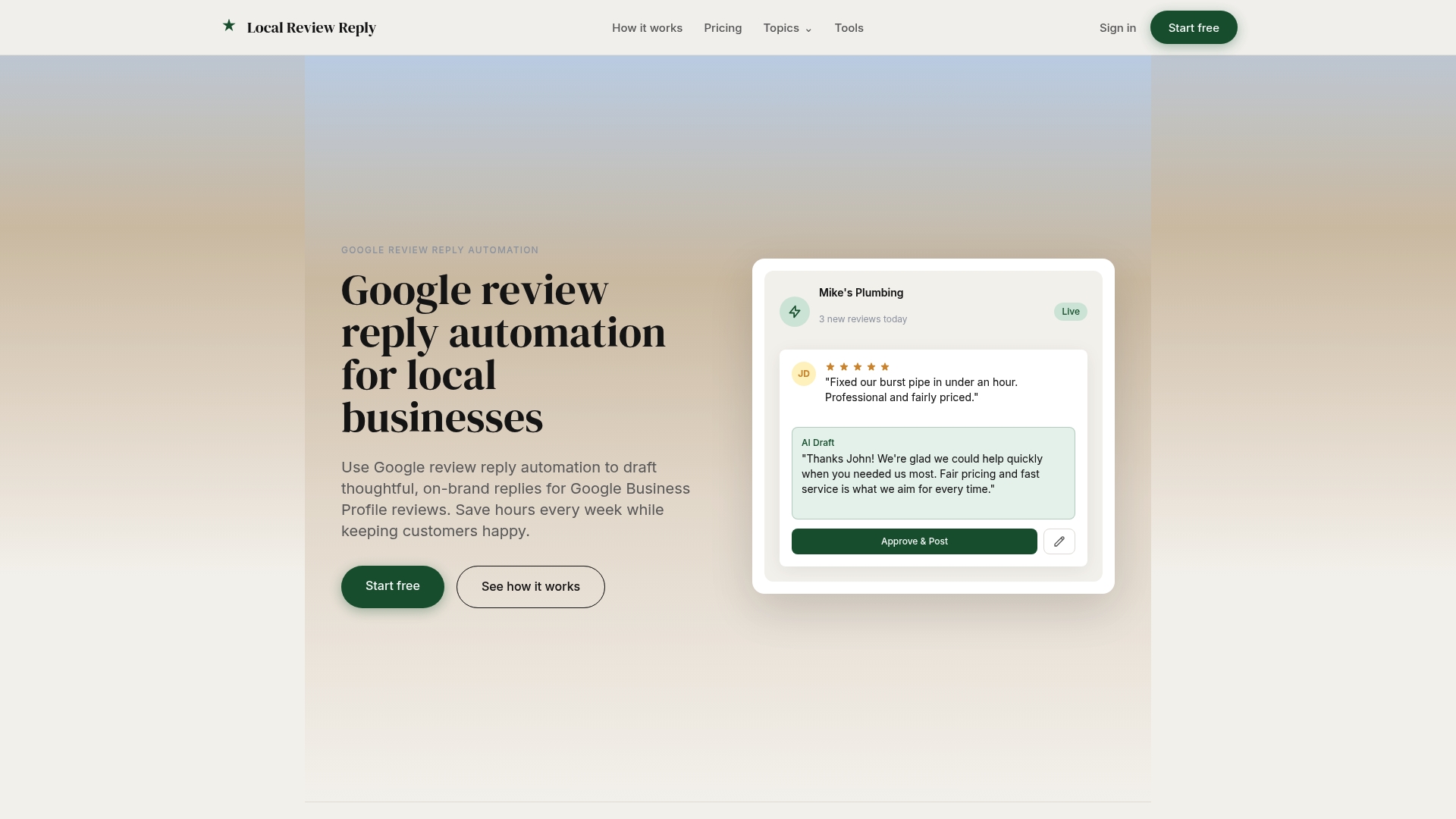
The approval workflow means your brand voice stays intact even when volume spikes. Location managers handle routine replies; HQ reviews anything sensitive. You get speed and control, across every location, from one dashboard.
Start a free trial at Localreviewreply and connect your Google Business Profile locations in minutes. The AI draft generator is available immediately after signup.
Sources and further reading
Authoritative references used in this article:
- Customer service response time benchmarks — Channel-specific FRT targets (live chat, social, email) used throughout the benchmarks section
- First Response Time KPI examples — Business-hour measurement guidance, Goldilocks SLA concept, and tiered SLA advice
- What is First Response Time? (Front) — Coordination overhead as the primary FRT cost; median vs. mean reporting
- What is First Response Time? (Genesys) — AI as context aggregator and draft generator to reduce triage time
- Customer service KPIs (Zendesk) — FCR alongside FRT; speed vs. quality trade-off
- How to calculate First Response Time (Shopify) — Automated acknowledgments excluded from FRT; substantive human reply definition
- Social media statistics (Sprout Social) — 73% consumer switching stat for brands that don't respond on digital channels
- Features — Localreviewreply — AI drafting, approval controls, and multi-location workflow capabilities
- Homesafe Franchise case study — Franchise workflow adoption with Localreviewreply (EEAT proof asset)
For field-service franchise operators, the AI for Field Service: A 2026 Manager's Guide from TradePilot covers AI adoption patterns and workflow integration across multi-location operations.