
Yes, you can offer a coupon in a review reply, but the offer must go to any reviewer who leaves an honest review, not just the ones who say nice things, and you have to disclose it clearly. The safest default: thank the reviewer publicly, then move the coupon into a private message or email. If you'd rather post the discount publicly, make sure that exact offer is available to every reviewer, positive or negative, and say so in plain language.
Here's what that looks like in practice.
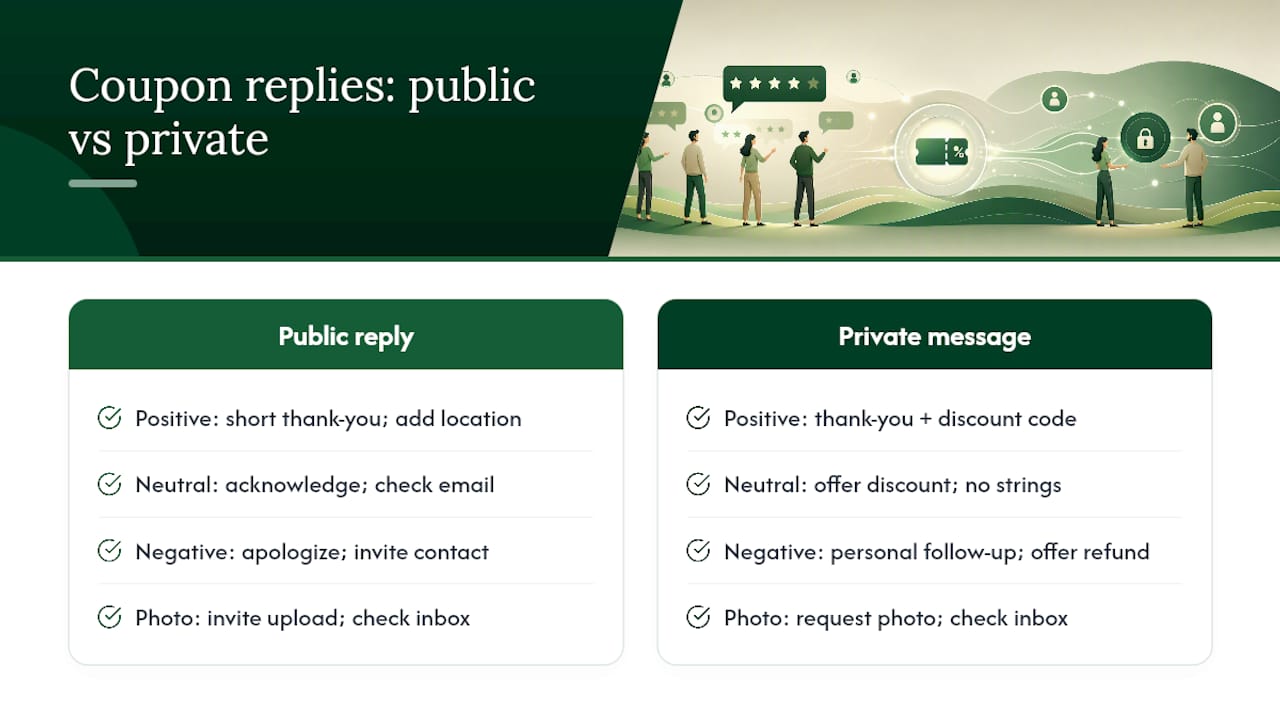
Public reply: "Thanks for the detailed feedback, Maria! We'd love to have you back. Check your email; we sent you something."
Private message: "Hi Maria, thanks again for your review. As a thank-you for sharing honest feedback, here's a discount code for your next visit. No purchase required to have left the review; this is our way of saying thanks."
Three rules govern everything that follows:
- The offer must be available to any customer who leaves an honest review, not just five-star reviewers.
- You must disclose the incentive clearly, in the reply or the private message, not buried in fine print.
- You cannot condition the reward on a positive rating or ask someone to change a review in exchange for a discount.
Key Takeaways
A compliant coupon-in-reply program offers the same incentive to any honest reviewer, discloses it clearly, and never conditions the reward on a positive rating.
| Point | Details |
|---|---|
| Default to private delivery | Reply publicly with a warm thank-you, then send the actual coupon code through email or DM. |
| Disclose every incentive | State clearly that the offer is available to any honest reviewer, not just positive ones. |
| Use unique, trackable codes | Tie each code to a reviewer ID for accurate redemption tracking and fraud detection. |
| Route negatives to private support | Never delete or discourage negative reviews as a condition of any offer. |
| Automate drafts, keep human approval | Local Review Reply drafts replies instantly but routes low-star or coupon-related replies to a human before publishing. |
Primary Sources and Further Reading
- FTC Consumer Reviews and Testimonials Rule: the governing standard for legal compliance on review incentives.
- Google promo code developer guidance: explains how checkout systems handle code errors and validation.
- Shopify DiscountCode documentation: technical reference for generating codes at scale.
- Yotpo's coupon workflow guide: practical vendor approach to verify-then-reward sequencing.
Table of Contents
- Why Offer Coupons in Review Replies?
- What Do the FTC and Ethics Rules Require?
- Public Reply or Private Offer: Which Should You Use?
- How Do You Create and Distribute Coupon Codes Safely?
- What Are Good Reply Templates for Offering a Coupon?
- How Do You Measure and Approve a Coupon Program?
- What Actually Works When You Run This at Scale?
- How Local Review Reply Fits Into a Compliant Coupon Workflow
- Frequently Asked Questions
- Sources
Why Offer Coupons in Review Replies?
Businesses use coupons in review replies for three different jobs, and confusing them is where most programs go wrong. The first job is retention: turning a one-time customer into a repeat one. The second is recovery: giving a frustrated customer a reason to come back instead of walking. The third is momentum: encouraging more people to leave reviews, including detailed ones with photos.

Each goal points to a different move. A happy customer who mentions a specific technician or product gets a warm public reply and, often, a private coupon as a loyalty nudge. A neutral three-star review calling out a slow wait time is a chance to acknowledge the issue publicly and offer a private discount tied to fixing that specific complaint next time. A negative review is trickier: you still respond publicly with empathy and a path to resolution, but the coupon conversation usually needs to happen through private support, not in the public thread where it can look like you're paying for a rating change.
The upside is real. A fast, specific reply that references what the customer actually said, paired with a low-pressure invitation to return, converts goodwill into a second visit far more often than a generic "thanks for your review!" response, according to guidance built around restaurant review response patterns. The downside is just as real: reviewers know when an incentive smells like payment for praise, and so do regulators. Research on incentivized feedback also flags a subtler risk, incentives tend to raise response rates but can shift the tone and length of reviews in ways that make it harder to tell what's an honest opinion, according to research on incentives and response behavior.
Pro Tip: Save the private coupon for after you've read the full review, not the moment it posts. A ten-minute delay lets you tailor the offer to what the person actually said instead of sending a form-letter discount that feels canned.
What Do the FTC and Ethics Rules Require?
The Federal Trade Commission's position is more permissive than most business owners assume, but it comes with hard limits. You are allowed to reward customers for leaving reviews. You are not allowed to reward them for leaving good reviews, and you cannot hide the fact that an incentive exists. The FTC's Consumer Reviews and Testimonials Rule draws that line explicitly: incentivizing honest feedback is fine, incentivizing positive feedback is not, and every incentive needs clear disclosure.
Incentivizing honest feedback is permitted; incentivizing positive feedback is not. Disclose all incentives clearly to maintain transparency with your audience.
That distinction rules out review-gating, the practice of only asking happy customers to post publicly while routing unhappy ones to a private feedback form. It also rules out language like "leave us five stars for 20% off," which conditions the reward on sentiment rather than honesty.
Here's a compliance checklist to run your program against before you launch it:
- Confirm the coupon offer applies to anyone who leaves an honest review, regardless of star rating.
- Write disclosure language into every reply or message where a coupon appears, not just some of them.
- Never delete, hide, or discourage negative reviews as a condition of the incentive.
- Verify the reviewer is a real buyer where your platform allows it, to reduce fraud and strengthen your compliance record.
- Keep the reward modest. A steep discount tied to reviews starts to look like payment for opinion rather than a thank-you gesture.
- Document your policy internally so every team member replying to reviews applies the same rules.
A few pitfalls sit next to this checklist and trip up otherwise careful teams:
- Offering a bigger discount to reviewers who mention specific keywords or leave five stars.
- Asking a customer to edit or remove a negative review in exchange for a coupon.
- Sending the same public coupon code to some reviewers and not others based on rating.
Practical guidance built around these rules lands on a simple version: offer the reward to any honest review, disclose it, route unhappy customers to private support instead of suppressing their reviews, keep the reward modest, and verify purchases where you can, according to best-practice guidance on discount programs.
Public Reply or Private Offer: Which Should You Use?
This decision shapes everything downstream, from how you word the reply to how you track redemptions. Each approach carries a different mix of transparency, risk, and conversion potential.
| Factor | Public reply with coupon | Private offer after public reply |
|---|---|---|
| Disclosure visibility | High. Anyone reading the review sees the offer and terms. | Lower. Only the reviewer sees the code, but the public reply can still state that an offer was sent. |
| Reputation risk | Higher. Other reviewers may notice inconsistent offers or feel excluded. | Lower. No public comparison between what different reviewers received. |
| Compliance simplicity | Requires the exact offer to be available to all reviewers uniformly. | Easier to tailor per situation while still meeting disclosure rules. |
| Fraud/abuse exposure | Higher. Public codes get shared or scraped by non-customers. | Lower. Unique codes tied to one reviewer are harder to abuse. |
| Best for | Simple loyalty programs with one flat offer for every reviewer. | Businesses recovering a specific complaint or personalizing offers by segment. |
Most local service businesses land on a hybrid default: post a public reply that's warm, specific, and free of coupon codes, then move the actual discount into a private channel. The public thread stays clean and compliant, and the private message carries the trackable, unique code.
The micro-workflow looks like this:
- Reply publicly within 24 to 48 hours, referencing something specific from the review.
- Invite the reviewer to check their email or direct message for a thank-you note.
- Generate a unique code tied to that reviewer's contact information.
- Send the code with disclosure language and an expiry date.
- Log the code, reviewer, and review ID together for tracking.
How Do You Create and Distribute Coupon Codes Safely?
Three code types cover almost every use case, and picking the wrong one is a common source of both fraud and wasted discount spend.
Single-use unique codes are the gold standard for review-response programs. Each reviewer gets a code that works once, tied directly to their identity and the review that triggered it. This is the format Shopify's discount system is built around: codes attach to a PriceRule object, and merchants can batch-generate up to 100 single-use codes per request, with each code capped at 255 characters and treated as case-insensitive, according to Shopify's DiscountCode documentation.
One-time generic codes work for smaller operations without the infrastructure to generate unique codes at scale. The trade-off is real: a shared code posted in a public reply can spread past the people it was meant for. If you go this route, cap usage per customer and set a short expiry window to limit exposure.
Loyalty points suit businesses that already run a rewards program. Instead of a standalone coupon, the review triggers points that redeem later, which sidesteps some of the code-sharing risk entirely.
A few operational notes matter regardless of which type you pick:
- Set an expiry date on every code, typically 30 to 90 days, so unredeemed offers don't sit open indefinitely.
- Cap usage to one redemption per customer unless you intend it as an ongoing loyalty perk.
- Store an audit record linking the code, the reviewer, and the review ID, so you can trace any dispute later.
- If your checkout platform accepts promo codes through an API, expect it to echo back the code a customer entered and return a specific error, such as an expired or invalid code, rather than a generic failure. Google's checkout guidance outlines this pattern, and building your reply workflow around it avoids confusing customers with vague error messages.
Pro Tip: Tag every coupon with a UTM parameter or unique code prefix tied to "review reply" so redemption reports separate this channel from email or social promotions. Without that tag, you'll never know if the program actually pays for itself.
Vendor implementations commonly let you choose between sending the coupon the moment a review is submitted or waiting until after it's published; many teams prefer the second option so they can confirm authenticity first, based on Shopify coupon workflow guidance from Yotpo.
What Are Good Reply Templates for Offering a Coupon?
Copy these, adjust the tone to match your brand, and keep the disclosure line intact no matter how much you shorten the rest.
Positive review, public reply: "Thank you, [Name]! We're glad the [specific detail they mentioned] worked out well. Keep an eye on your inbox; we've got something for you."
Positive review, private message: "Hi [Name], thanks again for the kind words about [specific detail]. As a thank-you for sharing honest feedback, here's a discount code for your next order. This offer is available to anyone who leaves an honest review, not just five-star ones, and it expires after a limited time."
Neutral review, public reply: "Thanks for the honest feedback, [Name]. We hear you on [specific complaint] and we're working on it. We'd like to make it right; check your email."
Neutral review, private message: "Hi [Name], we appreciate you flagging [issue]. We'd like to offer you [discount] toward your next visit as a thank-you for the honest review, no strings attached. Code: [CODE], valid through [date]."
Negative review, public reply: "We're sorry [issue] happened, [Name]. That's not the experience we want anyone to have. Please reach out at [contact] so we can make this right."
Negative review, private recovery message: "Hi [Name], I'm the [role] here and I wanted to personally follow up on your review. I'd like to offer [discount or refund] to help fix what went wrong. This isn't conditional on changing your review; we just want to make it right."
Neutral review with a photo request, public reply: "Thanks for sharing your experience, [Name]! If you have a photo from your visit, we'd love to see it; drop us a line and check your inbox."
Positive review, franchise or multi-location reply: "Thanks for choosing our [location name] team, [Name]! Glad you enjoyed [specific detail]. Look out for an email from us."
Positive review, service-recovery follow-up (repeat customer): "So good to hear from you again, [Name]! Thanks for the continued trust. We've sent something to show our appreciation."
Generic disclosure snippet for any private message: "As a thank-you for any honest review, we offer this discount to all customers who share their feedback, positive or negative."
A few formatting notes make these hold up under scrutiny. Put the disclosure sentence in the same message as the code, never in a separate follow-up that a customer might not read. Keep expiry dates in the private message rather than the public reply, since public replies should stay short and warm, not read like a terms-and-conditions page. And never vary the offer amount based on star rating; if a five-star reviewer gets 20% off and a three-star reviewer gets 10%, that gap alone signals sentiment-conditioning even if you never say so outright.
For businesses building out reply libraries by industry, template collections for home services, cleaning services, and auto repair shops offer a starting structure you can adapt with the disclosure language above.
How Do You Measure and Approve a Coupon Program?
Five metrics tell you whether a coupon-in-reply program is working or quietly costing you money. Repeat-purchase rate among redeemers tells you if the coupon is doing its real job, bringing people back, rather than just being a one-time discount they'd have used anyway. Review cadence, meaning reviews collected per number of requests sent, shows if the incentive is actually growing your review volume. Average order value on redemptions flags whether discount-seekers are spending less than typical customers. And a rising count of duplicate or suspicious redemption attempts is your fraud signal.
Build the approval workflow around three checkpoints:
- Draft stage: an automated or human-written reply gets created for every incoming review.
- Review stage: any reply tied to a low-star review or a coupon offer routes to a human for approval before it sends. This is the point where sentiment-conditioning mistakes get caught before they go public.
- Audit stage: every issued code gets logged with the reviewer's identity, the review ID, and the redemption status, so a dispute or an FTC inquiry has a paper trail.
Pro Tip: Assign each coupon a code that encodes the review ID, not just a sequential number. If someone disputes a redemption or asks why they got a different offer than a friend, you can trace the decision in seconds instead of digging through spreadsheets.
Businesses managing this across multiple locations tend to hit scaling problems fastest, since inconsistent approval standards between managers create exactly the kind of sentiment-conditioning risk the FTC flags. A shared workflow with defined approval rules keeps the process consistent across locations.
What Actually Works When You Run This at Scale?
Running review responses across dozens of locations teaches you fast that the biggest risk isn't the coupon itself, it's inconsistency. One manager offers 10%, another offers 20%, a third forgets the disclosure line entirely, and now you've got a compliance patchwork instead of a policy.
What worked operationally: route every negative or three-star-and-under review straight to private support before any coupon conversation happens, and keep the reward the same regardless of rating. Verified buyers only, and the discount stays modest, enough to feel like a genuine thank-you, not so large it looks like a bribe. On staffing, a same-day reply SLA for public responses, with private coupon delivery following within 24 hours, kept the whole thing feeling personal instead of automated. Reviewers notice the difference between a fast, specific reply and an obvious form response, and that gap shows up in whether they come back.
How Local Review Reply Fits Into a Compliant Coupon Workflow
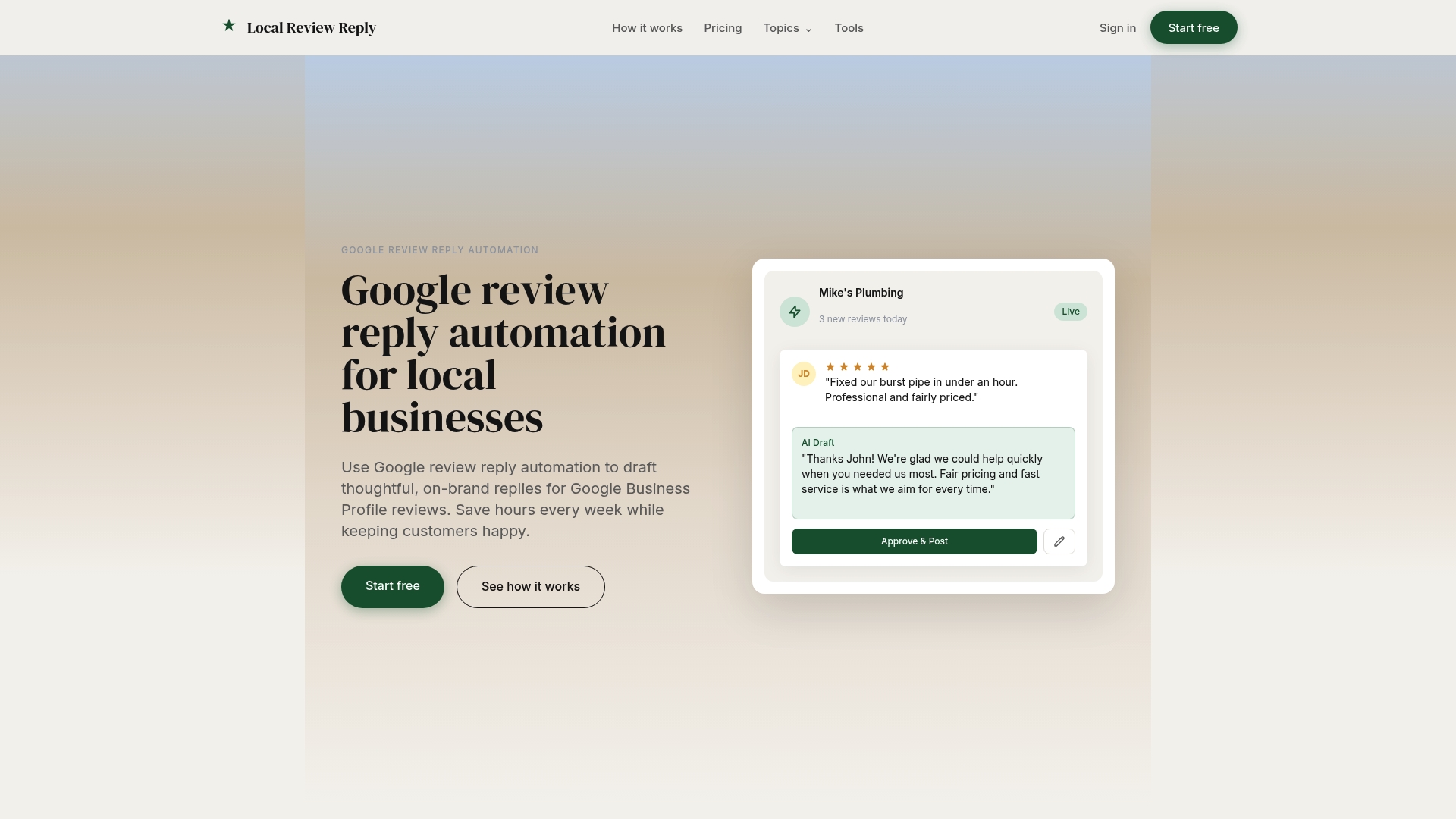
Local Review Reply is built for exactly the workflow this article describes: fast, on-brand drafts paired with human control over anything sensitive, so you're not choosing between speed and compliance. The platform drafts a personalized reply to every review in seconds, but it doesn't publish low-star or high-risk replies without a human checking them first, which is precisely where sentiment-conditioning mistakes tend to creep in.
Here's how it maps onto the process covered above:
- Drafts a public reply automatically for every incoming review, keeping the tone consistent across locations.
- Flags low-star or complaint-heavy reviews for human approval before anything goes live.
- Supports team roles so a manager or agency reviewer signs off on replies before they post, which matters most when a coupon or private-message follow-up is involved.
- Gives multi-location and franchise operators one consistent policy instead of dozens of managers improvising their own offers.
If you're managing reviews across more than a couple of locations, or you're an agency handling this for clients, inconsistent replies are usually the first crack in a compliance program. Check out Local Review Reply's Google review management software and start a free trial to see how the approval workflow handles your next batch of reviews.
Frequently Asked Questions
Is it legal to offer a coupon for a review? Yes. The FTC allows incentives for honest reviews as long as the reward isn't tied to a positive rating and the incentive is disclosed clearly to the reviewer.
Should the coupon code go in the public reply or a private message? Most businesses default to a public thank-you reply with the actual code delivered privately, which keeps the public thread clean and limits code-sharing risk.
How big should the discount be? Keep it modest. A steep discount tied to reviews starts to resemble payment for opinion rather than a simple thank-you gesture.
What happens if I only offer coupons to positive reviewers? That's sentiment-conditioning, and it violates FTC guidance. The same offer needs to be available to anyone who leaves an honest review, regardless of rating.
How do I track whether the program is working? Watch redemption rate, repeat-purchase rate among redeemers, and review cadence. A UTM tag or unique code prefix tied to "review reply" separates this channel from other promotions in your reporting.
Sources
- The Consumer Reviews and Testimonials Rule: Questions and Answers | Federal Trade Commission
- Promotions and promo codes — Google Developers
- DiscountCode — Shopify developer docs
- Rewarding Reviews With Shopify Coupons: The Ultimate Guide | Yotpo
- Offering Discounts for Reviews: Is It Allowed? (2026 Rules) · Reviewz