
Use a franchise-aware, multi-location review-management platform that centralizes monitoring, automates review requests, and enforces HQ-approved reply workflows to cut response time and protect brand reputation across every location. The right setup connects directly to Google Business Profile, routes sensitive low-star reviews through an approval gate before anything goes live, and targets a time-to-first-response under 24 hours. Localreviewreply is built for exactly this workflow. Your immediate next step: run a 30-location pilot or a 30-day audit of your current review coverage to establish a baseline before you commit to a full rollout.
Key Takeaways
Effective franchise review management requires centralized governance, HQ-controlled templates, and approval workflows that keep every location on-brand without slowing response time below the 24-hour target.
| Point | Details |
|---|---|
| Centralize monitoring first | Connect all Google Business Profile listings to one dashboard before building any response workflow. |
| HQ templates are non-negotiable | Lock brand-approved templates at the HQ level; allow local personalization only within defined fields. |
| Approval workflows protect and speed up | Route one-star and two-star reviews through a regional manager gate; target under 24 hours to first public reply. |
| Track response rate and SLA weekly | Locations below 80% response rate or above 24-hour SLA need immediate regional manager outreach. |
| Localreviewreply for franchise rollouts | Localreviewreply provides AI drafting, approval workflows, and multi-location dashboards built for franchise Google review management. |
Table of Contents
- What does franchise review management actually include?
- Why franchise reputation management is a business problem, not just a PR task
- What features should franchises require from review-management software?
- How to roll out franchise review management in 90 days
- How should franchises handle response timing, tone, and escalation?
- What KPIs and reports should your franchise track?
- How does an approval workflow actually work? A Local Review Reply example
- Quick rollout checklist and 30/60/90-day milestones
- What the conventional wisdom on franchise reviews gets wrong
- Localreviewreply gives franchises the reply infrastructure they need
- Sources
What does franchise review management actually include?
Franchise review management covers six functional areas. Miss one and the whole program has a gap.
- Monitoring and aggregation. A single feed pulls reviews from every location into one dashboard. Google Reviews and Google Business Profile are the non-negotiable starting point; depending on your vertical, you may also need Yelp, Healthgrades, or industry-specific directories. The goal is zero blind spots.
- Review generation. Automated SMS, email, or QR-code workflows prompt customers to leave a review right after a transaction. Without a systematic ask, review volume stays low and unrepresentative.
- Response drafting and publishing. AI drafts a personalized, on-brand reply for each review. A human approves or edits before it goes live, particularly for anything below four stars.
- Approval workflows and governance. HQ sets the rules: which reviews go straight to publish, which require a regional manager's sign-off, and which escalate to legal or brand. Role-based permissions keep local teams inside the guardrails.
- Reporting and analytics. Per-location metrics and consolidated roll-up views let HQ spot underperformers, track trends, and report to leadership.
- Integrations. Connections to your CRM, POS, or ticketing system let review data flow into the tools your ops and marketing teams already use.
Franchise resources consistently recommend centralizing these processes with templates, tone guidance, and escalation paths so every location follows the same response model. The governance layer is what separates a real program from a loose collection of local logins.
Why franchise reputation management is a business problem, not just a PR task
A single franchisee posting a defensive reply to a one-star review can surface on a brand search for weeks. Multiply that across 50 or 200 locations and the reputational variance becomes a real business risk.
Active reputation management is directly linked to franchise growth and local conversion. Google's local ranking algorithm weighs review recency, volume, and response rate, so locations that reply consistently tend to rank higher in local pack results. That translates to more foot traffic and more inbound calls, not just a better star rating.
The risks of doing nothing are specific. Unmanaged negative reviews sit unanswered, signaling to prospective customers that nobody is home. Inconsistent tone across locations dilutes brand equity, especially when one franchisee sounds warm and another sounds like a legal disclaimer. Slow response times let a resolvable complaint become a public thread. And franchisee-level variation in how reviews are handled creates compliance exposure when a reply inadvertently admits liability or violates a brand standard.
The measurable KPIs that a well-run program moves: average star rating per location, response rate, time-to-first-response, and local search ranking position. Foot traffic and lead volume follow from those, though the connection takes months of consistent execution to show clearly.

What features should franchises require from review-management software?
The buying decision comes down to whether the platform was designed for multi-location governance or retrofitted for it. Here is what to require.
HQ-level requirements
- Multi-location dashboard with location-level drill-down and consolidated roll-up views
- HQ-controlled reply templates with tone and brand guardrails that local users cannot override
- Approval workflow engine: configurable rules by star rating, keyword, or location
- Role-based permissions (HQ admin, regional manager, local manager, read-only)
- Roll-up reporting exportable to PDF or CSV for executive review
- Google Business Profile integration as a baseline; additional sources depending on vertical
Local-level requirements
- Reply publishing directly to Google from within the platform
- Local review-request campaign tools (SMS, email, QR code)
- Notification alerts for new reviews, especially low-star
- Ability to personalize within HQ-approved template guardrails
Comparison dimensions for vendor evaluation
| Dimension | What to look for | Red flag |
|---|---|---|
| Automation for review requests | SMS, email, and QR triggers post-transaction | Manual-only workflows that require local staff to remember |
| Multi-location management | Location dashboards plus consolidated roll-up | Single-location UI with no roll-up view |
| Reply approval workflows and role controls | Configurable by star rating, keyword, or location | No approval gate; all replies publish instantly |
| Response templates and brand consistency | HQ-locked templates with local personalization fields | Free-text only; no template enforcement |
| Reporting and KPIs | Per-location and aggregate; exportable | Dashboard-only with no export or scheduling |
| Integrations | Google Business Profile, CRM, POS, ticketing | No native Google integration; API-only with no documentation |
| Response SLAs and time-to-first-response | Configurable SLA alerts; tracks time-to-first-response | No SLA tracking or alerting |
Procurement questions to ask during demos: How does the approval workflow handle a review that matches multiple rules? Can templates be locked at the HQ level while still allowing local personalization? How are integrations implemented, and is there a professional services fee? How does per-location pricing scale past 50 or 100 locations?
Red flags to walk away from: per-location pricing that doubles your cost at scale with no volume discount; no role or approval controls; no native Google Business Profile support.
How to roll out franchise review management in 90 days
This plan assumes a 10–30 location pilot before full rollout. Adjust timelines as appropriate for different sizes of networks.
Days 0–30: Pilot setup
- Assign a program owner at HQ. This person owns the platform configuration, template library, and escalation rules. Without a named owner, rollouts stall.
- Inventory all Google Business Profile listings. Audit every location for claimed status, correct NAP (name, address, phone), and current review volume. Fix unclaimed listings before connecting them to any platform.
- Connect pilot locations to the platform. Start with a pilot of a moderate number of locations that represent your geographic and performance range, not just your best performers.
- Build the HQ template library. Write templates for reviews across different star ratings to cover common response needs. Include a template for reviews that mention a specific staff member by name and one for reviews that raise a safety or legal concern.
- Configure approval workflows. Set rules: one-star and two-star reviews require regional manager approval before publishing; reviews containing legal keywords (injury, lawsuit, refund demand) escalate to HQ brand or legal.
- Assign roles and permissions. HQ admin, regional managers, and local managers each get the access level they need, nothing more.
- Launch review-request campaigns at pilot locations. Connect to your POS or CRM to trigger post-transaction requests automatically.
- Establish baseline KPIs. Record current average rating, response rate, and time-to-first-response for each pilot location before the program touches them.
Days 31–60: Pilot operation and refinement
- Run the pilot for 30 days without changes. Resist the urge to adjust templates mid-cycle; you need clean baseline data.
- Hold a weekly review with regional managers. Surface approval bottlenecks, template gaps, and any locations struggling with the workflow.
- Refine templates based on real reviews. If a template produces replies that feel generic for your brand, rewrite it. Aim for replies that sound like a person, not a policy.
- Document escalation outcomes. Track how many reviews escalated, how long approval took, and whether the published reply resolved the issue.
- Train local managers. A 30-minute live session plus a one-page reference card covering: how to receive a notification, how to personalize a template reply, and when to escalate.
Days 61–90: Full rollout preparation and launch
- Evaluate pilot against graduation criteria. Minimum thresholds before expanding: response rate above 80% at pilot locations, average time-to-first-response under 24 hours, zero unapproved replies published.
- Batch-onboard remaining locations in groups of 20–30. Stagger to avoid overwhelming your program owner and regional managers.
- Schedule monthly executive reporting. A consolidated roll-up showing average rating by region, response rate, escalation volume, and trend direction.
- Communicate the program to franchisees. A brief email from HQ explaining the program, what local managers need to do, and who to contact with questions. Acknowledge that some franchisees will push back; address opt-out concerns directly and explain the brand-protection rationale.
- Set a 90-day review date. Confirm KPI targets, identify locations that need additional support, and decide whether to expand the template library or adjust approval rules.
Practitioner guidance consistently calls for simple, repeatable processes: embrace every review, respond quickly, escalate sensitive issues, and use automation for draft replies while keeping human oversight in place.
How should franchises handle response timing, tone, and escalation?
The answer-first version: reply to every Google review within 24 hours of receipt. For sensitive reviews (one-star, legal language, safety concerns), the public reply should still go up within 24 hours, but it must clear an approval gate first. Internal escalation to a regional manager should happen within two hours of the review appearing.

Response framework by star rating
Five-star and four-star reviews: Use an HQ template. AI drafts a personalized version using the reviewer's name and any specific detail they mentioned. Local manager reviews and publishes. No approval gate needed.
Three-star reviews: These are the most underrated category. The reviewer is not angry enough to escalate but not satisfied enough to return. Acknowledge the specific issue, offer a direct contact (email or phone), and keep the tone warm. Regional manager notification is good practice; approval gate is optional.
Two-star and one-star reviews: Mandatory approval gate. The framework: acknowledge the experience without admitting liability, apologize for the inconvenience (not for the alleged fault), offer a specific offline remediation path (a named contact, not a generic email address), and keep the public reply under 100 words. The goal is to move the conversation offline, not win an argument in public.
Legal or safety language: Escalate immediately to HQ brand or legal. Publish a holding reply ("We take this seriously and will be in touch directly") within 24 hours while the full response is reviewed.
Pro Tip: Avoid the instinct to over-explain or justify in a public reply. A short, warm reply that offers a direct contact outperforms a long defensive one every time. AI drafting is appropriate for four-star and five-star reviews and for generating a first draft of lower-star replies; mandatory human approval is the right call for anything below three stars.
Time-to-first-response best practices from Localreviewreply's own guidance reinforce the 24-hour target as the standard for local businesses and franchises.
What KPIs and reports should your franchise track?
Core KPIs
- Review volume per location (monthly new reviews, trailing 90 days)
- Average star rating per location and network-wide average
- Response rate (percentage of reviews that received a reply)
- Time-to-first-response (median hours from review posted to reply published)
- Escalation volume (number of reviews that triggered an approval gate)
- Escalation resolution time (hours from escalation trigger to published reply)
- Sentiment trend (direction of average rating over 30/60/90 days)
- Review-request conversion rate (requests sent vs. reviews received, where trackable)
Reporting cadence
| Report | Frequency | Audience | Trigger for action |
|---|---|---|---|
| Negative review alert | Real-time | Local manager, regional manager | Any one-star or two-star review |
| Response rate and SLA summary | Weekly | Regional managers | Response rate below 80% or SLA breach |
| Location performance roll-up | Monthly | HQ marketing, operations | Locations below 4.0 average rating |
| Executive reputation summary | Monthly | Franchise leadership | Network-wide trend, escalation volume |
| Quarterly deep-dive | Quarterly | HQ program owner | Template performance, workflow gaps |
Using KPIs to trigger action: any location that falls below a 4.0 average rating for two consecutive months enters an "assist" workflow: the regional manager reviews all recent replies, the program owner audits the template fit, and a franchisee check-in is scheduled.
The dashboard for HQ should show the network-wide average rating, response rate, and time-to-first-response at the top, with a sortable location table below. Regional managers need a filtered view of their own locations. Local managers need only their own location's metrics and an alert feed.
How does an approval workflow actually work? A Local Review Reply example
The core problem the franchise review-reply approval workflow solves is the gap between speed and control. Without a workflow, franchises face a choice: let local managers publish freely (fast but risky) or route everything through HQ (safe but slow). An approval workflow eliminates that trade-off.
How the workflow runs from receipt to publish
- Review received. The platform detects a new Google review and logs it with timestamp, star rating, and location.
- AI drafts a reply. The draft uses the HQ-approved template for that star rating, personalizes it with the reviewer's name and any specific detail, and flags any keywords that trigger escalation rules.
- Routing decision. Four-star and five-star reviews route to the local manager for a quick review and one-click publish. One-star and two-star reviews route to the regional manager's approval queue. Reviews with legal or safety keywords route to HQ.
- Approval or edit. The approver reviews the AI draft, edits if needed within the template guardrails, and approves. The platform tracks time-in-queue.
- Published. The reply goes live on Google Business Profile. The platform logs the published reply, the approver, and the time-to-first-response.
- Reporting. Every step is captured in the dashboard, feeding the KPIs described above.
Implementation tips from real rollouts
- Assign a named approver for each location, not a shared inbox. Shared inboxes create diffusion of responsibility.
- Set an SLA alert: if a one-star review sits in the approval queue for more than two hours without action, the system pings the next level up.
- Build a "holding reply" template for legal escalations so something goes live within 24 hours even when the full response is still being reviewed.
- Review the approval queue weekly for patterns: if the same template keeps getting edited, the template is wrong, not the approver.
Common pitfalls and how to avoid them
- Pitfall: Local managers bypass the platform and reply directly in Google. Fix: Revoke direct Google access for local managers and route all replies through the platform.
- Pitfall: Approval queues back up because regional managers are not checking daily. Fix: Set mobile push notifications and a two-hour SLA escalation trigger.
- Pitfall: Templates are too generic and every reply sounds identical. Fix: Build templates with mandatory personalization fields (reviewer name, specific service mentioned) that the AI must populate.
- Pitfall: No one owns the template library after launch. Fix: Assign template ownership to the HQ program owner with a quarterly review cadence.
Quick rollout checklist and 30/60/90-day milestones
Copyable rollout checklist
Days 0–30 (Pilot setup)
- Name HQ program owner
- Audit and claim all Google Business Profile listings
- Connect 10–30 pilot locations to platform
- Build HQ template library (5-star through 1-star, plus legal/safety)
- Configure approval workflow rules
- Assign roles and permissions
- Launch review-request campaigns at pilot locations
- Record baseline KPIs
Days 31–60 (Pilot operation)
- Run pilot for 30 days without workflow changes
- Hold regular regional manager reviews
- Refine templates based on real review data
- Document escalation outcomes
- Train local managers (live session plus reference card)
Days 61–90 (Full rollout)
- Evaluate pilot against graduation criteria that include satisfactory response rate, timely replies, and no unapproved replies
- Batch-onboard remaining locations in groups of 20–30
- Schedule monthly executive reporting
- Send franchisee communication from HQ
- Set 90-day program review date
Milestone table
| Phase | Owner | Deliverable | Success criteria |
|---|---|---|---|
| Pilot setup (Days 0–30) | HQ program owner | Platform configured, pilot locations live, baseline KPIs recorded | All pilot locations connected; templates and workflows active |
| Pilot operation (Days 31–60) | Regional managers | Weekly review cadence, templates refined, local teams trained | A response rate considered satisfactory and timely response consistent with good practice |
| Full rollout (Days 61–90) | HQ program owner + regional managers | All locations onboarded, executive reporting live | Network-wide response rate above 80%; no unapproved replies |
Graduate from pilot to full rollout when most pilot locations meet response-rate and SLA targets consistently for a sustained period. Do not expand until those thresholds hold; scaling a broken workflow just multiplies the problem.
What the conventional wisdom on franchise reviews gets wrong
Most franchise marketing guides treat review management as a reputation task, something you do to protect the brand when things go wrong. That framing undersells the opportunity and leads to under-investment.
The locations that respond to every review, including the five-star ones, build a visible track record of engagement that influences both Google's local ranking signals and the decision-making of prospective customers reading those replies. The reply itself is a public-facing content asset.
The other thing most guides miss: the approval workflow is not primarily about preventing bad replies. It is about building a feedback loop. When regional managers review AI drafts before publishing, they see patterns in customer complaints that would otherwise stay buried in a review feed nobody reads carefully. That intelligence belongs in operations, not just in marketing.
Automation handles the volume. Human oversight catches the signal. The programs that work long-term treat those two things as complementary, not competing.
Localreviewreply gives franchises the reply infrastructure they need
Franchise teams that have tried managing Google reviews through spreadsheets, shared logins, or manual copy-paste workflows know the real cost: missed reviews, inconsistent tone, and local managers publishing replies that should have gone through legal first.
Localreviewreply is built for the franchise use case specifically. AI drafts personalized replies in seconds using your HQ-approved templates. Approval workflows route sensitive reviews to the right person before anything goes live. Multi-location dashboards give HQ a real-time view of every location's response rate and average rating. And the platform connects directly to Google Business Profile, so there is no manual copy-paste step.
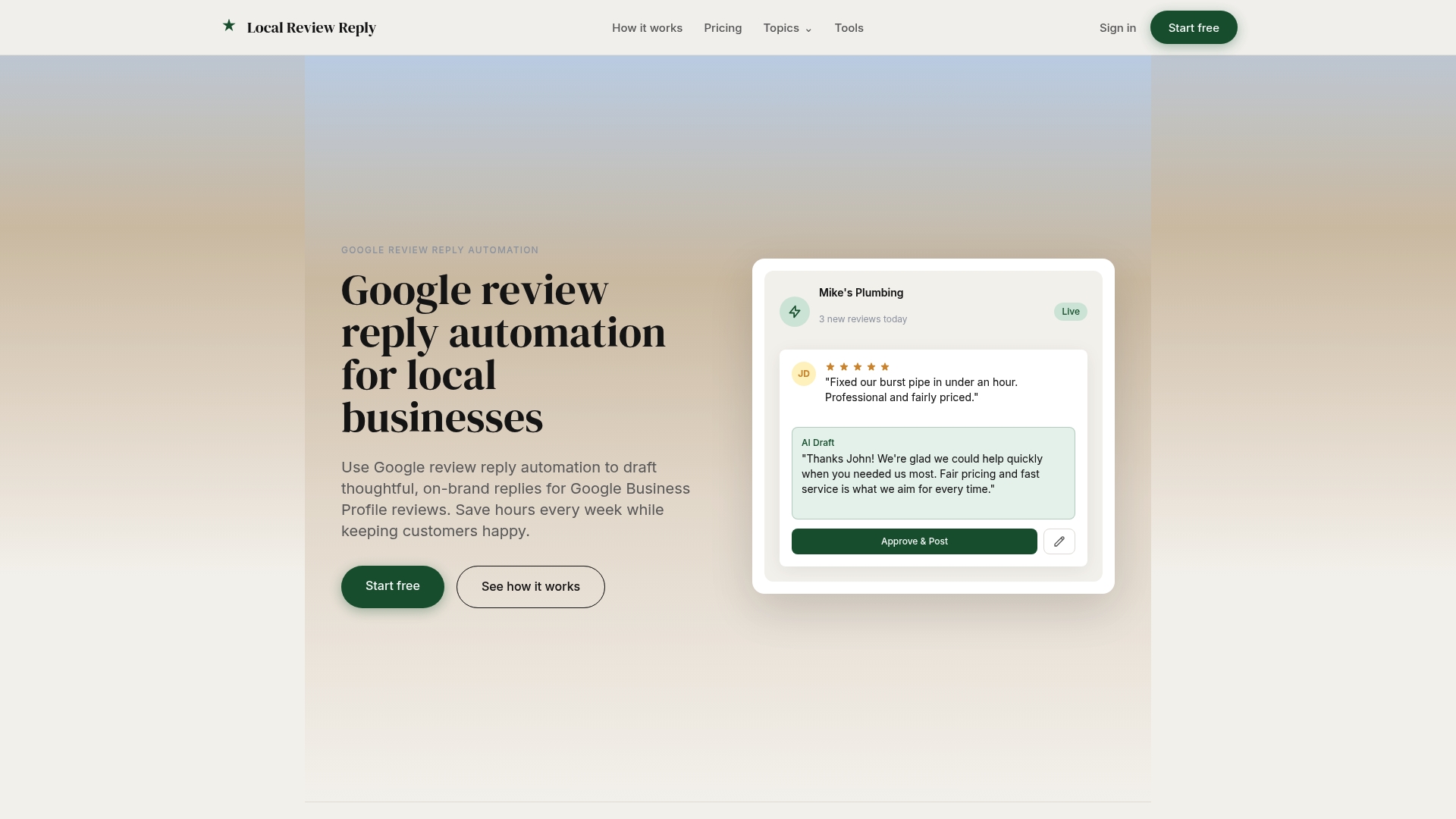
For field service franchises and multi-location operators, the platform supports role-based permissions so local managers, regional managers, and HQ admins each see and control exactly what they should. Sensitive low-star reviews stay in the approval queue until a human signs off.
The low-friction starting point: run a 30-day pilot on 10–30 locations, measure response rate and time-to-first-response against your current baseline, and decide from real data. Start a free trial or explore the features to see how the approval workflow maps to your current process.
Sources
External resources
- Reputation & Review Management Franchise Resources
- Why Your Franchise's Online Reputation Management ...
- Mastering Franchise Review Management: Strategies for ...
Localreviewreply resources