
If you're paying a mid-to-high monthly fee for Podium and using only a portion of its features, you're not alone. The most common reasons businesses switch come down to three things: pricing opacity, contract friction, and paying for a full unified platform when you only need one or two of its capabilities.
Here's the short answer on the best Podium alternatives in 2026:
- Localreviewreply — Best for franchises, multi-location operators, and agencies whose primary need is Google Review reply automation with approval workflows and brand-consistent responses at scale.
- Birdeye — Best for multi-location businesses that need deep listings management across 250+ directories alongside reputation tools.
- MessageDesk — Best for small service businesses that want straightforward SMS/MMS without the enterprise price tag.
- Broadly — Best for single-location home service businesses (HVAC, plumbing, cleaning) that want a simple all-in-one: webchat, reviews, and payments.
- Weave — Best for healthcare and dental practices that need phone, texting, and scheduling tightly integrated.
- Yext — Best for multi-location brands where listings accuracy and search visibility are the top priority.
- NiceJob — Best for budget-conscious service businesses that want automated review generation without a complex platform.
- BrightLocal — Best for marketing agencies managing local SEO and reputation across multiple client accounts.
- REVIEWS.io — Best for e-commerce and product-based businesses that need verified review collection and display.
- Grade.us — Best for agencies and consultants who want white-label review management at a lower per-client cost.
- GatherUp — Best for service businesses that want customer feedback, NPS, and review generation in one workflow.
Pro Tip: Before you demo anything, write down the three features you actually use in Podium every week. Most businesses discover they're paying for five features and using two — which cuts the shortlist in half immediately.
Key Takeaways
The strongest Podium alternative depends on whether your core problem is slow lead response, inconsistent reviews, or paying for features you don't use.
| Point | Details |
|---|---|
| Two distinct categories | Reputation-first tools (Birdeye, Yext, NiceJob) and messaging-first tools (MessageDesk, Broadly) solve different problems — match the tool to your actual failure mode. |
| Hidden costs are real | Budget for onboarding fees, 10DLC carrier registration, and per-location add-ons; always get a written 12-month total before signing. |
| Migration takes 3–8 weeks | Single-location swaps run 3–7 days; multi-location rollouts typically take 4–8 weeks, with phone number porting as the longest step. |
| Budget tools cover most needs | For many SMBs, a $75–$99/month review tool plus a low-cost SMS platform replaces what Podium charges $289–$649/month to bundle, depending on plan tier. |
| Localreviewreply for review replies | Franchises and multi-location operators focused on Google Review response and approval workflows should evaluate Localreviewreply's tiered subscription model. |
Table of Contents
- How do these Podium alternatives compare on the features that matter?
- Profiles of the top Podium alternatives: features, trade-offs, and migration notes
- How do you choose the right Podium alternative for your business?
- How to migrate from Podium without losing data or downtime
- What does Podium actually cost, and what do alternatives charge?
- How we picked and evaluated these alternatives
- What most buyers get wrong when switching from Podium
- Localreviewreply handles the one thing most platforms treat as an afterthought
- Useful sources and vendor documentation
How do these Podium alternatives compare on the features that matter?
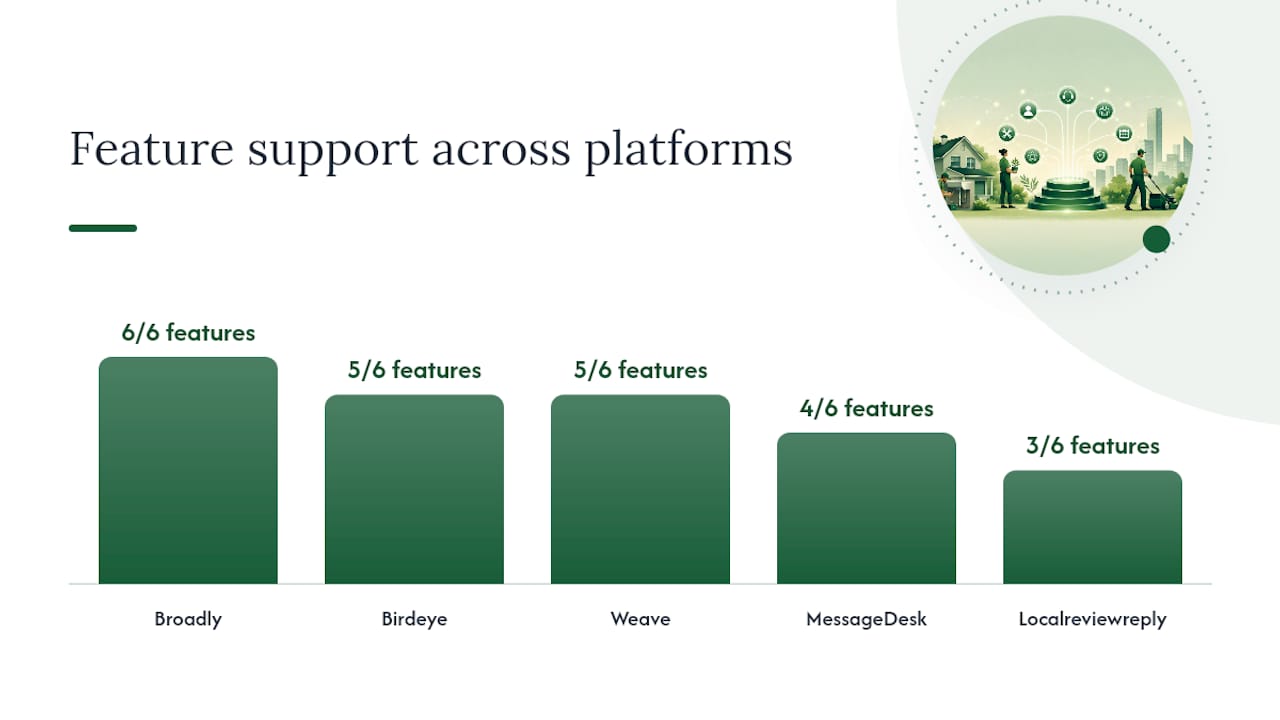
The table below covers the dimensions that drive most buying decisions: messaging, reviews, webchat, payments, integrations, multi-location support, and pricing shape.
| Platform | Best for | SMS/Messaging | Review requests & replies | Webchat | Payments | CRM integrations | Multi-location | Pricing model |
|---|---|---|---|---|---|---|---|---|
| Localreviewreply | Franchises, agencies, SMBs focused on Google Review replies | No (review-reply focus) | AI-drafted replies, approval workflows | No | No | Google Business Profile | Yes, tiered by location | Subscription, free trial |
| Birdeye | Multi-location reputation + listings | Yes | Yes, strong | Yes | No | Salesforce, HubSpot, 200+ | Yes, enterprise-ready | Quote-based, ~$299+/mo |
| MessageDesk | SMS-first small service businesses | Yes, core feature | Basic | No | No | Zapier, limited native | Limited | Per-seat, lower entry |
| Broadly | Single-location home services | Yes | Yes | Yes | Yes | Limited | Limited | Flat monthly |
| Weave | Healthcare, dental, veterinary | Yes (VoIP + SMS) | Yes | No | Yes | EHR/PMS integrations | Moderate | Quote-based |
| Yext | Listings-first multi-location brands | No | Basic | No | No | Salesforce, HubSpot, 200+ | Yes, enterprise | Quote-based |
| NiceJob | Budget review generation | No | Yes, automated | No | No | Zapier, ServiceTitan | Limited | ~$75–$99/mo |
| BrightLocal | Agencies, local SEO | No | Yes, citation + review | No | No | Agency dashboard | Yes, per-location | Per-location, — |
| REVIEWS.io | E-commerce, product reviews | No | Yes, verified | No | No | Shopify, Magento, Klaviyo | Moderate | Tiered, quote-based |
| Grade.us | Agencies, white-label | No | Yes, white-label | No | No | Zapier, limited | Yes, per-location | — |
| GatherUp | Feedback + review generation | No | Yes, NPS + reviews | No | No | Zapier, limited | Yes | ~$99+/mo per location |
Strongest at messaging first: MessageDesk and Broadly. Both prioritize SMS workflows without burying them under reputation features.
Strongest at listings + reputation: Birdeye and Yext. Birdeye covers listings sync across 250+ directories while Yext leads on structured data and knowledge graph accuracy.
Budget specialists: NiceJob, Grade.us, and BrightLocal all deliver targeted functionality at a fraction of what Podium charges for its full suite.
Profiles of the top Podium alternatives: features, trade-offs, and migration notes
Localreviewreply
AI-powered Google Review response software built for local service businesses, franchises, and marketing agencies that need consistent, on-brand replies at scale.
Standout features: Drafts personalized replies in seconds, approval workflows for sensitive or low-star reviews, team roles and permissions, multi-location dashboard, and analytics for response consistency.
Pros:
- Approval controls mean a human reviews flagged replies before they go live, which matters for franchise brand standards.
- Designed specifically for Google Business Profile, so the workflow is tight rather than spread across a dozen features you won't use.
- Free trial available; pricing scales by location count rather than locking you into a seat-based model.
Cons:
- Not a replacement for Podium's SMS inbox, webchat, or payment features — it solves one problem very well.
- No native review generation (requesting new reviews) in the core product.
Migration note: No phone number porting needed. Export your existing Google reviews via Google Business Profile; Localreviewreply connects directly to your GBP account. Setup is typically same-day for a single location.
For a direct feature comparison, see the Localreviewreply vs Podium breakdown.
Birdeye
A full-stack reputation and customer experience platform targeting multi-location businesses and enterprises.
Standout features: Listings management across 250+ directories, review generation and monitoring, webchat, surveys, and a unified social inbox.
Pros:
- Listings depth is genuinely stronger than Podium's — if inconsistent NAP data is hurting your local search rankings, Birdeye addresses it directly.
- Robust CRM integrations (Salesforce, HubSpot, and 200+ others).
- Strong multi-location reporting.
Cons:
- Entry pricing starts around $299/month, and full-feature tiers climb to $449/month per location — comparable to Podium's cost.
- Onboarding can be slow for large location counts.
- Overkill for a single-location business that only needs review generation.
Migration note: Birdeye can port your existing phone number. Export Podium contacts as CSV; Birdeye's onboarding team handles import. Expect 2–4 weeks for a full multi-location setup.
MessageDesk
A business texting platform focused on two-way SMS and MMS for small service teams.
Standout features: Shared team inbox for SMS, scheduled messages, text-to-landline capability, and basic contact management.
Pros:
- Significantly lower cost than Podium for businesses that only need SMS.
- Clean, simple interface with a short learning curve.
- No long-term contracts on entry plans.
Cons:
- No native review management or webchat.
- Limited CRM integrations beyond Zapier.
- Not built for multi-location franchise management.
Migration note: Port your existing Podium number to MessageDesk via a standard carrier port request (allow 5–10 business days). Export Podium contacts as CSV and import directly.
Broadly
An all-in-one platform for single-location home service businesses: webchat, reviews, payments, and SMS in one tool.
Standout features: Webchat-to-text widget, automated review requests post-job, text-to-pay, and a simple mobile app.
Pros:
- Covers the core Podium use case (webchat, reviews, payments) at a lower price point for single locations.
- Built specifically for trades and home services, so the onboarding is fast.
- Flat monthly pricing with no per-seat surprises.
Cons:
- Limited CRM integrations compared to Podium or Birdeye.
- Not suitable for multi-location or franchise operations.
- Review management is basic relative to dedicated reputation platforms.
Migration note: Port your Podium number; Broadly's support team assists with this. Webchat widget swap takes under an hour. Review history stays in Google — no export needed.
Weave
A VoIP, SMS, and practice management platform built for healthcare, dental, and veterinary businesses.
Standout features: Integrated phone system, two-way texting, appointment reminders, payment processing, and EHR/PMS integrations.
Pros:
- The phone + text + scheduling integration is genuinely tight for medical practices.
- Payment processing built in.
- Strong customer support reputation in the healthcare vertical.
Cons:
- Quote-based pricing with no public rates — budget conversations start blind.
- Overkill and potentially expensive for non-healthcare service businesses.
- Limited listings management.
Migration note: Weave handles number porting as part of onboarding. EHR integration setup adds time — budget 3–6 weeks for a full practice migration.
Yext
An enterprise listings and knowledge management platform for multi-location brands.
Standout features: Structured data sync across 200+ publishers, review monitoring, pages product for location landing pages, and analytics.
Pros:
- Best-in-class for listings accuracy at scale — if your NAP data is inconsistent across directories, Yext fixes it faster than any alternative.
- Strong enterprise integrations (Salesforce, HubSpot, Adobe).
- Detailed location-level analytics.
Cons:
- No SMS or messaging features.
- Review response tools are basic compared to dedicated platforms.
- Enterprise pricing; not cost-effective for businesses under 10 locations.
Migration note: No phone number porting needed. Connect your location data and let Yext sync. For a review-reply comparison, see Localreviewreply vs Yext.
NiceJob
A review generation platform focused on automating the ask-for-a-review workflow for service businesses.
Standout features: Automated review request sequences via SMS and email, review widget for your website, and basic reporting.
Pros:
- One of the lowest entry prices for automated review generation.
- Simple setup — most businesses are live within a day.
- Integrates with ServiceTitan, Jobber, and other field service tools.
Cons:
- No SMS inbox, webchat, or payments.
- Review response features are minimal.
- Not built for multi-location management.
Migration note: No number porting. Connect your CRM or job management tool; NiceJob pulls customer data automatically. Review history stays in Google.
"Shorter, review-focused platforms like NiceJob can deliver the core review-generation workflow at a fraction of the price of an enterprise reputation platform — the trade-off is that you're buying one capability, not a suite." Source
BrightLocal
A local SEO and reputation management platform built for marketing agencies managing multiple client accounts.
Standout features: Citation building and auditing, rank tracking, review monitoring across platforms, and white-label reporting.
Pros:
- Per-location pricing makes it cost-effective for agencies with many clients.
- Citation management depth is stronger than most alternatives.
- White-label reports are polished and client-ready.
Cons:
- No SMS, webchat, or payments.
- Review response is monitoring-focused, not automation-focused.
- Not designed for in-house business operators.
Migration note: No number porting. Connect client Google Business Profiles and start monitoring immediately. Full citation audit takes 1–2 weeks per location.
REVIEWS.io
A verified review collection platform primarily serving e-commerce and product-based businesses.
Standout features: Verified buyer reviews, Google Shopping integration, video reviews, and rich snippet support.
Pros:
- Strong for product-based businesses that need verified purchase reviews.
- Google Shopping and Shopify integrations are well-built.
- Review display widgets are clean and conversion-focused.
Cons:
- Not designed for local service businesses or Google Business Profile management.
- No SMS, webchat, or payments.
- Pricing is quote-based for most feature tiers.
Migration note: No phone number porting. Connect your e-commerce platform; REVIEWS.io imports order data to trigger review requests automatically.
Grade.us
A white-label review management platform for agencies and consultants.
Standout features: White-label dashboard, multi-platform review monitoring, review request campaigns, and client reporting.
Pros:
- White-label capability is one of the strongest in this category.
- Per-location pricing scales well for agencies with growing client rosters.
- Covers Google, Facebook, and 100+ review sites.
Cons:
- No SMS inbox, webchat, or payments.
- UI feels dated compared to newer platforms.
- Limited automation compared to AI-native tools.
Migration note: No number porting. Connect client GBP accounts; review monitoring starts immediately. Full campaign setup takes a few hours per client.
GatherUp
A customer feedback and review generation platform for service businesses.
Standout features: NPS surveys, first-party feedback collection, automated review requests, and multi-location reporting.
Pros:
- NPS + review generation in one workflow is useful for businesses that want both internal feedback and public reviews.
- Multi-location dashboard is solid for franchise operators.
- Integrates with Zapier for CRM connectivity.
Cons:
- No SMS inbox, webchat, or payments.
- Review response automation is limited.
- Per-location pricing adds up quickly for large franchise networks.
Migration note: No number porting. Connect GBP accounts and import customer lists via CSV. Most single-location setups go live within a day.
Pro Tip: If you're evaluating GatherUp or NiceJob, ask specifically about their review response features — most review-generation tools treat response as an afterthought. If responding consistently at scale matters to you, pair them with a dedicated Google review management tool.
How do you choose the right Podium alternative for your business?
The answer depends on which problem you're actually trying to solve. Buyer guidance consistently points to two distinct failure modes: losing leads because response is too slow, and losing search clicks because listings and reviews are inconsistent. Those two problems need different tools.
Four buyer archetypes and what they should prioritize
SMS-first service businesses (plumbers, HVAC, auto repair, cleaning): Your priority is speed-to-lead. A webchat-to-text workflow that routes inquiries to a shared inbox closes more jobs than a reputation dashboard. MessageDesk or Broadly fit here. Birdeye or Podium are overkill unless you also have a listings problem.
Review-first single-location shops: You need automated review requests and a clean response workflow. NiceJob handles the generation side cheaply. For response at scale with approval controls, Localreviewreply is the focused option. You probably don't need SMS or payments from the same platform.
CRM-native sales teams: If your workflow lives in Salesforce or HubSpot, you need a platform with a native integration, not a Zapier workaround. Birdeye and Yext both connect directly. Evaluate whether you need messaging or listings more, then pick accordingly.
Multi-location franchises: You need per-location reporting, approval workflows for brand-sensitive replies, and a pricing model that doesn't punish growth. Birdeye works at this scale for full-suite needs. For Google Review response specifically, Localreviewreply's franchise review reply workflow is built for exactly this use case.
Questions to ask every vendor before signing
- What is the total first-year cost, including onboarding, setup fees, and carrier fees?
- Can I port my existing phone number, and who owns it if I cancel?
- What is the minimum contract length, and what are the exit terms?
- Is multi-location billed per location or per seat?
- What SLA applies to support response times?
- Is API access included or an add-on?
- What happens to my data (contacts, reviews, conversations) if I cancel?
Red flags to watch for
- Pricing that requires a sales call to get any number at all.
- Onboarding fees quoted verbally but not in writing.
- No phone number porting on cancellation.
- Annual contracts with no monthly option for new customers.
- Demo environments that don't reflect the actual product tier you'd buy.
Pro Tip: Ask the sales rep to send you a written itemized cost for year one before you sign anything. Verbal quotes routinely omit 10DLC carrier registration fees, onboarding charges, and per-location add-ons. G2 reviewers consistently flag this as a pain point with Podium and similar platforms.
How to migrate from Podium without losing data or downtime
A single-location migration typically takes 3–7 days. Multi-location rollouts typically run 4–8 weeks depending on location count, phone number complexity, and staff training needs.
Step-by-step migration checklist
- Set up inbox routing and templates. Configure your new shared inbox, assign team members, and build your message templates before go-live. For review response templates, pre-built response libraries cut setup time significantly.
Pro Tip: If you're switching to a platform with AI-drafted review replies, set up an approval workflow for the first 30 days even if you plan to automate later. Reviewing the first batch of AI drafts manually lets you catch tone mismatches and adjust settings before replies go out at volume. Automated reply workflows work best when a human has validated the output first.
What does Podium actually cost, and what do alternatives charge?
Podium's published pricing runs from $289/month (Essentials), $449/month (Standard), to $649/month (Professional), per the comparison data available from review sources. Those numbers don't include onboarding fees, 10DLC carrier registration, additional phone numbers, or API access, which are common add-ons.
Typical pricing ranges across the category
| Tier | Platforms | Typical entry price | What's usually included |
|---|---|---|---|
| Budget / single-feature | NiceJob, Grade.us, BrightLocal | entry-level pricing | Review generation OR listings OR citation management |
| Mid-range all-in-one | Broadly, MessageDesk, GatherUp | moderate pricing | SMS + reviews + basic webchat or feedback |
| Full-suite reputation | Birdeye, Localreviewreply (review-reply focus) | higher pricing levels | Listings, reviews, messaging, multi-location |
| Enterprise / quote-based | Yext, Weave, Birdeye enterprise | Custom | Full platform, dedicated support, SLA |
Budget-conscious operators often find that a $75–$99/month review generation tool plus a separate low-cost SMS tool covers 80% of what they were paying Podium $400/month to do.
Negotiation tactics that actually work
- Request a written total first-year cost before signing — not a monthly rate, a full 12-month number including all fees.
- Ask for a monthly contract for the first 3 months before committing to annual.
- Confirm phone number porting rights in the contract, not just verbally.
- If you're bringing multiple locations, ask for a volume discount on the per-location rate.
Pro Tip: The platforms with the most opaque pricing (quote-only, no public rates) are also the ones most likely to have negotiable onboarding fees. If a vendor won't give you a written itemized quote within 48 hours of a demo, that's a signal about how their support will operate post-sale.
How we picked and evaluated these alternatives
This list was built to serve U.S. local service businesses, franchises, and marketing agencies evaluating Podium replacements in 2026. The evaluation criteria:
- User review sentiment: Sourced from G2, Gartner, and comparative roundups including Sticky Marketing and SmbAI.
This article was last updated in 2026. Pricing and features change; always verify current rates directly with vendors before signing.
If you believe a platform has been miscategorized or a pricing figure is out of date, the contact details on this site are the right place to flag it.
What most buyers get wrong when switching from Podium
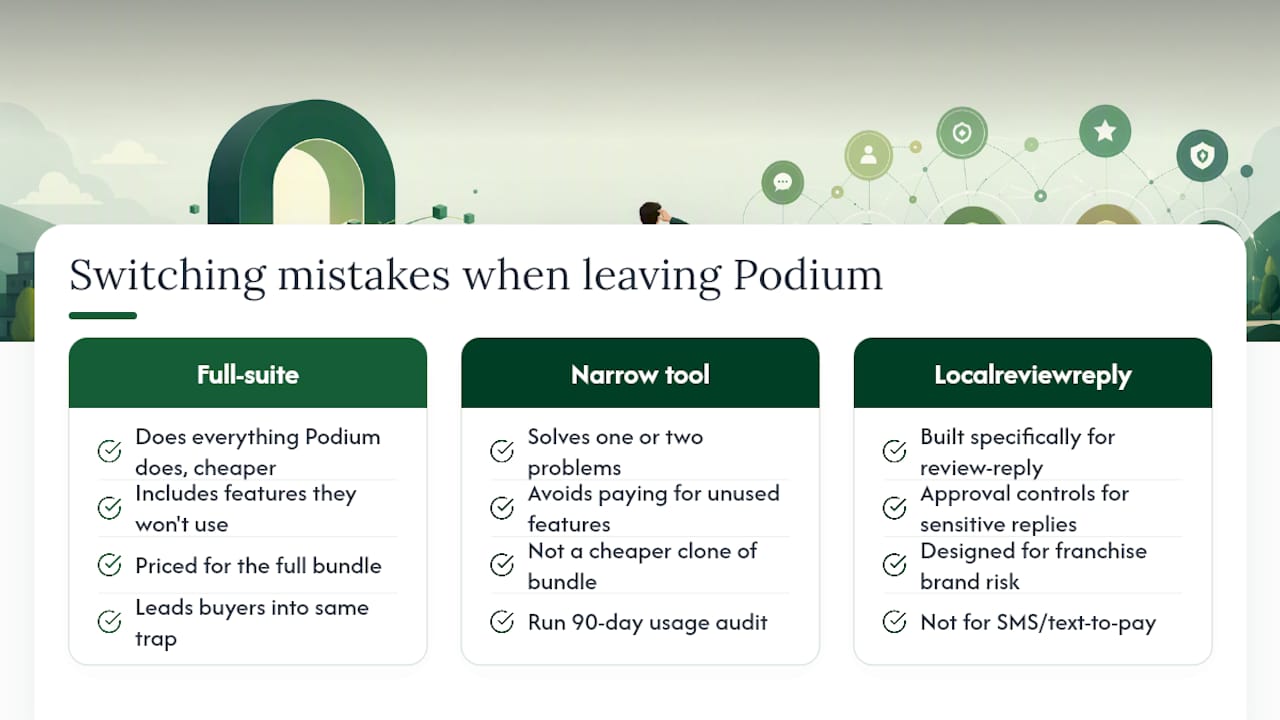
The conventional wisdom in this category is to find a platform that does everything Podium does, but cheaper. That framing leads most buyers straight into the same trap: a full-suite platform with features they won't use, priced accordingly.
The more useful question is: what did Podium actually fix for your business, and what did it fail at? For most local service businesses, Podium solved one or two problems well and charged for eight. The right move is usually a narrower tool that solves those one or two problems better, not a cheaper version of the same bundle.
The other mistake I see consistently: switching before auditing. Businesses cancel Podium, sign with a new platform, and then discover mid-onboarding that they needed a feature they forgot they were using. The 90-day usage audit in the migration checklist above isn't optional — it's the step that prevents a second expensive switch six months later.
On the review-reply side specifically: most platforms treat response as a checkbox feature. They'll let you reply to reviews, but the workflow is manual, the tone is inconsistent, and there's no approval layer for sensitive replies. For a franchise with 20 locations, that's a brand risk, not just an inconvenience. Localreviewreply is the only tool on this list built specifically around that problem, with approval controls designed for exactly the scenario where a low-star reply needs a human to sign off before it goes public.
One more thing worth saying plainly: if your primary Podium use case is SMS lead response and text-to-pay, Localreviewreply is not the right replacement. It's a focused tool for a specific job. Know which job you're hiring for.
Localreviewreply handles the one thing most platforms treat as an afterthought
Every platform on this list will let you respond to Google reviews. Almost none of them were built to do it well at scale, with approval controls, consistent brand voice, and per-location analytics.
Localreviewreply drafts personalized, on-brand replies for your Google Business Profile reviews in seconds. For low-star or sensitive reviews, the approval workflow holds the draft for human review before anything goes live — which matters when a single poorly-worded reply can undo months of reputation work. Agencies and franchise operators can manage dozens of locations from one dashboard, with team roles and permissions that keep the right people in the loop.
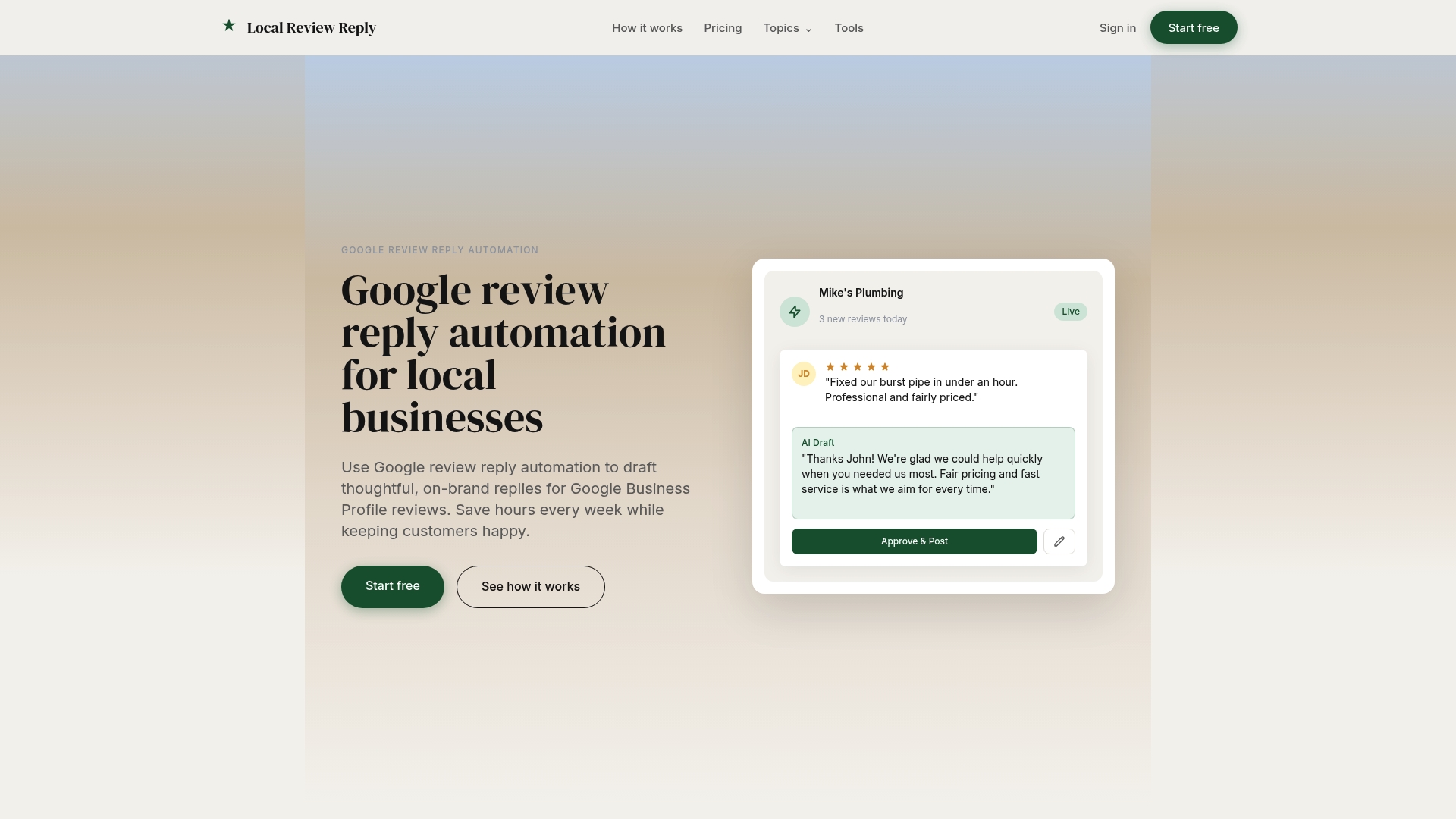
The pricing scales by location count, starting with a free trial. There's no SMS inbox, no webchat, and no payments — because the product does one thing and does it properly. If Google Review response consistency, approval workflows, and multi-location management are your core need, see how it works and start a free trial to validate the fit before committing.
Useful sources and vendor documentation
These sources were used to build the shortlist, verify pricing ranges, and assess feature depth. Pricing pages change frequently — treat all figures as starting points and confirm directly with vendors.
| Source | What it covers |
|---|---|
| Birdeye vs Podium: 2026 Comparison | Feature-by-feature comparison, entry pricing for both platforms |
| SmbAI: Birdeye vs Podium for Local Businesses | Buyer guidance by business type, speed-to-lead vs. listings framing |
| Salesmessage: Best Podium Alternatives | Category split (reputation vs. SMS), pricing examples, buyer reasons to switch |
| Sticky Marketing: Podium Alternatives | Roundup confirming shortlist candidates and feature summaries |
| G2: Podium Reviews 2026 | User sentiment, praise for ease of use, complaints about pricing opacity |
| ITQlick: Top Podium Competitors | Budget and free-tier alternatives, lower-cost options for small operators |
| Localreviewreply vs Podium | Direct feature comparison for review-reply workflows |
Sources were selected for pricing transparency, feature documentation, and user review depth. G2 and Gartner were used for sentiment validation; vendor pricing pages were cross-referenced against comparative roundups to flag discrepancies.