
Response macros for reviews are pre-written reply templates that let you answer customer feedback in seconds instead of drafting from scratch every time. The single most important rule: never post a macro word-for-word on a low-star review. Swap in real specifics, and route anything sensitive, legal, or emotionally charged to a human for approval before it goes live, a workflow Google Business Profile's own owner-reply documentation is built around.
TL;DR:
- Macros should be customized with reviewer-specific details and routed for human approval when containing sensitive or complex issues to prevent inappropriate replies.
- Response templates vary by star rating, emphasizing personalization and a genuine tone, with openers and closers rotated regularly to avoid sounding repetitive.
- Automating review responses is helpful during high volume periods but must be paired with proper training and oversight to avoid purely robotic interactions and maintain trust.
- Speed of response should aim for under 24 hours for negative reviews and 48 hours for positive ones, with prioritized handling of older complaints and critical issues.
- Automated drafting tools require human review, especially for regulated industries, and replies referencing private or sensitive information should never be public to avoid legal or privacy breaches.
Table of Contents
- Ready-To-Use Macro Templates by Star Rating
- How Do You Set Up Macros for a Team or Multiple Locations?
- The Tone Checklist That Keeps Macros From Sounding Canned
- How Fast Should You Respond to a Review?
- Where AI Drafting Helps and Where It Needs a Human
- Quick Phrase Swaps and Platform Notes
- Training Staff to Use Macros Without Sounding Like a Script
- Legal and Compliance Considerations When Replying to Reviews
- Industry-Specific Macro Examples
- When Macros Help and When They Get You in Trouble
- Get Macros and Approval Workflows Running Without the Manual Grind
- Sources
- FAQ
Ready-To-Use Macro Templates by Star Rating
Good macros aren't scripts you recite. They're skeletons you fill in with the one detail that proves you actually read the review. Below are starting points organized by sentiment, with variants so you're not posting the identical sentence to every five-star reviewer in a single week.
5-star templates (thank, specify, invite back):
- "Thanks so much for the kind words, [Name]! We're glad [specific detail] worked out for you. Hope to see you again soon."
- "This made our day, [Name]. Our team works hard on [specific detail], so it means a lot to hear it landed. See you next time!"
- "We appreciate you taking the time to write this, [Name]. Glad [specific detail] hit the mark. Come back anytime!"
3-star templates (acknowledge the good, own the gap, offer a path forward):
- "Thanks for the honest feedback, [Name]. Glad [positive detail] worked for you, but we clearly missed the mark on [issue]. We're looking into it. Reach out at [contact] if you'd like to talk it through."
- "We appreciate the review, [Name]. Sounds like [positive detail] was solid, though [issue] fell short of what we aim for. We'd love the chance to make it right. Email us at [contact]."
- "Thank you for taking the time to write this. We're happy [positive detail] worked, and we're already addressing [issue] so it doesn't happen again."
1 to 2-star templates (acknowledge, apologize, move offline):
- "We're sorry to hear this, [Name]. That's not the experience we want anyone to have. Please call us at [phone] so we can look into what happened."
- "Thank you for flagging this, [Name]. We take it seriously and want to understand what went wrong. Reach us directly at [email] so we can make this right."
- "This isn't the standard we hold ourselves to, and we're sorry you experienced it, [Name]. Please contact [contact info] directly so we can resolve it."
Rotate openers ("Thanks for," "We appreciate," "Thank you for taking the time") and closers ("See you soon," "Hope to see you again," "Come back anytime") so ten five-star replies in a row don't read like a form letter. Industry guidance backs this directly: best-practice guides recommend responding to all negative reviews and at least 20% of positive ones, using macros for structure but varying the language every time.
Pro Tip: Keep a running list of five alternate phrases for "thank you," "we're sorry," and "reach out." Rotate them manually or build them into your macro variables so no two replies in the same week read identically.
How Do You Set Up Macros for a Team or Multiple Locations?
Scaling macros across a franchise or agency account means building structure before you build volume. A macro that works for one location manager becomes chaos when twenty people are each writing their own version of "thanks for the feedback."
- Organize macros by level. Most platforms let you set macros at the tenant (brand-wide), location, or individual-user level, so a corporate tone guide can sit above local flexibility for things like naming a specific staff member.
- Tag by sentiment first, category second. Group templates as positive, neutral, or negative before subdividing by scenario (billing complaint, service delay, staff praise). This cuts selection time when a manager is working through a backlog.
- Name macros for scanning, not memory. "Negative_ServiceDelay_v2" beats "Response 14." Whoever is picking a template at 6 p.m. on a Friday needs to find the right one in three seconds.
- Set approval gates before you set volume goals. Decide now which star ratings or keywords (refund, lawsuit, injury, discrimination) trigger mandatory human review instead of auto-post.
- Bulk import once you have 15 to 20 clean macros. Importing early with typos or inconsistent voice just multiplies the cleanup work later.
A few maintenance habits keep the system from decaying:
- Audit macros quarterly and retire ones that keep getting edited before posting, that's a signal the template itself needs a rewrite.
- Give every location manager edit rights on local-level macros but lock brand-level tone macros to a marketing admin.
- Track which macros get used most and least, low-use templates are often duplicative or poorly worded.
The Tone Checklist That Keeps Macros From Sounding Canned
Four rules separate a macro that builds trust from one that reads like corporate legal boilerplate. Thank the reviewer specifically, not generically. Reference something from their actual review; "your stylist Maria" beats "our team." Apologize for the experience, not for the reviewer's feelings; "I'm sorry you had a slow service experience" reads as ownership, "I'm sorry you feel that way" reads as deflection. And always move detailed problem-solving offline; public threads are not the place to negotiate refunds or discuss account specifics.
What to avoid is just as important:
- Never argue with a reviewer publicly or dispute their version of events point by point.
- Never share private account details, order numbers, or medical or financial specifics in a public reply.
- Never use a generic "Management" signature when a real name and role is available. "Sarah, Store Manager" reads as accountable; "The Team" reads as evasive.
- Never leave a resolved complaint's public reply unchanged. If you fixed the issue, add a short follow-up: "Update: we spoke with [Name] and resolved this on [date]."
Analysis of review-response strategies has found that de-escalation language consistently outperforms defensive language for perceived service recovery, which is the whole point of moving fast, but moving fast without those four rules just produces faster damage.
Pro Tip: Before you save any new macro, read it out loud as if you were the angry customer receiving it. If it sounds like it's protecting the business instead of helping the person, rewrite it.
How Fast Should You Respond to a Review?
Twenty-four to 48 hours is the general benchmark most industry guides recommend for review replies, and negative reviews deserve the faster end of that window. A one-star review that sits unanswered for four days reads as neglect to every future customer who finds it, not just the person who wrote it.
Coverage matters as much as speed. Reply to 100% of negative reviews and roughly 20% of positive ones, which is a ratio that reputation management guidance sets specifically because responding to negatives protects your reputation while responding to some positives reinforces the behavior without consuming your whole day.
Track a handful of numbers monthly, not daily:
- Median response time (aim under 48 hours; under 24 for one and two-star reviews).
- Response rate by star category.
- Escalation rate: how many replies get flagged for manual review instead of auto-posting.
- Resolved-offline update rate: how often you circle back to update a public reply after fixing the issue.
When the backlog piles up after a busy weekend, work newest negative reviews first, then older negatives, then positives. A three-day-old complaint outranks a same-day compliment every time.
Where AI Drafting Helps and Where It Needs a Human
AI can draft a review reply in seconds, match your established tone, and generate several phrasing variants so you're not repeating yourself. What it can't reliably do is judge context: sarcasm, a legal threat buried in casual language, or a complaint that touches a regulated claim (health outcomes, financial advice, safety incidents). That's why AI-drafted replies should always get a human edit pass before posting, especially in healthcare, legal, financial, and other regulated industries where a single careless sentence carries real liability.
A few configuration rules keep automation safe:
- Set auto-post only for straightforward positive reviews with no complaint language and no sensitive keywords.
- Queue anything mentioning refunds, injury, discrimination, legal action, or a named employee complaint for manual approval, no exceptions.
- Use merge fields (customer first name, service type, location name) rather than pulling personal details like order numbers or addresses into a public reply.
- Review your auto-post rules monthly; language that seemed safe last quarter can drift as your business adds new services or locations.
Pro Tip: If a drafted reply contains a phrase you wouldn't say out loud to the customer's face, it needs a human rewrite, not just a spelling check.
Tools like the free AI review response generator exist precisely for the drafting half of this equation. The approval half still belongs to a person on your team.
Quick Phrase Swaps and Platform Notes
Rotating a small bank of interchangeable phrases keeps macros from reading identically even when the underlying structure repeats.
- Openers: "Thanks so much," "We really appreciate," "So glad to hear," "Thank you for sharing this."
- Closers: "Hope to see you again soon," "Looking forward to your next visit," "We'd love to have you back," "See you next time."
- Apology variants: "We're sorry to hear this," "This isn't the experience we aim for," "We regret that this happened."
Safe tokens to build into templates: [Name], [specific detail], [contact info], [date]. Avoid tokens that pull order numbers, addresses, or account IDs into a public field.
Platform limits matter too: Google Business Profile replies have no strict character cap but display best under roughly 200 words, and Google doesn't allow clickable links in owner replies, so save the "call us" phrasing rather than pasting a URL.
Training Staff to Use Macros Without Sounding Like a Script
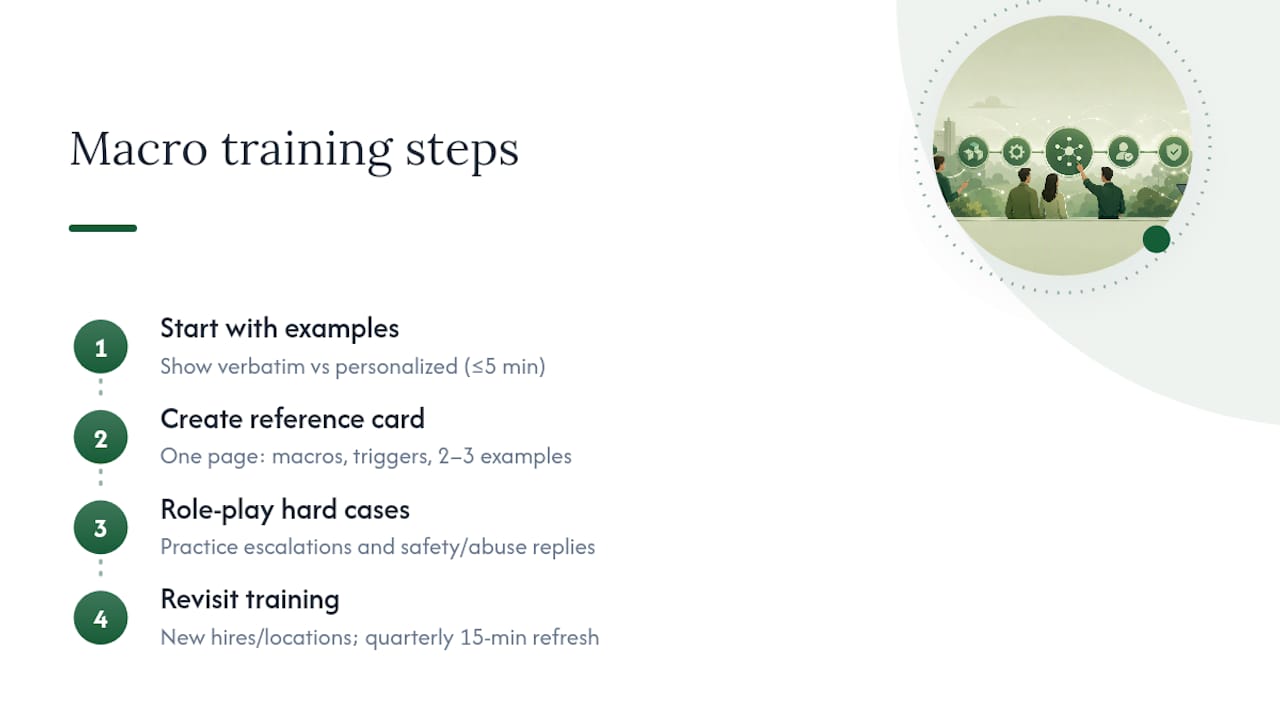
The biggest failure mode with review macros isn't a bad template, it's an untrained employee treating the template as the finished product. Training should cover three things: when to use a macro versus when to escalate, how to personalize in under 30 seconds, and what never to type in a public field.
Start new hires with side-by-side examples: a macro pasted verbatim next to the same macro personalized with a name and specific detail. The difference is obvious once you see it next to each other, and it takes less than five minutes to teach.
Build a short reference card, not a manual. One-page listing your approved macros by category, your escalation triggers, and two or three example personalizations per template gives staff something they'll actually use during a busy shift. A 40-page style guide gets skimmed once and forgotten.
Role-play the hard cases. A one-star review accusing a staff member by name, a review mentioning a health or safety incident, a reviewer who's clearly venting rather than describing a real problem. Staff need practice deciding "this goes to a manager" before it happens for real, not during it.
Revisit training every time you add a location or a new hire touches the review inbox. Consistency erodes fast when three different people are each interpreting "personalize the macro" differently. A quarterly 15-minute refresher, reviewing two or three recent replies as a group, catches drift before it becomes a pattern across dozens of reviews.
Legal and Compliance Considerations When Replying to Reviews
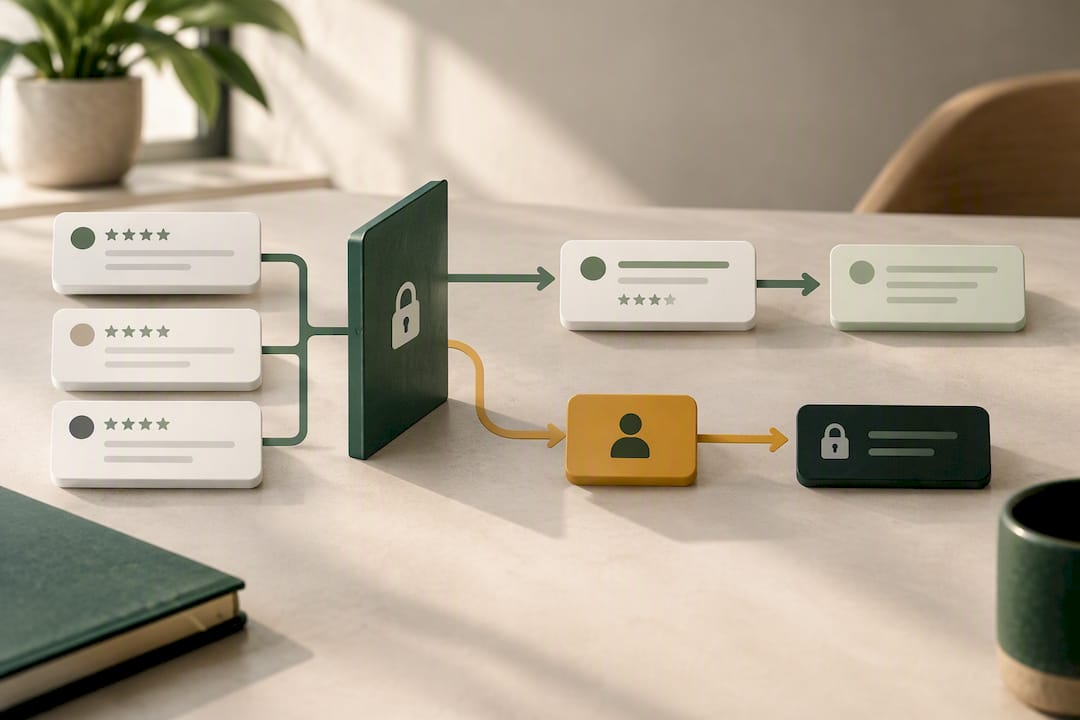
Public review replies are public statements, which means anything you write can be quoted, screenshotted, and used in ways you didn't intend. Never confirm or deny specific account details, treatment information, or transaction specifics in a public reply, even to correct a factual error the reviewer made. Confirming "yes, you were a patient here" in a healthcare context, for example, can itself be a disclosure problem depending on your industry's privacy rules.
Never argue liability in a public reply. Saying "that's not our fault" or debating fault publicly can complicate an actual legal claim later, regardless of who's right. The safer move, and the one de-escalation-focused guidance consistently recommends, is acknowledging the experience without admitting or denying fault, then moving the conversation to a private channel where specifics can be discussed appropriately.
Regulated industries carry extra weight here. Healthcare, legal, and financial service providers should have every negative or ambiguous reply reviewed by someone familiar with their industry's disclosure rules before it posts, not just a manager checking tone. A dental practice's approach to patient communication illustrates the broader point: sensitive industries need a human checkpoint that general retail or hospitality reviews don't.
None of this is legal advice, and rules vary by industry and location. When in doubt, loop in whoever handles compliance at your business before a reply goes live.
Industry-Specific Macro Examples
A macro that works for a restaurant sounds off coming from a dental office, and vice versa. Home service businesses, think plumbers, electricians, HVAC techs, tend to lean on macros that reference the specific job completed and invite the reviewer to call for future scheduling, since repeat business is the whole model. A home services template set built around that logic looks different from a restaurant's, which usually references the dish or the server by name.
Cleaning services often deal with recurring-service complaints (missed spots, scheduling conflicts) rather than one-time transaction issues, so their macro templates tend to emphasize consistency and scheduling flexibility in the reply itself. Healthcare and dental practices need the most conservative language of any category, acknowledging concern without confirming any protected detail, and routing almost everything negative to a human before posting. Retail and hospitality can afford a warmer, more casual tone since the stakes per reply are generally lower.
The pattern across all of them: the macro structure (acknowledge, specify, resolve or invite contact) stays constant. The vocabulary and formality level shift by industry, and getting that mismatch wrong is often what makes a reply feel like it was copied from somewhere else.
When Macros Help and When They Get You in Trouble
Macros earn their keep during volume spikes: a restaurant after a busy holiday weekend, a franchise location that just got featured on local news, an agency managing forty client accounts at once. In those moments, a solid template library is the difference between responding within 48 hours and letting reviews sit for a week.
Where I'd push back on how most guides frame this: the risk isn't using macros, it's treating macro selection as the finish line instead of the starting point. The operational pitfall I see most often is a manager picking the "closest match" template and hitting send without reading the review twice. That's how a business ends up thanking someone for a "wonderful visit" on a review that was actually a complaint about wait times. Build in a forced pause, even ten seconds, between selecting a macro and posting it. Manual response still wins for anything involving a named employee, a legal or safety claim, or language that reads more emotional than factual. Speed matters, but not more than getting it right.
— Ryan
Get Macros and Approval Workflows Running Without the Manual Grind
Some platforms give you the speed of macros without the risk of posting the wrong one at 2 a.m. Some services draft personalized, on-brand replies for Google Business Profile reviews automatically, then route anything low-star or sensitive into an approval queue so a real person signs off before it goes public.
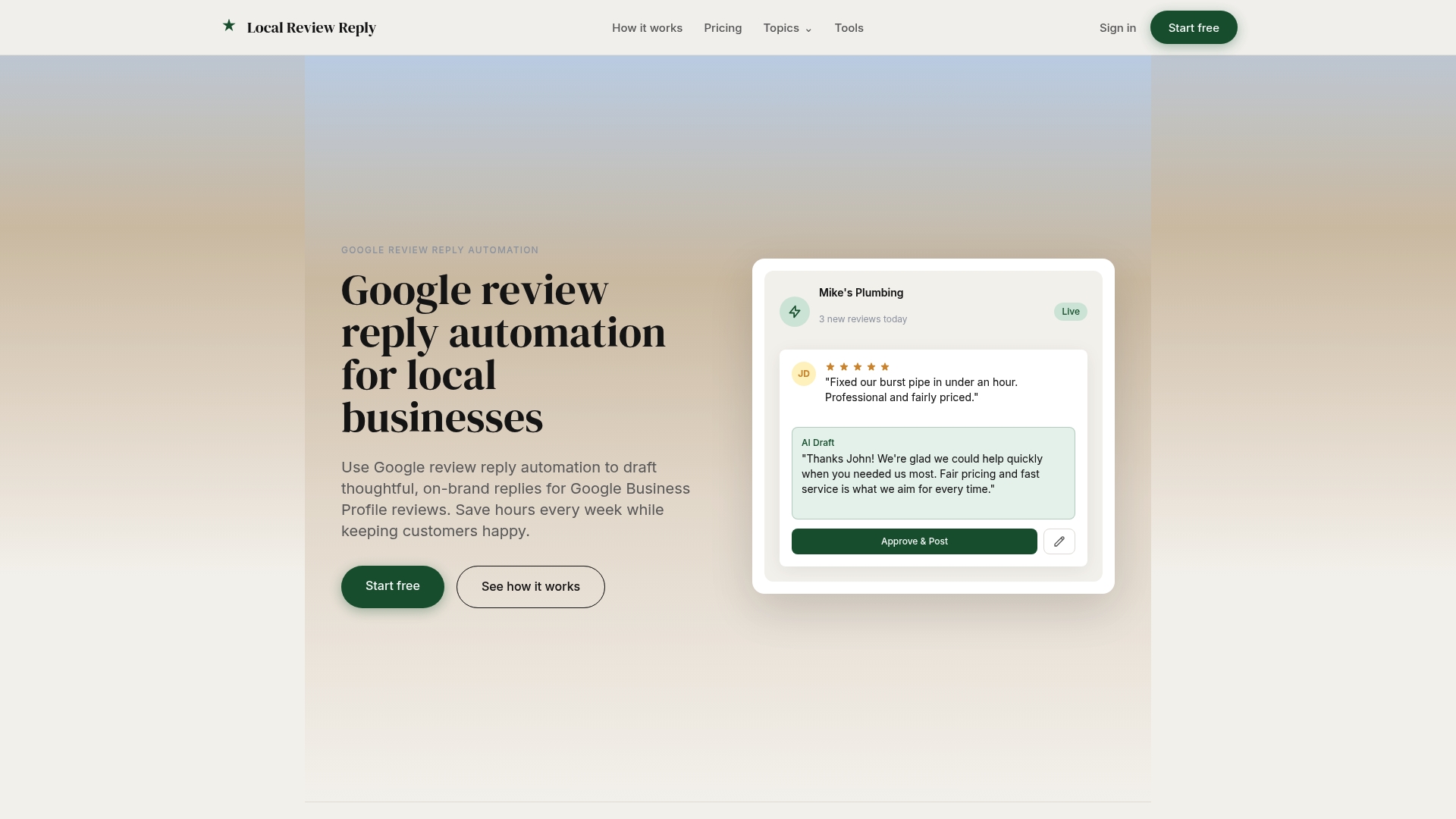
This combination is especially helpful for franchises and agencies managing reviews across multiple locations or client accounts, where a single inconsistent or careless reply can undercut reputation efforts. Team roles and permissions can allow a location manager to handle their own storefront while a brand admin keeps tone consistent across the network, and multi-location dashboards can help identify locations falling behind on response time before it becomes a pattern.
Plans run from a Free tier with no published price up through Starter at $5 AUD per month, Growth at $19 AUD per month, and Scale at $49 AUD per month, with Custom pricing available for larger networks. Check the full pricing breakdown and start a trial to see how the approval workflow fits your current review volume.
Sources
- Review response templates — BrightLocal
- Google Business Profile help — owner replies workflow
- Responding to Online Reviews: The Ultimate Guide — TextRequest
FAQ
What Are Good Responses to Positive Reviews?
A strong response thanks the reviewer by name, references something specific from their review (a dish, a service, a staff member), and invites them back. Avoid generic lines like "thanks for your feedback," swap in the actual detail they mentioned so the reply doesn't read like a copy-paste job.
How Should I Respond to a 5-Star Review?
Keep it short: thank them, mention the specific thing they praised, and close with an invitation to return. Responding to roughly 20% of your positive reviews is a reasonable target, you don't need to reply to every single one to show engagement.
What Are Some Examples of Positive Feedback Responses?
"Thanks so much, [Name]! Glad [specific detail] worked out so well for you. Hope to see you again soon" is a solid starting template. Vary the opener and closer across different reviews so your replies don't all read identically to anyone scrolling through your profile.
What Are Some Examples of Review Response Macros for Negative Feedback?
A reliable structure is: acknowledge the issue, apologize for the experience without admitting fault, and give a direct contact method. "We're sorry to hear this, [Name]. Please call us at [phone] so we can look into what happened" follows the de-escalation approach experts recommend for public replies.
Does Localreviewreply Handle Both Drafting and Approval?
Yes, Localreviewreply drafts personalized, on-brand replies automatically and includes approval controls so sensitive or low-star reviews get routed to a human before posting. Current pricing and plan details are available on the pricing page.