
For most small businesses, the fastest route to authentic, on-brand review replies is a hybrid workflow: AI drafts the reply, a human edits it before it posts. Pure templates feel robotic at scale, and pure AI without review risks tone-deaf responses to sensitive complaints. The exceptions are narrow: very low review volume favors templates, and very high volume of simple 5-star reviews can run on rules-based automation alone.
TL;DR:
- Small businesses should use a hybrid approach of AI drafts with human edits, especially for moderate review volumes, to balance speed and authenticity.
- Automated replies are suitable mainly for high-volume, non-sensitive reviews, while low-volume or sensitive reviews require templates or manual handling.
- Implementing review classification and SLA-driven approval processes ensures sensitive reviews are handled carefully and compliance risks are minimized.
- Tracking metrics such as reply time, editing time, and review sentiment helps optimize the hybrid workflow and proves its effectiveness over time.
- Using platforms that support both AI draft generation and human review, like Localreviewreply, can streamline multi-location review management efficiently.
Table of Contents
- Why a Hybrid Approach Wins on Templates vs AI Review Replies
- Templates vs AI vs Manual Replies: A Method-Level Comparison
- How to Deploy AI and Human Review Together at Scale
- Step-by-Step Checklist for a 30-to-90-Day Pilot
- Copy-Ready Templates and AI Prompts for Review Replies
- Handling Sensitive Reviews Without Legal Exposure
- Which KPIs Prove the Hybrid Approach Is Working
- What Actually Works After Watching This Play Out
- How Local Review Reply Fits Into a Hybrid Workflow
- Sources
Why a Hybrid Approach Wins on Templates vs AI Review Replies
The math behind this recommendation is simple. Templates are fast but generic, and customers notice when three reviewers receive the identical sentence. Full AI automation without a human pass can misfire on a sensitive complaint, and full manual replies do not scale past a handful of locations. A hybrid workflow splits the difference: AI handles structure and speed, a person adds the detail that proves someone actually read the review.
Three decision rules make this concrete:
- Use templates when volume is very low, staffing is thin, or legal and compliance language must stay fixed and predictable, such as fair housing disclosures.
- Let AI run mostly unsupervised only for high-volume, non-sensitive 5-star reviews with no complaint content, and even then, spot-check regularly.
- Default to hybrid for the mixed volume most small businesses actually see, since it protects brand voice while cutting the time cost of manual replies.
A single-location restaurant getting ten reviews a week can lean on templates for routine praise and handle complaints by hand. A ten-location franchise getting hundreds of reviews monthly needs AI to draft everything, with staff editing before anything sensitive goes live.
Templates vs AI vs Manual Replies: A Method-Level Comparison
Every method trades speed for personalization somewhere. Static templates post instantly but read as boilerplate the moment a customer compares notes with another reviewer. Manual replies are the most authentic option available but do not scale once a business crosses a few dozen reviews a month. AI-generated replies sit between the two, and a controlled test found AI drafts score well on tone and helpfulness but lag on personalization and authenticity when posted unedited.
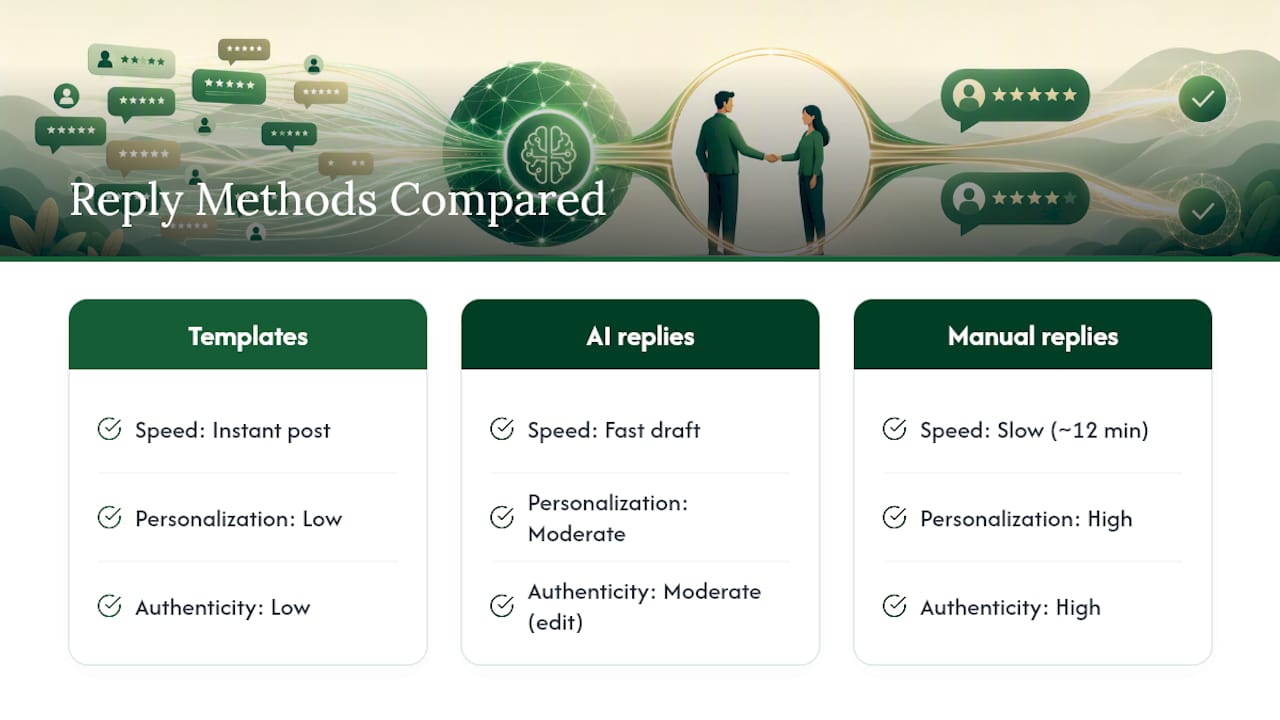
That same test found something more useful than a pass/fail grade: hybrid workflows, where AI drafts and a human edits, cut time-to-publish from roughly 12 minutes to about 2 minutes while pushing final quality close to what a skilled human writes from scratch. Vendor comparisons echo this, showing AI-assisted replies outperform static templates on scalability and personalization once the AI is trained on brand voice.
Here is how the three methods stack up across the factors that actually matter for a small business:
Industry write-ups comparing the two approaches consistently find templates predictable but risky for sounding generic, while AI scales personalization but needs prompt engineering and oversight to avoid corporate-speak creeping back in. The category labels matter more than any specific tool here: AI generators, static templates, and manual replies each have a role, and the winning setup usually blends all three depending on the review.
How to Deploy AI and Human Review Together at Scale
A safe hybrid workflow follows five steps, and each one needs an owner and a service-level agreement (SLA) attached to it.
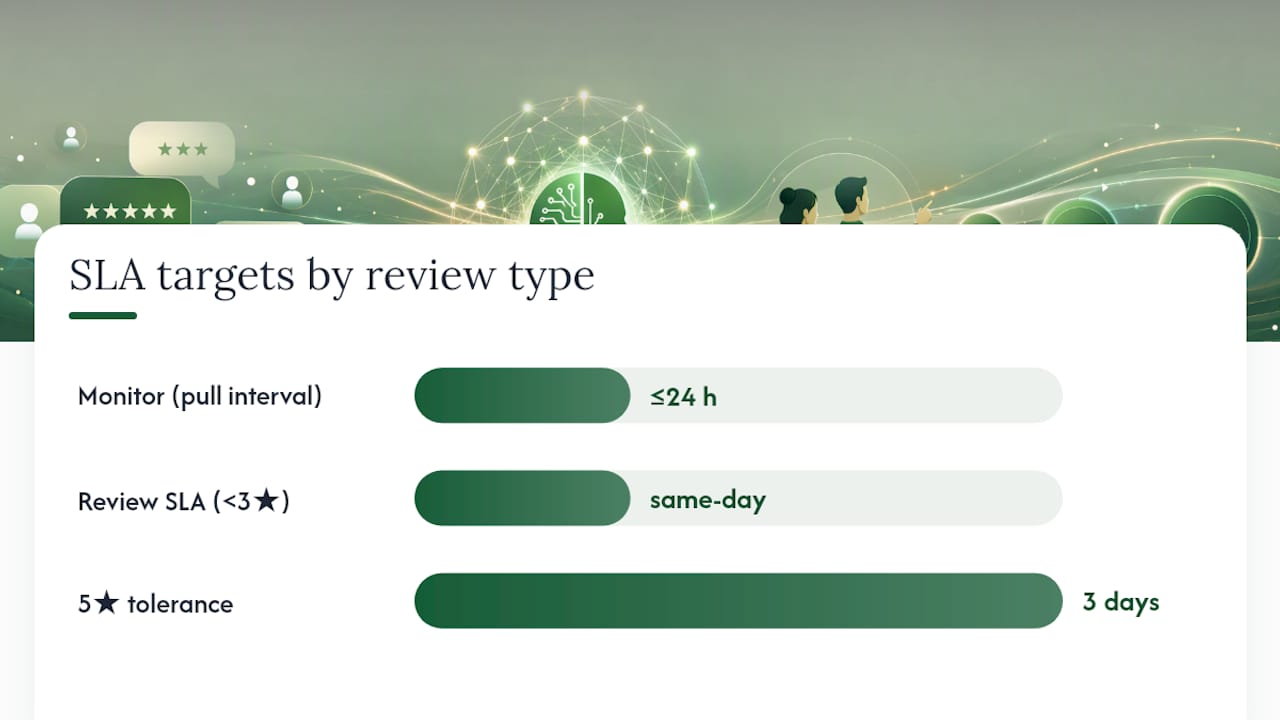
- Monitor. Reviews get pulled from Google Business Profile in real time or on a fixed check interval, ideally under 24 hours.
- Classify. Sort by star rating and keyword flags (refund, unsafe, lawsuit, discrimination) so sensitive reviews route differently than routine praise.
- Draft. AI generates a reply drafted in brand voice, pulling in any specific detail the reviewer mentioned.
- Review. A designated staffer edits the draft, ideally within a same-day SLA for anything under three stars.
- Post. Approved replies go live, with sensitive ones tagged for a manager's final sign-off before publishing.
Platform guidance backs a rating-based split for what gets auto-posted: auto-post simple positive replies while holding low-star or flagged reviews for human approval. That single rule prevents most of the embarrassing auto-reply screenshots that circulate online.
For franchises and agencies, add two more layers and consider complementary tools like an AI receptionist for small business to automate customer interactions and support your hybrid review workflow. White-labeled dashboards let an agency manage replies across dozens of client locations without exposing the tool underneath, and per-location permissions stop a single store manager from approving replies for a location they do not own.
Pro Tip: Set your approval SLA by star rating, not by volume. A 5-star review sitting unanswered for three days is a missed opportunity; a 1-star review sitting unanswered for three days is a brand risk. Treat them differently in your workflow, not just in your reply tone.
Step-by-Step Checklist for a 30-to-90-Day Pilot
Running a short pilot before rolling out review automation company-wide saves you from scaling a broken process. Vendors and industry guides consistently recommend a 30 to 90 day pilot window with clear metrics before expanding further.
- Set objectives and KPIs before touching any tool: target time-to-reply, edit time per response, and a sentiment baseline.
- Pick a pilot scope, ideally one location or one review category (all 5-star, for instance) to limit risk while you tune the process.
- Configure brand voice, including a short list of forbidden phrases (no "we value your feedback" boilerplate) and required elements like signing off with a name.
- Train the staff who will edit drafts on what a good 20% edit looks like versus a rubber-stamp approval.
- Measure weekly, then iterate on prompts, routing rules, and SLAs based on what the pilot data shows.
Assign roles clearly from day one: one person reads incoming reviews and classifies them, one edits AI drafts, and a manager signs off on anything flagged as sensitive. Skipping the sign-off step is the most common reason pilots stall when scaled to multiple locations.
Copy-Ready Templates and AI Prompts for Review Replies
A short reply beats a long one almost every time. Best-practice guidance suggests 2 to 4 sentences for most replies, stretching to five only for serious complaints that need a concrete next step.
Positive review template: "Thanks so much, [name]! We're glad the [specific service/dish/detail] worked out. Hope to see you again soon."
Matching AI prompt: "Write a 2-sentence thank-you reply to a 5-star review mentioning [detail from review]. Warm, brief, no clichés."
Neutral/mixed review template: "Thanks for the honest feedback, [name]. We'd like to make the [specific issue] right. Please reach out at [contact] so we can follow up directly."
Negative review template: "We're sorry to hear about your experience with [specific issue], [name]. This isn't the standard we hold ourselves to, and we'd like to discuss it directly. Please contact us at [contact]."
The checklist that turns any AI draft into something that sounds human:
- Add the reviewer's actual name instead of "valued customer."
- Reference one specific detail from their review (a dish, a technician's name, a delivery time).
- Swap "we value your feedback" and "we strive for excellence" for plain, conversational language.
- Cut any sentence that could apply to literally any business in any industry.
Statistic Callout: Hybrid workflows that pair an AI draft with a human edit cut publishing time from around 12 minutes to about 2 minutes per reply, while pushing quality close to fully manual writing.
Handling Sensitive Reviews Without Legal Exposure
Certain reviews should never touch an auto-post rule, full stop. Escalate immediately to a human, and often to a manager or legal contact, when a review alleges illegal conduct, describes a safety incident, touches HIPAA-protected health details or fair housing language, or contains a threat.
Three drafting rules keep replies safe regardless of who writes them:
- Never admit fault or liability in a public reply, even when you believe the business was wrong.
- Move specific details offline by directing the reviewer to call or email rather than litigating specifics in public comments.
- Invite direct contact with a real channel (phone, email) instead of a vague "we'll look into it."
Practical controls make these rules enforceable: maintain a red-flag keyword list that automatically routes matching reviews to a human-only queue, tag those replies so they cannot be bulk-approved, and enforce an SLA that requires manager sign-off before anything sensitive posts.
Pro Tip: Build your red-flag keyword list once, then review it quarterly. New complaint patterns (a specific product recall, a new health claim) show up faster than most businesses update their filters.
Which KPIs Prove the Hybrid Approach Is Working
Track five numbers during and after your pilot, and review them on a fixed cadence, ideally monthly for the first quarter.
- Average time-to-reply, measured from review posting to public response.
- Percent of replies that are AI-drafted versus fully manual, tracked by location if you operate more than one.
- Edit time per reply, which tells you whether your prompts and brand voice settings are actually saving staff time.
- Sentiment trend in new reviews over the pilot window, watching for shifts after replies go live.
- Profile engagement, including click-throughs or direction requests tied to your Google Business Profile.
Vendor comparisons suggest AI-assisted replies outperform static templates on scalability and personalization when the numbers are tracked this way, but the only threshold that matters is whether your own edit time drops without sentiment dropping alongside it. Assign one owner, usually a marketing manager or franchise operations lead, to report these numbers monthly.
What Actually Works After Watching This Play Out
Templates versus AI is the wrong frame. The businesses getting this right treat AI as a drafting tool and treat the human edit as the actual product. Skip the edit and you have a faster template. Skip the AI and you have a bottleneck that does not scale past one location.
The mistake I see most often is businesses auto-posting everything above three stars to save time, then getting burned when a "4-star but actually furious" review goes live unedited. Caution matters more than speed there.
— Ryan
How Local Review Reply Fits Into a Hybrid Workflow
If you're weighing templates against AI, the real question is whether your tool lets you do both without rebuilding your process twice. Localreviewreply is built for exactly this split: it drafts personalized, on-brand replies in seconds, but nothing sensitive posts without your sign-off.
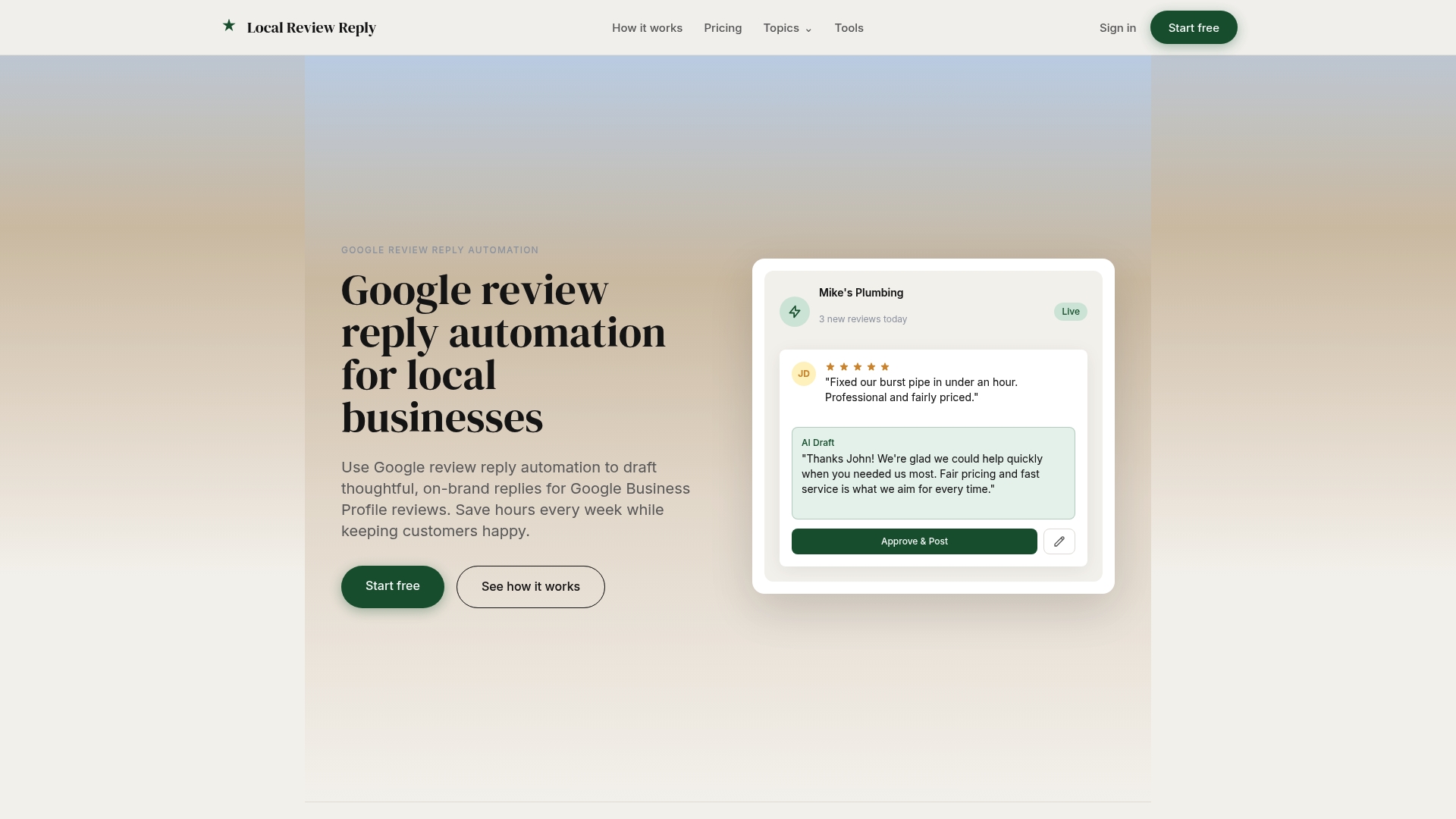
The platform maps directly onto the workflow described above. Its AI review response generator drafts replies pulling in specifics from the actual review, approval controls hold low-star or flagged reviews for human review before they ever go public, and white-label options for agencies let you manage replies across client accounts without exposing the tool underneath. Multi-location permissions mean a franchise operator can let each store manager handle their own queue without losing brand consistency across the network.
Start with the free response generator to see how a draft reads for your own reviews, then pilot approval rules on one location before rolling out Localreviewreply's Google review management software across your full portfolio.
Sources
For deeper detail on the test data behind hybrid quality gains, see ReviewGen.AI's controlled comparison of AI, human, and hybrid replies. For platform-level automation rules, Zoho's guidance on review automation covers rating-based posting and approval queues in more depth. Chatmeter's review response template library is a solid starting point for reply length and tone.
- Reviewgen
- Review Automation Software | Zoho Publish
- AI Review Responses vs. Manual: High-Converting Examples for 2026 | Vendasta
- Templates vs. AI review response: Which is the best strategy | Respage