
When you spot a competitor review worth acting on, screenshot it, save the reviewer's profile history, and post a calm, non-accusatory public reply if it's your own review in question. If the review looks fake or violates platform rules, report it through the proper channel rather than arguing in the comments. Set a 48-hour reply SLA and put competitor review audits on a recurring calendar.
TL;DR:
- Focus on reviews from platforms most relevant to your category, like Google, Yelp, or industry-specific sites, to gather meaningful insights.
- Prioritize analyzing detailed, low-star reviews, especially those mentioning competitors or switching from other providers, to identify genuine market gaps.
- Respond to reviews within 24 to 48 hours using personalized templates, and escalate or report suspicious or fake reviews through proper channels.
- Convert common complaint themes into product or marketing improvements based on their frequency, impact, and fixability within a quarter.
- Implement a scalable review response SOP with designated roles, approval workflows, and audit trails to maintain consistency across multiple locations.
Table of Contents
- How to Collect and Analyze Competitor Review Data
- How to Respond to Reviews the Right Way
- Turning Review Themes Into Product and Marketing Moves
- Building an SOP for Responding at Scale
- A Simple Week-One Test for Your Own Review Process
- Where Local Review Reply Fits Into This Process
- Sources
How to Collect and Analyze Competitor Review Data
Start with the platforms where your category actually gets reviewed. For most local service businesses, that means Google Business Profile first, then Yelp, Facebook, and any vertical-specific site (Houzz for contractors, Healthgrades for medical practices, G2 for software). Pulling reviews from a platform nobody in your category uses wastes time.
Sample deliberately instead of reading everything. One- and two-star reviews carry the highest signal because dissatisfied customers explain themselves in detail. Pay special attention to anyone using "switched from" or "used to use" language. That phrasing marks a customer who already tried an alternative and picked yours instead. It's close to a documented buying reason, and mining that language systematically surfaces gaps you can act on rather than guess about.
Collection can be as simple as a manual export into a spreadsheet, or you can use a competitor's own review-report pages if the platform offers one. Whatever method you use, keep the evidence: screenshots, timestamps, and the reviewer's profile history if the review looks suspicious. That documentation matters later if you need to report or defend a claim.
Once you have a batch of reviews, build a short codebook. Tag each review by theme, such as "pricing confusion," "slow response time," or "missed appointment." Then tally frequency and estimate impact, weighting themes that show up repeatedly across many reviewers over a one-off complaint from a single frustrated customer.
- Log source platform, date, star rating, and reviewer type for every entry
- Tag each review with one or two theme codes, not a paragraph of notes
- Flag "switched from" language separately; it's your highest-value signal
- Note whether the complaint is about a policy/price/scale limit or a one-time service slip
| Signal type | Example | What it usually indicates |
|---|---|---|
| Recurring 1 to 2 star theme | "Support never answers" mentioned repeatedly | Durable operational gap |
| "Switched from" mention | "Switched from [competitor] because pricing tripled" | Validated demand, messaging opportunity |
| Single low-rated review, no pattern | One angry review about a late technician | Likely a transient service miss |
| Vague or generic complaint | "Bad experience, wouldn't recommend" | Low signal, hard to act on |
The distinction between a durable issue and a passing bug matters more than most businesses realize. If ten reviewers over six months all complain that a competitor's pricing structure penalizes small accounts, that's an architectural or business-model limit, not something they'll patch next quarter. That's the kind of gap worth building a marketing message around.
How to Respond to Reviews the Right Way
The reply formula that works across nearly every platform follows a simple shape: thank the reviewer, mirror a specific detail from what they wrote, acknowledge the situation without over-apologizing for things outside your control, offer a concrete next step, and move detailed resolution to a private channel. Yelp's own guidance backs this up. Responding at all makes readers significantly more likely to leave their own review and more willing to look past a critical one if they see you engaged with it.
Timing and length both matter. Aim to respond within 24 to 48 hours, and keep most replies between 50 and 140 words. Shorter works fine for positive reviews; negative or complex ones usually need the extra length to show you understood the specific complaint.
Here are four templates you can adapt. Treat each bracket as a variable to swap in.
- Positive review: "Thank you, [name], for the kind words about [specific detail they mentioned]. Our team works hard on exactly that, and we're glad it showed. Hope to see you again soon."
- Neutral review: "Thanks for the honest feedback, [name]. We'd love to hear more about [specific issue] so we can do better. Feel free to reach us at [contact] directly."
- Negative review, service failure: "We're sorry your experience with [specific detail] didn't meet what you expect from us, [name]. That's not typical, and we'd like to make it right. Please contact us at [contact] so we can look into what happened."
- Suspected fake or competitor review: "We take all feedback seriously, but we're unable to locate a record matching this visit under [name/date/detail]. If you'd like to share more details, please contact us directly at [contact] so we can investigate."
Pro Tip: Build templates from modular blocks, not fixed scripts. A template with fewer than three personalization variables, name, specific detail, and remedy, reads as automated, and generic replies deter many consumers who read them.
If a review looks fabricated, was posted by someone with no transaction history, or appears to come from a competitor rather than a real customer, don't accuse them publicly. Collect your evidence first: screenshots, the reviewer's post history, and any internal record showing no matching visit. Then use the platform's reporting flow rather than escalating in the comments.

Turning Review Themes Into Product and Marketing Moves
A frequency-ranked list of complaints is only useful if you triage it. Score each recurring theme on three axes: how often it shows up, how much it likely affects purchase decisions, and how feasible it is to fix within a quarter. A complaint that's frequent, high-impact, and cheap to fix jumps to the top of your roadmap. A frequent but structurally hard-to-fix complaint, like a competitor's pricing tier confusion, becomes a messaging opportunity instead.
Concrete examples of what this looks like in practice:
- Recurring "hard to reach support" complaints become a chatbot or callback-request feature on your own site
- "Switched from" mentions naming a specific pain point get written into ad copy and landing page headlines
- Onboarding confusion flagged repeatedly in reviews becomes a revised welcome email sequence
- Slow response times mentioned across multiple competitor reviews become an internal SLA you can advertise
Reviewer language is also free copywriting. If multiple people describe a competitor as "impossible to cancel" or "confusing pricing," build a battle card with that exact phrasing and a direct rebuttal: "Cancel anytime, no phone call required" lands harder when you know it's answering a real, repeated objection.
After you make changes, watch three metrics over the following weeks: your own star rating trend, review volume (more reviews usually means more visibility and more feedback loops), and any measurable shift in conversion on the pages where you deployed the new messaging.
Building an SOP for Responding at Scale
Once you're managing reviews across more than a handful of locations, ad hoc replies stop working. You need defined roles: someone who owns the review process, someone who drafts responses, and someone who approves anything sensitive before it goes live. Pair that with a firm response-time SLA, 24 to 48 hours is standard, and clear escalation rules for legal threats, health and safety claims, or anything mentioning an employee by name.
- Assign an owner, a responder, and an approver for every location or region
- Set a 24 to 48 hour SLA and track it in a dashboard, not a spreadsheet nobody checks
- Route sensitive or low-star reviews through mandatory human approval before publishing
- Require role-based access so franchisees can't post replies on locations they don't manage
AI drafting speeds this up without removing the human check. The safest workflow is draft, human edit, approval, publish, with sensitive or low-star reviews always forced into manual review rather than auto-published. Businesses that respond consistently see it show up in the numbers: applying a structured framework like L.A.S.T. (Listen, Apologize, Solve, Thank) has been linked to measurable ratings gains, and prompt responses build the same trust at scale that a single well-written reply builds one customer at a time. For multi-location teams, the tooling question isn't whether to use AI drafting, it's whether the tool enforces approval gates, tracks who approved what, and gives you an audit trail if a reply is ever disputed later.
A Simple Week-One Test for Your Own Review Process
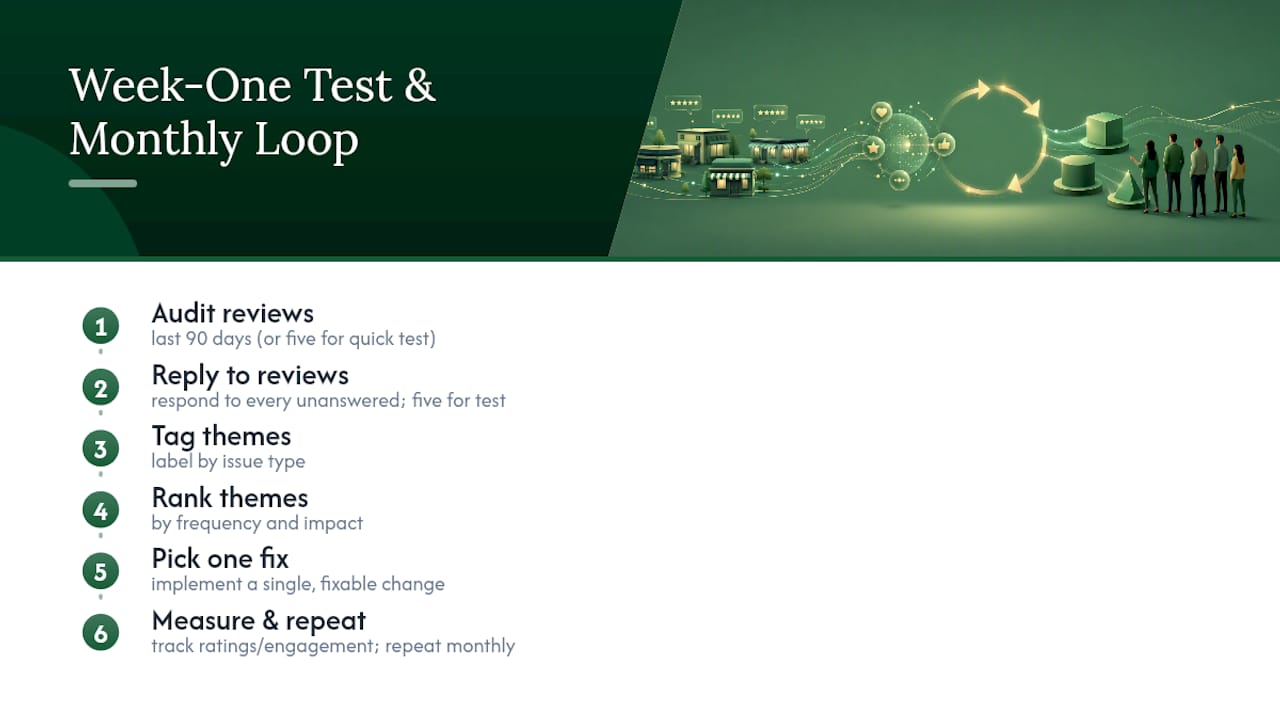
Here's a checklist worth running before you overhaul anything: audit your last 90 days of reviews, respond to every unanswered one, tag each by theme, rank themes by frequency and impact, pick one fixable issue and act on it, measure any shift in rating or reply engagement, then repeat monthly. None of this requires new software or a big process change to start.
If you want a fast gut check on whether this works for your business, try a smaller version first: audit five competitors, reply to five of your own recent reviews with sharper, more specific replies than you'd normally write, and track whether engagement or reply-driven traffic moves at all over the following week. Small experiments like this tend to reveal more than a month of theorizing.
— Ryan
Where Local Review Reply Fits Into This Process
Once you're juggling review responses across a dozen locations, the bottleneck stops being knowledge and starts being time in the day. Localreviewreply is built for exactly that gap: it drafts personalized, on-brand replies to Google reviews in seconds, routes sensitive or low-star reviews through an approval step before anything goes live, and gives multi-location teams role-based access so franchisees only touch what they're supposed to.
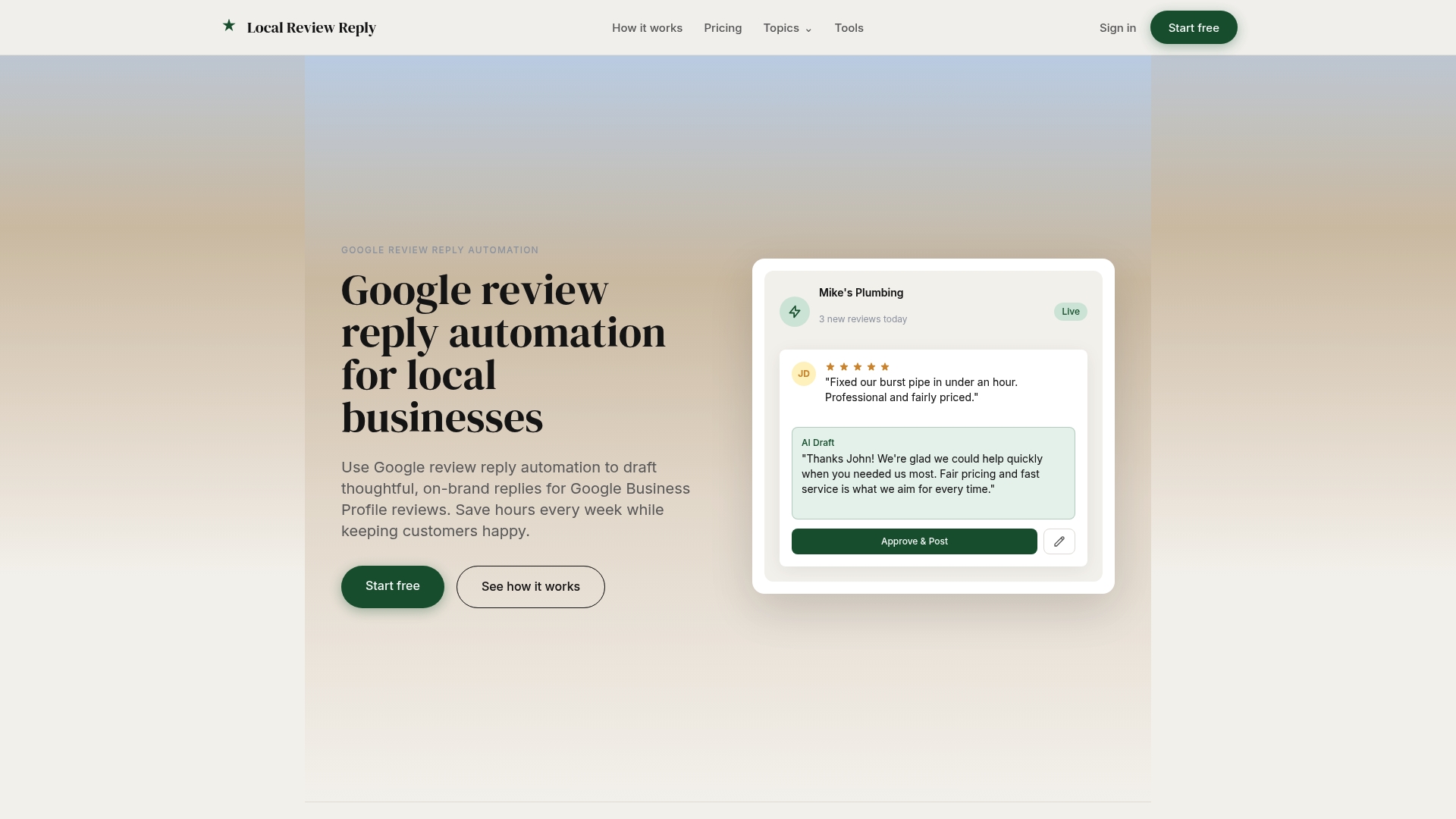
It's built for franchise operators, multi-location service businesses, and agencies managing reviews for multiple clients who need consistency without a full-time reviewer on staff for every location. The drafting is automated; the publishing decision stays with a human, especially on anything sensitive. If your current process is a shared inbox and good intentions, the Automated Google Review Replies workflow is worth a look, and you can start with a free trial to see how the approval flow fits your team before committing to a paid plan.
Sources
- Tips for responding to reviews on Yelp (Yelp for Business)
- Reply to customer reviews on Google Business Profile
- How to respond to negative reviews: the L.A.S.T. framework + 7 real examples · Reviewz
- Mining Competitor Reviews for Product Gaps | Seeto