
A good review reply prompt names its inputs, bans invented facts, and caps its own length. Here's the minimum viable version: "Write a 2-3 sentence reply to {reviewer_name}'s {rating}-star review of {business_name}. Thank them, reference {review_excerpt} specifically, and invite them to contact {location} directly. Never invent details not in the review." Anything below a 3-star rating should route to a human before it posts.
TL;DR:
- Automated review replies must rely on specific dynamic placeholders and avoid inventing facts to comply with FTC and platform rules.
- Different review types require tailored templates, with positive, neutral, and negative responses each maintaining appropriate tone and length.
- Regular review and update of templates are essential to adapt to evolving customer language patterns and complaint categories.
- Human oversight remains crucial for replies to low-star reviews, safety issues, or disputes to ensure compliance and appropriate tone.
- Software tools should combine auto-drafting with human approval, especially when managing multiple locations and platforms like Google, Yelp, and Amazon.
Table of Contents
- What Every Custom Prompt for Review Replies Needs
- Prompt Templates for Every Review Type
- Testing, Tuning, and Rolling Out Prompts Safely
- Building FTC and Google Rules Into the Prompt Itself
- Reading the Room: Sentiment Analysis in Prompt Design
- Keeping Prompts Current as Review Patterns Shift
- Turning Edits Into a Feedback Loop
- Adapting Prompts for Google, Yelp, and Amazon Formats
- Where Automation Should Stop
- How Local Review Reply Puts These Controls to Work
- Primary Sources Worth Bookmarking
- Sources
- FAQ
What Every Custom Prompt for Review Replies Needs
Most review reply prompts fail for one reason: they ask the model to sound like a brand without giving it anything real to work with. "Be friendly and professional" is not an instruction, it's a wish. The model fills the gap with generic phrases, and generic phrases are exactly what make review replies look automated.
A working prompt for review responses does two jobs at once. It hands the model dynamic facts pulled from the actual review, and it draws a hard line around what the model is allowed to say beyond those facts.
Dynamic placeholders to build into every template:
{reviewer_name}— pulled from the review itself, never guessed{rating}— determines tone and whether the reply needs escalation{review_excerpt}— a direct quote or paraphrase the model must reference{location}— critical for multi-location brands and franchises{business_name}— matters more than it sounds for agencies managing dozens of profiles
Facts the prompt must supply explicitly, because the model cannot know them: staff or technician names, refund and warranty terms, hours, pricing, and anything about an ongoing dispute. If the prompt doesn't hand over that information, the reply shouldn't reference it at all.
Constraints matter as much as content. Set a maximum reply length (two to four sentences works for most platforms), list phrases the model must avoid ("guaranteed results," anything implying a discount or payment for the review), and add one non-negotiable line: "If a detail is not provided, do not invent it. Say the team is looking into it instead." Vendor documentation on prompt construction for review tools echoes this same principle: concrete instructions outperform vague style cues because the model follows explicit text more reliably than it interprets personality descriptions.
Pro Tip: Test your prompt's default output before adding constraints. If the unmodified reply already sounds close to your brand voice, you need fewer guardrails than you think, and every extra constraint is one more thing that can break when the model updates.
Prompt Templates for Every Review Type
Build one template per review category rather than a single do-everything prompt. A positive-review prompt and a negative-review prompt have different jobs, and mixing them produces replies that either undersell the good ones or sound tone-deaf on the bad ones.
- Five-star, no detail: "Thank {reviewer_name} for the {rating}-star review. Keep it under 2 sentences, warm but not gushing. No invented specifics." Expected length: 15 to 25 words.
- Five-star, specific praise: "Thank {reviewer_name} and reference {review_excerpt} directly. Mention {business_name} looks forward to their next visit to {location}." Length: 20 to 35 words.
- Neutral (3 star): "Acknowledge {reviewer_name}'s {rating}-star review politely. Reference {review_excerpt}. Invite them to share more feedback at {contact_channel}. No apology unless a specific complaint is named." Length: 25 to 40 words.
- Negative, service issue: "Apologize briefly to {reviewer_name} for the experience described in {review_excerpt}. Do not admit fault beyond what's stated. Offer to continue the conversation at {contact_channel}." Length: 30 to 45 words.
- Negative, factual dispute: "Acknowledge {reviewer_name}'s concern without confirming or denying details not in {review_excerpt}. State that {business_name} is looking into it and provide {contact_channel}." Flag for manual review before publishing.
- Review mentioning staff by name: "Thank {reviewer_name}, reference {staff_name} if provided in {review_excerpt}, and reinforce {business_name}'s service standard at {location}." Length: 20 to 30 words.
Rotate three variants per review type so replies to similar star ratings don't read like copy-paste. A basic rotation rule (cycle through template A, B, C in sequence, or randomize) prevents the pattern-matching that makes automated replies obvious to repeat customers scanning a profile.
Testing, Tuning, and Rolling Out Prompts Safely
Run every prompt through a generate → review → edit → publish sequence, with a named person owning the review step. Skipping that step is how a fine template becomes a public complaint.
- Assign one team member to review drafts daily rather than rotating the task, so tone drift gets caught early.
- Test in small batches of 10 to 20 replies, changing exactly one variable per batch (reply length, one phrase, one placeholder) so you know what caused a shift in quality.
- Track three numbers: how often reviewers edit the draft before publishing, replies published per day, and time from review posted to reply live. A rising edit rate signals the prompt needs a rewrite, not more tweaking.
Faster replies carry real weight with future customers. An analysis of nearly 230,000 Google reviews found that responding quickly, especially to one-star reviews, delivers outsized value to the audience reading those replies later, not just the original reviewer.
Building FTC and Google Rules Into the Prompt Itself
The FTC's rule on consumer reviews and testimonials prohibits misrepresenting reviews and requires disclosure of material connections. Automated replies need to respect the same standard: no fabricated claims, no implying a review was incentivized when it wasn't, no pretending a complaint didn't happen.
Google's own guidance for replying to reviews on a Business Profile reminds owners that replies are public and permanent, which means a hallucinated detail doesn't just embarrass you once.
Build these lines directly into your prompts:
- "Never state a fact not present in {review_excerpt} or supplied context."
- "If a detail is unknown, say the team is looking into it rather than guessing."
- "Do not offer compensation, discounts, or refunds in the reply itself."
- "Do not accuse the reviewer of dishonesty, even if the claim seems inaccurate."
The FTC's Q&A on the rule clarifies that false accusations against reviewers are treated as seriously as fake positive reviews, so a defensive AI-generated reply is a real liability, not just a bad look.
Reading the Room: Sentiment Analysis in Prompt Design
Star rating alone misses a lot. A 3-star review with furious language needs a different opening line than a 3-star review that's mildly disappointed but polite, even though both carry the same numeric score.
Feed the model a sentiment signal alongside the rating rather than relying on stars as a proxy for tone. That can be as simple as a pre-processing step that tags reviews as frustrated, disappointed, neutral, pleased, or enthusiastic based on language intensity, then routes each tag to a matching prompt variant. A frustrated 2-star review gets a prompt that opens with acknowledgment before anything else. A merely disappointed 2-star review can open with a thank-you and pivot faster to resolution.
Watch for sarcasm and backhanded compliments, the cases where sentiment tagging fails most often. "Great, if you enjoy waiting an hour" reads as mixed or even positive to a naive sentiment model but is clearly negative to a person. Build a fallback: any review where sentiment confidence is low gets flagged for human drafting instead of automated generation. That single rule catches most of the edge cases that would otherwise produce a tone-deaf reply.
Sentiment tagging also helps prioritize the review queue itself, not just the reply tone. Routing the angriest reviews to the top of a team's review queue does more for customer perception than replying to everything in chronological order.
Keeping Prompts Current as Review Patterns Shift
Prompts age. A template built for common phrasing this quarter will start missing the mark as customer language, product lines, or complaint patterns shift, and nobody notices until the edit rate creeps up.
Set a recurring review, monthly for high-volume accounts, quarterly for lower-volume ones, where someone reads a sample of recent drafts against the reviews they respond to. Look specifically for: new complaint categories the current templates don't address, phrases customers use that the model doesn't pick up on, and any drift toward stock language across otherwise different reviews.
Update one template at a time rather than rewriting the whole prompt library at once. Changing everything simultaneously makes it impossible to tell which edit fixed or broke what. If a new complaint type appears repeatedly (a supply issue, a policy change, a new service line), write a dedicated template for it rather than stretching an existing one to cover a case it wasn't built for.
Keep a simple changelog: the date, what changed, and why. Six months from now, when a reply pattern looks off, that log is the fastest way to trace it back to the prompt edit that caused it. Practical guidance on responding to customer reviews consistently recommends treating templates as living starting points rather than finished text, which applies just as much to the prompts generating those templates as to the replies themselves.
Turning Edits Into a Feedback Loop
Every time a human edits an AI-drafted reply before publishing, that edit is data. Most teams throw it away. The ones that improve fastest treat it as the single best signal they have.
Track edits by type: tone corrections, factual fixes, length trims, added specifics. If tone corrections cluster around negative reviews, the negative-review template needs adjustment, not the positive one. If factual fixes cluster around a particular placeholder, that placeholder is probably pulling the wrong field or the source data feeding it is incomplete.
Feed patterns back into the prompt itself rather than fixing replies one at a time forever. If reviewers consistently add a specific phrase the model never generates on its own ("we'll follow up personally"), that's a candidate line to add directly into the template. If a phrase the model generates gets deleted almost every time, cut it from the prompt.
This loop works best with a light structure: a shared log of edit types, a monthly look at which templates generate the most edits, and one person with authority to update the prompt library based on what the log shows. Without that ownership, the feedback just accumulates as noise nobody acts on.
Adapting Prompts for Google, Yelp, and Amazon Formats
Platform formatting rules change what a prompt should output, even when the underlying reply logic stays the same.
Google Business Profile replies show up directly beneath the review and support a moderate length, roughly two to four sentences reads naturally in that layout. Google's guidance on replying to reviews treats the reply as a visible signal of responsiveness, so prompts for Google replies should prioritize speed and clear acknowledgment over elaborate detail.
Yelp displays owner replies with less visual prominence and Yelp users tend to read them more skeptically, since Yelp's culture leans toward viewing business responses as defensive. Prompts for Yelp replies benefit from a slightly more measured, less promotional tone. Drop any line that sounds like marketing copy.
Amazon seller responses to product reviews (where available for a given account type) operate under stricter platform content rules and typically focus on product specifics rather than general service tone. A prompt built for a service-business Google reply won't translate directly. Build a separate template that references product details, not location or staff.
The core placeholders stay consistent across platforms, {reviewer_name}, {rating}, {review_excerpt}, but the length constraint, tone calibration, and allowed content shift per platform. Treat each platform as its own prompt variant rather than trying to force one universal template across all three.

Where Automation Should Stop
Automate high-volume positive replies; require a human for legal threats, safety complaints, or disputed facts. Speed, personalization, and compliance rarely max out together, so pick your trade-off deliberately. Before publishing, ask: is this factual, is anyone at risk, does this need a real apology?
— Ryan
How Local Review Reply Puts These Controls to Work
Everything above, placeholders, approval gates, template rotation, is easier to run consistently with software built around that exact workflow. Some platforms draft personalized, on-brand replies to Google Business Profile reviews automatically, then route sensitive and low-star reviews through an approval step before anything goes live.
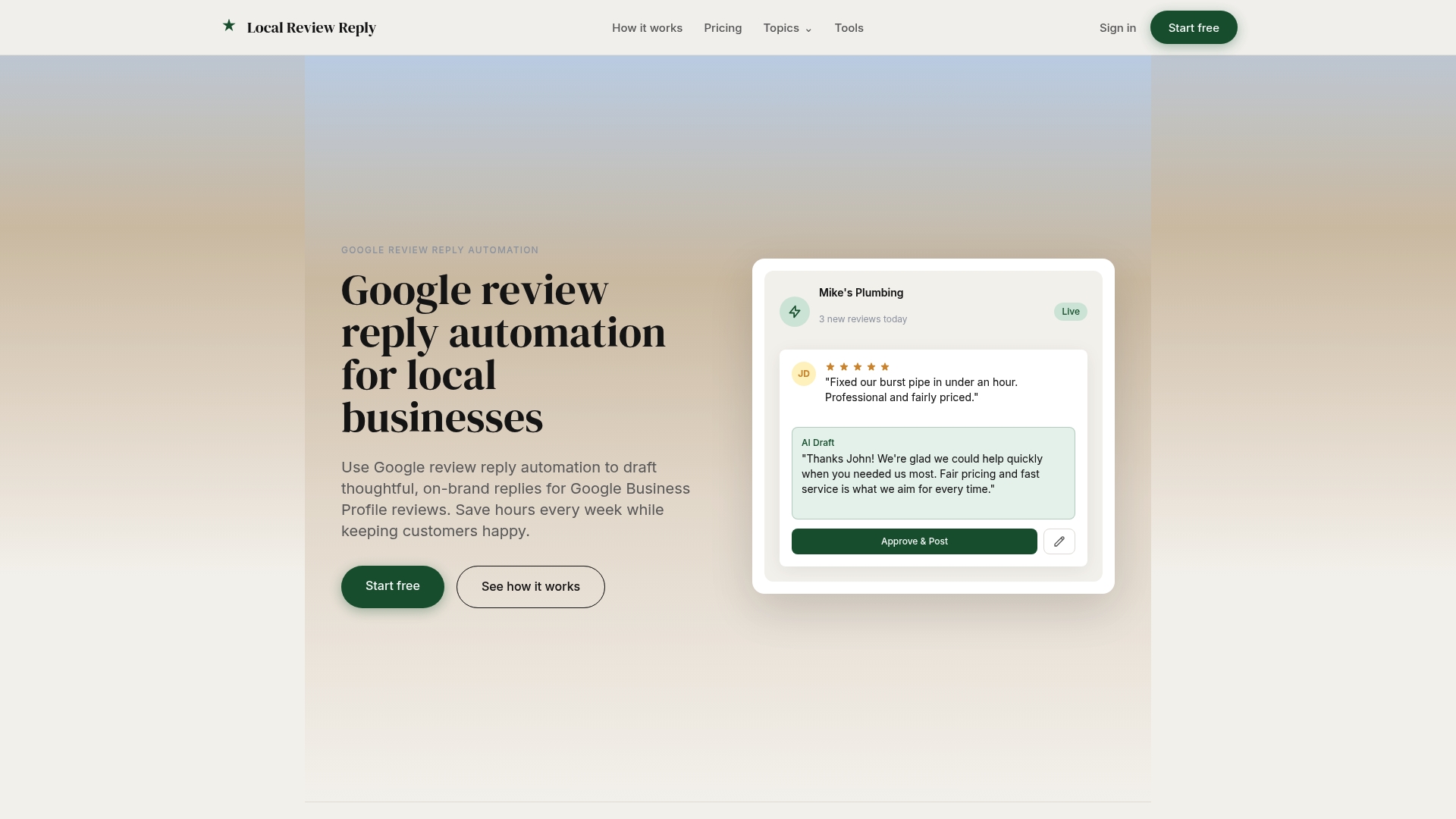
That maps directly onto the generate → review → edit → publish sequence covered earlier: the software handles the drafting, a team member handles the sign-off, and nothing posts without that human check on the reviews that need it most. For agencies and franchise groups managing reply consistency across many locations, separating automated drafting and human approval supports scaling review management while maintaining brand voice across profiles.
The platform includes role-based permissions for teams managing multiple locations, along with dashboard views built for exactly the kind of tracking this article recommends: reply volume, response time, and where drafts are getting edited most. Plans range from a Free tier up through Starter, Growth, Scale, and Custom options depending on location count and reply volume, detailed on the pricing page. If you manage reviews across several locations, the multi-location review reply tools are worth a look before you build your own prompt library from scratch. Whatever you choose, keep a human in the loop on anything below a 3-star rating.

Primary Sources Worth Bookmarking
The FTC's finalized rule and its companion Q&A govern the safety section above. Google's reply guidance covers platform mechanics. For deeper reading on generating more reviews in the first place, this practical guide to earning Google reviews is a solid next stop. Consult legal counsel for compliance questions specific to your business.
Sources
- Trade Regulation Rule on the Use of Consumer Reviews and Testimonials
- The Consumer Reviews and Testimonials Rule: Questions and Answers | Federal Trade Commission
- Respond to reviews - Google Business Profile Help
- Respond to Google Reviews: What 229,882 Reviews Show
- Best practices for responding to customer reviews (Shopify)
FAQ
What Makes a Good Reply to a Positive Google Review?
A good reply thanks the reviewer by name, references something specific from their review, and stays under a few sentences. Generic thank-yous read as automated even when a human wrote them, so specificity is what separates a strong reply from a forgettable one.
Can You Give an Example of a 5-Star Review Response?
"Thank you so much, Maria! We're glad the team could get your AC fixed the same day you called. Hope to see you again at our downtown location." This works because it names the reviewer, references the specific service, and mentions the location without inventing anything the review didn't already say.
What Should a Negative Review Reply Avoid?
It should never dispute facts not confirmed internally, admit fault beyond what's already documented, or offer compensation publicly. The safest structure acknowledges the concern, apologizes for the experience, and moves the conversation to a private channel.
How Much Does Local Review Reply Cost?
Local Review Reply offers a Free plan along with paid tiers, Starter, Growth, Scale, and Custom, priced by location count and reply volume. Exact pricing for each tier is listed on the pricing page.
Are There Templates for Different Review Platforms?
Yes. Reply length, tone, and formatting expectations differ across Google, Yelp, and Amazon, so a single universal template rarely performs well everywhere. Local Review Reply's template library covers platform-specific starting points you can adapt with your own placeholders.