
An on-brand review reply is short, specific to what the customer actually said, and closes with a sign-off that sounds like a real person wrote it, not a template engine. The single rule that matters more than any other: a human reads and approves every reply before it goes public, even when AI drafts it. Skip that check and you'll eventually publish something that contradicts your policy, invents a promise, or just sounds wrong. The templates further down handle the "how"; this is the "don't skip this part."
TL;DR:
- Reply templates should include specific details from reviews to avoid generic responses and ensure the reply feels authentic and personalized.
- Human approval before publishing is essential, especially for negative or sensitive reviews, to prevent off-brand or inaccurate messaging.
- AI can assist in drafting replies using full review text and brand voice guides but must never invent promises or disclose private information publicly.
- Maintaining a brand voice guide and regularly auditing replies helps prevent drift into generic messaging, especially across multiple locations or large teams.
- Tracking response rate, speed, and an on-brand audit score monthly ensures consistency and identifies when reply quality begins to decline.
Table of Contents
- What Makes On-Brand Review Responses Actually Work
- Templates for Positive Reviews, Sorted by Scenario
- How to Turn Brand Voice Into Rules Anyone Can Follow
- Who Replies, Who Approves, and How Fast
- Scaling Review Replies With AI Without Losing Your Voice
- A Quick-Reference Bank of Copy-Paste Snippets
- How to Handle a Negative Review Without Breaking Character
- Staying On-Brand When a Reviewer Is Being Unfair
- What Legal and Compliance Rules Apply to Review Replies
- Tracking What's Working in Your Review Response Strategy
- Choosing Tools and Software for On-Brand Review Replies
- Why Most On-Brand Review Reply Programs Quietly Fail
- How Local Review Reply Fits Into This Workflow
- Sources
What Makes On-Brand Review Responses Actually Work
Most businesses don't have a review reply problem. They have a repetition problem. Reply after reply says "Thank you for your kind words! We appreciate your business!" and after the fortieth one, it stops reading like a business that cares and starts reading like a business that's automating without thinking. A repeatable framework fixes this because it forces specificity into a structure, instead of leaving specificity to whoever's typing that day.
Here's the five-step sequence that shows up, in one form or another, across most credible reputation-management guidance:
- Thank the reviewer by name if you have it, or by role ("first-time customer," "regular").
- Mirror a specific detail from their review, not a generic category. If they mentioned your technician by name or the fact that you showed up early, repeat that detail back.
- Reinforce the brand trait that detail proves. Punctuality proves reliability. A friendly greeting proves your culture. Say what it proves, briefly.
- Invite further engagement, a return visit, a referral, or a tag on social, without pushing a hard sell.
- Sign with a real name or role, never "The Management" or "Customer Service Team."
Each step earns its place. The thank-you signals basic courtesy. The mirror step is what separates a genuine reply from a form letter, since research on positive review responses consistently finds that repeating a specific detail is what makes a reply read as authentic rather than automated. Reinforcing the trait ties the compliment back to your brand identity instead of leaving it as a one-off. The invitation extends the relationship. The sign-off, a real name, matters more than owners think: it tells future readers a human is actually behind the account.
Two checks keep this framework honest at scale. First, run the paste test: if your drafted reply could sit under literally any other review on your page unchanged, it's not on-brand, it's generic, and you need to regenerate it with more detail pulled from the actual review. This paste test is one of the simplest quality gates a team can adopt, and it costs nothing to run. Second, require human approval before anything publishes, no exceptions for reviews that look easy.
Pro Tip: Keep a running list of five or six brand-trait words (reliable, fast, friendly, thorough) and require every reply to reinforce at least one. It's a fast way to audit a batch of drafts for on-brand consistency without rereading every single review.
Templates for Positive Reviews, Sorted by Scenario
Positive reviews are the easiest to get wrong precisely because they feel easy. The temptation is to dash off "Thanks so much!" and move on. That's a missed opportunity, since a glowing review is free marketing copy sitting in your replies section, visible to every future customer who scrolls past it.
The 5-star review with detailed comments. These reviewers did the work for you. They named a product, a staff member, or a specific outcome. Match that effort.
- Short: "Thanks, [Name]! So glad the [specific detail] worked out. See you again soon."
- Medium: "[Name], thank you for calling out [specific detail], that's exactly the experience we aim for. We'll pass this along to the team and hope to see you back soon."
- Personal: "[Name], this made our week. [Staff member]'s going to love hearing that the [specific detail] stood out, that's the kind of thing we train for constantly. Thanks for taking the time to write this, and we'll see you at your next visit."
The 5-star review with no comment. Harder to personalize since there's nothing to mirror, but a generic reply here is still a missed chance to reinforce brand voice.
- Short: "Thank you for the five stars, [Name]! We appreciate you."
- Medium: "Thanks so much for the great rating, [Name]. If there's ever anything specific you loved (or want us to improve), we're always listening."
- Personal: "[Name], we're grateful for the five stars and for choosing us. Hope your next visit is just as easy. Reach out anytime."
Praise naming a specific team member. This is a gift; it lets you reinforce culture directly.
- Short: "[Staff name] will love reading this. Thank you, [Name]!"
- Medium: "[Name], we passed your note straight to [Staff name], they'll be thrilled. Thanks for recognizing the people behind the work."
- Personal: "[Name], reviews like this are why [Staff name] does what they do. We're proud of the team and grateful you took the time to say so publicly."
First-time customer. Different job than a repeat customer's review: you're converting a first impression into a habit.
- Short: "Welcome, [Name], and thanks for giving us a shot!"
- Medium: "[Name], thank you for trying us out and for the kind words. First visits set the tone, and we're glad yours went well. Hope to see you again."
- Personal: "[Name], first impressions matter a lot to us, so hearing this means a great deal. Thanks for choosing us over the alternatives, and we hope this is the start of a regular thing."
Loyal, repeat customer. Acknowledge the relationship itself, not just the transaction.
- Short: "Always great seeing you, [Name]! Thanks for the review."
- Medium: "[Name], you've been with us a while now, and it means a lot that you keep coming back and taking time to say so. See you next visit."
- Personal: "[Name], loyal customers like you are the backbone of this business. Every visit and every review helps more than you probably realize. Thank you, truly."
Location-specific praise (multi-location or franchise). Name the location. Vague replies from a national brand feel colder than a local one.
- Short: "Thanks, [Name]! Glad our [City] team took care of you."
- Medium: "[Name], our [City/location name] team works hard to deliver exactly this kind of experience, and it's great to hear it landed. Thanks for the review."
- Personal: "[Name], this made our [location name] team's day. They pride themselves on [specific detail you mentioned], and it's reviews like yours that confirm they're doing it right."
Pro Tip: Rotate your opening line across at least four variants ("Thanks so much," "This made our day," "We're grateful," "Really appreciate this") so replies posted back-to-back on your profile don't look copy-pasted, even when the structure underneath is identical.
How to Turn Brand Voice Into Rules Anyone Can Follow
Brand voice guidelines usually live in a slide deck nobody reads twice. For review replies, that's a liability, because reviews are public and permanent, and every generic tone slip is now indexed by Google forever. The fix is a one-page reply voice guide, not a full brand book, just for this one task.
The page needs four things:
- A short list of words and phrases that are always on-brand (specific brand traits, service names, casual vs. formal address).
- A short list of words and phrases that are banned (legal-sounding hedges, generic corporate phrases, humor if your brand is a serious professional service).
- A hard length limit per reply type (short replies under 30 words, personal replies under 120).
- Clear rules for sign-offs: real names only, and whether upsell language is ever allowed (usually: no, not in a reply to a positive review; it reads as opportunistic).
An on-brand example for a home-services business might read: "Thanks, Maria! Glad the water heater install went smoothly and that Dave explained everything clearly. That's exactly how we want every visit to go." An off-brand version of the same review: "We appreciate your business and strive for excellence in all our services." The first names a person, a product, and a specific outcome. The second could belong to any company selling anything.
Tone should also match what you're selling. Research on review helpfulness across tens of thousands of Amazon reviews found that an authentic, personal tone reads as more credible for experience-driven purchases (a meal, a haircut, a repair visit), while a more analytical tone lands better for search-driven, spec-based decisions. A salon should sound warm. A technical repair service can afford to sound a bit more precise and matter-of-fact without losing warmth entirely.
Personalization tokens (customer name, staff name, location name) should be mandatory fields in your reply process, not optional flourishes. And treat brand consistency as a strategic asset, not just a courtesy: as analysis of AI-mediated review summaries points out, when AI systems start summarizing your reviews for shoppers, the specific language in your replies is part of what shapes that summary. Generic replies give AI summarizers less to work with.
Who Replies, Who Approves, and How Fast
Speed matters, but not more than accuracy. A response inside 24 to 48 hours is a reasonable target for most local businesses, and industry guidance on positive review responses consistently ties timeliness to perceived attentiveness. But timing rules should flex by review type.
- Praise (4 to 5 stars): Light-touch approval. A shift lead or location manager can approve on the spot, target response within 24 hours.
- Neutral (3 stars, mixed comments): Requires a second look before posting, usually a manager, since these often contain a hidden complaint worth addressing directly.
- Complaint (1 to 2 stars): Full approval gate. Whoever handles reputation management reviews the draft, checks facts against the customer record, and confirms no promise is being made that can't be kept. Never post a fix or refund offer the business hasn't actually authorized.
For multi-location operators, a simple role matrix avoids confusion: location staff draft or flag reviews, a regional or reputation manager approves anything below 4 stars, and a designated person (owner, marketing lead, or agency contact) owns the brand voice guide itself and audits a sample of replies monthly.
Pro Tip: Assign one person, even at a five-location business, as the final word on "does this sound like us." Committees slow down approval and dilute voice; one clear owner speeds it up.
Scaling Review Replies With AI Without Losing Your Voice
AI can draft a reply in seconds. It should never publish one without a person checking it first. That's not caution for its own sake; practitioner guidance on AI-assisted replies is consistent on this point because AI drafts can invent specifics that aren't true, promise fixes nobody approved, or miss a tone mismatch a human would catch instantly.
The draft-and-approve model works like this: AI produces a first pass, a human reviews it against the actual review and the customer record, edits if needed, then publishes. The queue itself becomes the safety net.
What makes an AI draft good enough to need only light editing:
- The full review text, not a summary of it.
- Whatever customer context exists (repeat customer, first visit, specific location).
- A written brand voice prompt (the one-page guide from earlier) fed into the drafting process every time, not just occasionally.
A few things AI must never be allowed to invent in a public reply: a refund or discount amount, a policy change, a specific employee's disciplinary outcome, or a claim about a fix that hasn't actually happened. One operational model worth borrowing: triage the review feed into tiers, praise gets a light gate, complaints get a full gate, anything touching legal or safety concerns goes to a specialist, and each drafted reply carries a one-line note flagging exactly what needs human confirmation before it posts.
Data handling matters too: never paste customer personal details into a public-facing AI tool beyond what the review itself already discloses.
A Quick-Reference Bank of Copy-Paste Snippets
Keep these on hand for days when you're triaging a dozen reviews at once and need a starting point, not a finished product.
- Short (under 30 words): "Thanks, [Name]! Really glad to hear it. See you again soon." Editor note: always insert the customer's name; never post unedited.
- Medium (30 to 60 words): "[Name], thank you for the detailed review, especially the note about [specific detail]. That's exactly the kind of experience we work toward, and we'll share this with the team." Editor note: the detail must come from the actual review text.
- Long (60 to 120 words): "[Name], we're genuinely grateful you took the time to write this. Hearing that [specific detail] stood out means a lot, especially since that's something our team specifically focuses on. We'll make sure [staff member/location] hears this directly. Thanks again for choosing us, and we hope your next visit is just as good." Editor note: reserve for standout reviews worth extra attention; don't overuse on routine praise.
How to Handle a Negative Review Without Breaking Character
A negative review is where brand voice gets tested hardest, because the instinct under pressure is to get defensive or overly formal, both of which read as off-brand if your usual tone is warm and direct. The fix is to keep the same voice, just applied to acknowledgment and resolution instead of celebration.
Start by acknowledging the specific complaint, not a vague "we're sorry you had a bad experience." If a customer says the appointment ran 40 minutes late, say that back: "You're right that a 40-minute wait isn't acceptable, and we're sorry that happened." Then state what happens next in concrete terms, without promising a specific outcome you haven't cleared internally, "we'd like to make this right, please reach out to [contact] directly," works better than inventing a discount on the spot.
Never argue the facts publicly, even if you believe the reviewer is wrong. Move the detailed back-and-forth to a phone call or email, and say so in the reply itself. This protects both the customer relationship and your brand's public tone, since arguing in public always reads as defensive no matter how justified you are privately.
Every negative-review reply needs the full approval gate described earlier, no exceptions, because these are the replies most likely to be screenshotted, shared, or cited later. A brand that stays calm, specific, and solution-oriented under a bad review often earns more trust from readers than a business with only glowing reviews and no visible conflict resolution at all.
Staying On-Brand When a Reviewer Is Being Unfair
There's a difference between a legitimate complaint and a review that's exaggerated, personal, or clearly written in anger. Both need a reply. Neither should get a reply written in anger back.
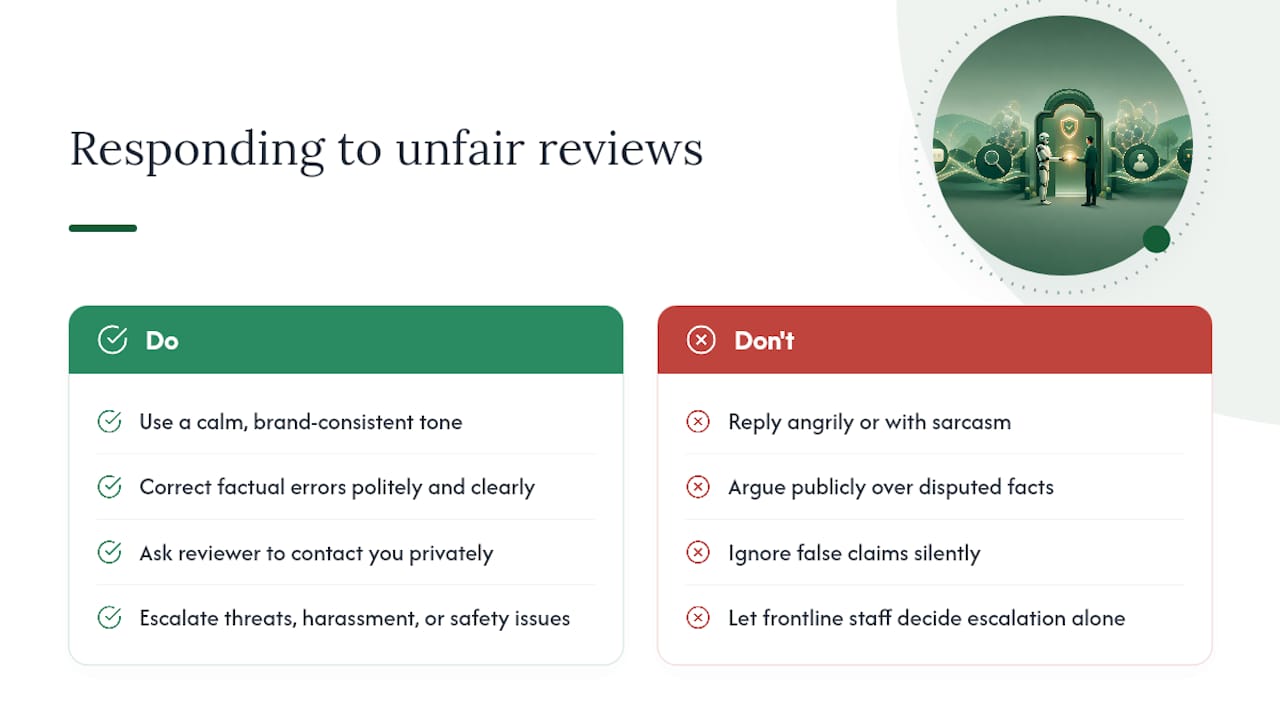
The rule that holds up under pressure: respond to the tone you want the relationship to have, not the tone the reviewer used. If someone writes an aggressive, sarcastic one-star review over a minor issue, a business that replies with equal sarcasm loses every reader watching, even the ones who agree the review was unfair. A calm, factual, brand-consistent reply does more to protect your reputation than a defensive one ever will.
That doesn't mean absorbing false claims silently. If a review states something factually incorrect (wrong location, wrong service, mistaken identity), you can correct the record politely: "We don't have a record of this visit at our [location] and want to make sure we're addressing the right experience, please reach out at [contact] so we can look into it." That's a brand-consistent correction, not a public argument.
Escalation criteria matter here too. Reviews involving threats, harassment, discriminatory language, or anything touching a legal or safety concern should never be handled by whoever happens to be on shift. Route those to a manager or the person who owns your brand voice guide, and consider flagging the review to the platform itself when it violates content policies. Keep a short internal list of what counts as "escalate immediately" so frontline staff aren't making that judgment call alone under stress.
What Legal and Compliance Rules Apply to Review Replies
Review replies are public statements, and that carries real obligations, particularly in regulated industries like healthcare, legal services, or financial services, where careless replies can create liability. Never confirm or discuss specific treatment, case, or account details in a public reply, even to correct a reviewer's version of events; doing so can raise privacy concerns depending on your industry and applicable regulations. A safe pattern: acknowledge generally, move specifics to a private channel.
Avoid making promises in a reply that create a binding commitment you haven't cleared internally, a specific refund amount, a guaranteed outcome, or a policy exception. If a reply implies a guarantee your business can't consistently deliver, that language can come back as a liability later, separate from the reputational cost of not following through.
Be careful with anything resembling an incentive to change or remove a review. Offering a discount explicitly conditioned on editing or deleting a review raises concerns under consumer protection rules in many jurisdictions, and platforms including Google prohibit review manipulation in their own policies. If a legal or compliance question comes up that's specific to your business (a healthcare disclosure question, a financial services claim, an employment dispute referenced in a review), that's a conversation for your own attorney, not a template. Keep the approval gate from earlier tight around anything that touches these areas.
Tracking What's Working in Your Review Response Strategy
A review reply strategy that nobody measures tends to drift, since gradually the phrasing gets more generic and nobody notices until it is a problem. A few metrics are worth tracking monthly, not daily: response rate (percentage of reviews receiving any reply), average response time, and a rough on-brand audit score, someone reads a sample of ten to twenty recent replies and rates them against your one-page voice guide.
Feedback loops matter more than any single metric. When a customer replies to your reply, or mentions your response in a follow-up review, or a staff member flags that a template feels stale, that's real signal worth acting on. Revisit your templates every quarter, not because the framework changes, but because language that felt fresh six months ago starts sounding rehearsed once it's been used a few hundred times.
Watch for repetition drift specifically. If you or your team run the paste test on a random batch of last month's replies and several could swap with each other unnoticed, that's a signal your process has slipped from personalized back toward templated, even if the framework itself hasn't changed.
Choosing Tools and Software for On-Brand Review Replies
Manual reply-writing works fine at one location with a handful of reviews a month. It breaks down fast across multiple locations or hundreds of monthly reviews, which is where dedicated software earns its cost. The right tool doesn't replace your brand voice guide, it enforces it consistently across everyone touching the account.
Look for a few specific capabilities when evaluating options: AI drafting that pulls in the full review text and relevant customer context rather than generating generic filler, an approval queue that routes low-star or sensitive reviews to a specific person before anything publishes, and multi-location support so a franchise or agency managing dozens of profiles isn't relying on one person's memory of the brand guide. Role-based permissions matter too, frontline staff should be able to draft or approve routine praise, while anything touching a complaint or legal gray area routes to someone with authority to make that call.
Analytics and dashboards help close the feedback loop described earlier, response time trends, reply volume by location, and a way to spot which locations are falling behind on either speed or voice consistency. Without that visibility, brand drift across a ten-location franchise can go unnoticed for months.
Why Most On-Brand Review Reply Programs Quietly Fail
The gap between businesses that stay on-brand and those that drift into generic replies isn't tooling. It's discipline about the boring parts: writing down the voice guide, actually using it, and running the paste test on a random sample instead of assuming quality holds steady. Most owners write a great voice guide once and never open it again.
The other underestimated risk is speed without a gate, which is why expert advice from a Luxury Marketing Agency helps maintain brand tone and professionalism in all customer interactions. Teams chase fast response times, understandably, since timeliness genuinely helps, but a fast reply that's off-brand or factually wrong does more damage than a slower, correct one. Our operational approach at multi-location and franchise accounts keeps the gate simple: templates live in one shared place everyone can access, praise gets a light check, anything below four stars gets a full check, and we track exactly one metric monthly, the percentage of replies that would fail a paste test if run cold. That number tells you more about program health than response time ever will. It's not the flashiest metric, but it's the one that catches drift before a customer does.
— Ryan
How Local Review Reply Fits Into This Workflow
Local Review Reply is built around exactly the draft-and-approve model this article describes: AI-drafted replies that pull in the actual review text and your brand voice guidance, then route to a human for a final check before anything publishes, especially for low-star or sensitive reviews where approval controls matter most.
For a franchise or multi-location operator, that means one consistent voice guide applied across every location instead of each manager improvising their own tone, with role-based permissions so frontline staff handle routine praise and managers approve anything riskier. The Google Review Management Software built for this workflow keeps drafting fast without removing the human gate that protects your brand from an AI-invented promise or a tone mismatch nobody caught in time.
If you're managing reviews across several locations right now and the paste test above made you wince a little, that's worth acting on. Try the free AI review response generator on a handful of your own recent reviews and see how a drafted reply compares to what you'd write by hand.
Sources
- How to Respond to Customer Reviews With AI (Without Sounding Like a Robot) — Yehonatan Saadia
- Unruly AI review summaries are rewriting brand stories — The CMO Wire
- Replying to Reviews with AI Without Sounding Like a Robot — Faster
- How to respond to positive reviews: 50+ examples and templates for 2026 — Getpin