
An approval SLA for review replies works best when it splits acknowledgment from approval to publish, then assigns each a time window based on severity. A one star complaint about a health or safety issue needs eyes in minutes; a routine three star review can wait hours. Get the tiers right, and speed stops being the enemy of quality.
TL;DR:
- Critical reviews require acknowledgment within minutes and approval to publish within a few hours, while positive reviews can wait days.
- Routing rules should consider review severity, keywords, and location to ensure the right approver handles each case, with auto-escalation set at 80% of the SLA window.
- AI-generated drafts require the same approval process as human drafts, especially for low-star, legal, or incentivized reviews, to maintain quality and compliance.
- Tracking multiple KPIs, such as first-reply time and edit rates, provides better insight into SLA effectiveness than speed metrics alone.
- Google review moderation can delay public visibility for up to 30 days regardless of internal approval timing, which must be factored into SLA and reporting.
Table of Contents
- What Is an Approval SLA for Review Replies?
- SLA Framework and Severity Tiers for Approval Workflows
- How to Design Routing, Ownership, and Approver Roles
- Templates and Automation Guardrails for AI Drafting
- What KPIs Actually Prove Your SLA Is Working
- How Google's Review Moderation Affects Your SLA Timing
- Scenario Playbooks by Severity and Business Impact
- Rolling Out Approval SLAs Without Breaking Your Team
- Why Most Approval SLAs Quietly Fail on Quality, Not Speed
- Let Local Review Reply Handle the Drafting While You Keep the Approvals
- Sources
What Is an Approval SLA for Review Replies?
An approval SLA for review replies is a documented commitment covering two distinct clocks: how fast someone acknowledges and triages a new review, and how fast an approver signs off so the reply can post. Most teams collapse these into one number and then wonder why "24 hour SLA" still produces angry customers waiting three days for a real answer.
The distinction matters because acknowledgment and resolution measure different things. Voc recommends defining acknowledgment, triage, ownership, escalation, and expected outputs as separate elements of the service promise, rather than one vague deadline covering the whole process. An SLA should not promise a resolved customer or a fixed star rating. It should promise a process: this review gets seen by X, routed to Y, and either approved or escalated by Z.
Zendesk's SLA framework uses a similar structure for support tickets: reply time, update time, and resolution time as three separate metrics, with explicit rules for what happens when a closed item reopens. Review replies benefit from the same split. A reply that gets edited and reposted after a customer responds again is functionally a reopened ticket, and your SLA timers need to account for that instead of treating the second reply as a fresh, low-priority item.
The standard industry term for this discipline is service level management, and it applies to review response the same way it applies to IT tickets or customer support inboxes. The label "approval SLA" simply narrows the scope to the specific gate where a human (or a rule) must sign off before anything goes public.
SLA Framework and Severity Tiers for Approval Workflows
Not every review deserves the same clock. A tiered severity model is the fastest way to stop treating a typo complaint the same as a lawsuit threat.
Here's a workable four-tier structure most local businesses and franchises can adapt within a day:
- Critical: Safety incidents, allegations of discrimination, harassment claims, or anything implying legal exposure. Acknowledge quickly, within a short time frame; approval to publish should follow within a few hours, often after legal or ownership review.
- High: One and two star reviews naming a specific employee, a refund dispute, or a service failure with reputational risk. Acknowledge within a reasonable timeframe, typically within an hour; approval to publish within the same business day.
- Standard: Three star reviews, mixed feedback, or negative reviews without named individuals or legal language. Acknowledge within several hours; approval to publish within the next business day.
- Monitor: Four and five star reviews, generic positive feedback, or reviews that need a light personalized touch. Acknowledge within a business day; approval to publish within a few business days, with many teams auto-publishing these after a template pass.
The acknowledgment target is an internal marker, meaning someone has seen and classified the review, not that a public reply has posted. The approval-to-publish target is the harder deadline, since it determines how long an unanswered review sits visible to prospective customers.
Rules for when a reply must enter an approval gate should be explicit, not left to judgment calls under pressure. Common triggers include:
- Any review scoring one or two stars.
- Any review mentioning an employee by name, a refund, a health or safety concern, or legal terms like "lawsuit," "attorney," or "discrimination."
- Any review flagged by keyword filters for profanity, competitor mentions, or incentive language ("I got a discount for this review").
- Any reply drafted by AI for a low star review, regardless of how polished the draft reads.
Everything else, particularly four and five star reviews with no red flags, can often move through a lighter review or a pre-approved template path. That distinction is what keeps your approvers from drowning in low-risk sign-offs while critical items wait in the same queue.
How to Design Routing, Ownership, and Approver Roles
SLAs fail less because the target minutes are wrong and more because nobody actually knows who is supposed to act. Routing and ownership design is where most approval SLAs quietly break down.
Start by separating the two roles clearly:
- The owner drafts, sources, or requests the reply, and is responsible for triage classification. Usually a location manager, front desk lead, or marketing coordinator.
- The approver reviews the draft against brand voice, legal risk, and factual accuracy, then releases it to publish. Usually a regional manager, marketing director, or, for critical tier reviews, legal or executive leadership.
- The escalation owner picks up anything that breaches its SLA window, tied to a role rather than a specific person, so coverage survives vacations, turnover, or a bad week.
Routing rules should key off three signals: severity tier, location, and keyword flags. A franchise with 40 locations might route all Critical tier reviews straight to a regional director regardless of location, while Standard tier reviews route to the location's own manager. Keyword flags (profanity, legal terms, competitor names) should override the default route and bump severity up a tier automatically, even if the star rating alone looks mild.
Auto-escalation prevents the single-point-of-failure problem that kills most SLA programs within a month. If an approver hasn't acted within most of the SLA window, the system (or a simple task rule) should notify a backup approver automatically. Mapping one approver per several locations, with a named backup, keeps the queue moving without requiring a full-time reviewer at every site.
- Define owner and approver roles per location or region.
- Set routing rules by severity, keyword flag, and location size.
- Build auto-escalation triggers at 80% of the SLA window.
- Assign a named backup approver for every primary approver.
Pro Tip: Tie the escalation owner to a job title, not a person's name. Staff turnover is the single most common reason approval SLAs quietly stop working six months after rollout.
Templates and Automation Guardrails for AI Drafting
AI drafting tools speed up the writing step, but the guardrail question is what still needs a human before anything posts. Get this wrong in either direction, either everything requires approval and the queue backs up, or nothing does and a bad reply goes live, and the SLA falls apart.
Template categories generally fall into three buckets:
- Auto-publish eligible: Generic five star thank you replies with no specific claims, no employee names, and no promises. These can often skip a human approval gate entirely if the template library is locked down and version controlled.
- Light review: Four star and neutral reviews needing personalization but carrying no legal or reputational risk. One reviewer, fast turnaround.
- Mandatory approval: Any low star review, any reply mentioning a refund or compensation, anything that sounds like it's responding to a legal threat, and any reply referencing an incentive ("thanks for leaving this after your discount"). These require a named approver every time, no exceptions.
AI drafted replies deserve the same gating logic as human drafted ones. An AI draft is a starting point, not a publish decision. A tool can produce a personalized, on-brand first pass in seconds, but a low star review, a legal-sounding complaint, or an incentive-adjacent reply should always route through a human approver before it goes live, regardless of how good the draft reads.
Template governance matters more than most teams expect. Version control on your reply templates, tracking who edited what and when, prevents the slow drift where a well-intentioned edit six months ago quietly reintroduced a phrase legal already flagged once. A shared, dated template library beats a folder of copy-pasted drafts every time. Local Review Reply's template and workflow guide covers how to structure that library so drafts stay personalized without drifting off brand voice.
What KPIs Actually Prove Your SLA Is Working
Speed metrics alone tell you almost nothing about whether your review replies are any good. That's the uncomfortable finding behind why quality-focused SLA design matters more than shaving minutes off a clock.
Track these five metrics weekly, not monthly:
- First-reply time: minutes or hours from review posting to internal acknowledgment.
- Approval lag: time from draft submission to approver sign-off.
- SLA breach rate: percentage of reviews missing either the acknowledgment or approval-to-publish target, tracked separately.
- Percent edits after approval: how often an approved reply gets revised post-publish, a signal of rushed sign-offs.
- Reply-quality sample score: a monthly spot check where a manager rates a random sample of published replies against a short rubric (tone, accuracy, personalization).
The speed trap: Research on feedback response programs found that prioritizing speed alone encourages low-effort, checkbox replies, while combining reasonable timing with genuinely substantive responses produces measurably better outcomes. A fast SLA breach rate of zero percent means nothing if every reply reads like a form letter.
A simple weekly scorecard, one row per location or per approver, with the five metrics above as columns, surfaces problems long before a customer complaint does. The goal isn't a perfect breach rate. It's catching the pattern where speed and quality start pulling in opposite directions.
How Google's Review Moderation Affects Your SLA Timing
Your internal SLA and the review's actual public visibility are two different clocks, and conflating them is the single most common design mistake in approval SLA programs. Approving a reply doesn't mean it appears instantly.
Google's own guidance on managing customer reviews states that business replies are reviewed for policy compliance, and while that check typically takes around 10 minutes, Google's review can delay visibility for up to 30 days in some cases. That gap means an approver hitting "publish" at 2:00 PM has done their job, even if the reply doesn't show publicly until later that day, or occasionally weeks later.
Recent guidance has also clarified that Google treats business owner replies as official business content subject to the same policy scrutiny as the review itself, which explains why moderation delays happen at all rather than replies posting instantly like a comment.
Build this distinction into your reporting: track "approved" as the SLA endpoint your team controls, and track "publicly visible" as a separate, informational metric you can't fully control. When a reply gets held or rejected:
- Confirm the reply doesn't violate Google's content policies (no personal information, no profanity, no off-topic promotion).
- Verify Business Profile ownership and account access, since display issues sometimes trace back to permissions rather than moderation.
- Avoid repeatedly deleting and reposting the same reply, which can extend the review window rather than shorten it.
- If the delay passes 30 days with no resolution, escalate through Google Business Profile support channels rather than resubmitting.
Scenario Playbooks by Severity and Business Impact
Abstract tiers are easier to apply when you've seen them mapped to a real review. Three playbooks cover the situations most local businesses and franchises hit repeatedly.
Critical incident playbook. A one star review alleges a customer got food poisoning, or a service tech was accused of theft. The owner (location manager or shift lead) acknowledges within 15 minutes and immediately flags it Critical, no waiting for a scheduled triage window. The approver, typically a regional director or, for anything with legal language, in-house counsel, reviews the draft within 2 hours. The published reply stays factual, avoids admitting fault language, and offers an offline channel (phone number, email) to continue the conversation. Nothing about pricing, compensation, or blame appears in the public reply.
High-impact negative review playbook. A two star review names a specific employee as rude, or describes a service failure without safety implications. The owner acknowledges within an hour and drafts a response, often AI-assisted, acknowledging the specific complaint by category (not by employee name in the public reply) and offering a path to resolution. The approver, usually a location or regional manager, signs off within the 4 to 8-hour Standard-High window. If the draft mentions a refund or compensation, it routes up one tier for a second approval layer before publishing.
Standard and positive review playbook. Three star reviews with mixed feedback, or four and five star reviews with generic praise, follow a lighter path. For three-star reviews, personalization matters. Reference something specific from the review rather than a generic thank-you, since a template reply to a moderately dissatisfied customer often reads as dismissive. For four and five star reviews, a well-maintained template library covers most cases with light editing, and many teams let these auto-publish once a manager has approved the template set itself rather than each individual reply. Local Review Reply's collection of positive review response templates is a useful starting library for this tier.
- Classify the review into a tier within the acknowledgment window.
- Draft the reply (human or AI-assisted) using the tier's approved template category.
- Route to the correct approver based on tier, location, and keyword flags.
- Publish once approved, and log the disposition (respond, monitor, escalate, or defer).
- For Critical and High tiers, confirm public visibility within 24 hours and escalate if Google holds the reply past that window.
- Keep a disposition log for every review, not just the ones that breach SLA.
- Revisit tier assignments quarterly; what counted as Critical during a product recall may not apply six months later.
Rolling Out Approval SLAs Without Breaking Your Team
A phased rollout beats a company-wide mandate, because SLA targets that seem reasonable initially often reveal bottlenecks when actual review volumes increase.
- Pick a pilot scope. One region, one franchise cluster, or one business unit, 5 to 15 locations is enough to surface routing problems without risking your whole reputation program. Start with the four tier structure above rather than inventing your own from scratch.
- Train two groups separately. Owners need training on triage classification and keyword flag recognition. Approvers need training on brand voice, legal red flags, and how to use the escalation backup process. Don't combine these into one generic session; the failure modes are different for each role.
- Build a QA rubric. Score a rotating weekly sample of published replies on tone, factual accuracy, and whether the SLA tier assigned actually matched the review's real severity. Misclassification, not slow approvers, is usually the first problem a pilot uncovers.
- Set an audit cadence. Monthly for the first quarter, quarterly after that. Adjust SLA windows based on what the data shows, not on what sounded reasonable in the planning meeting.
- Tune before you scale. Widen or tighten SLA windows based on observed approver capacity and breach patterns before rolling out to additional locations. Operational best practice favors piloting and adjusting over imposing aggressive deadlines from day one.
Pro Tip: Run your QA rubric on the pilot group for at least four weeks before you touch the SLA numbers. Two weeks of data almost always looks worse or better than the real steady state.
Why Most Approval SLAs Quietly Fail on Quality, Not Speed
Every team I've seen design an approval SLA starts by obsessing over the wrong number. They argue over whether the target should be 2 hours or 4 hours, when the real failure mode is almost never speed. It's an approver rubber stamping a draft they didn't actually read because the SLA clock was about to breach.
Rebalancing that incentive means measuring what happens after approval, not just before it. If your edits-after-approval rate is climbing, your approvers are optimizing for the clock, not the customer. The fix usually isn't a longer SLA window; it's fewer things routed to that approver, or a QA sample that catches rushed sign-offs before they become a pattern.
The organizations that get this right tend to share one trait: they treat the escalation backup role as seriously as the primary approver, so no single person's bad week becomes the whole program's failure point.
— Ryan
Let Local Review Reply Handle the Drafting While You Keep the Approvals
Building the tiered structure above by hand, spreadsheets, shared inboxes, manual routing, works for a handful of locations. It stops working around location twenty, when the same person is drafting, triaging, and approving because nobody built the workflow to separate those roles.
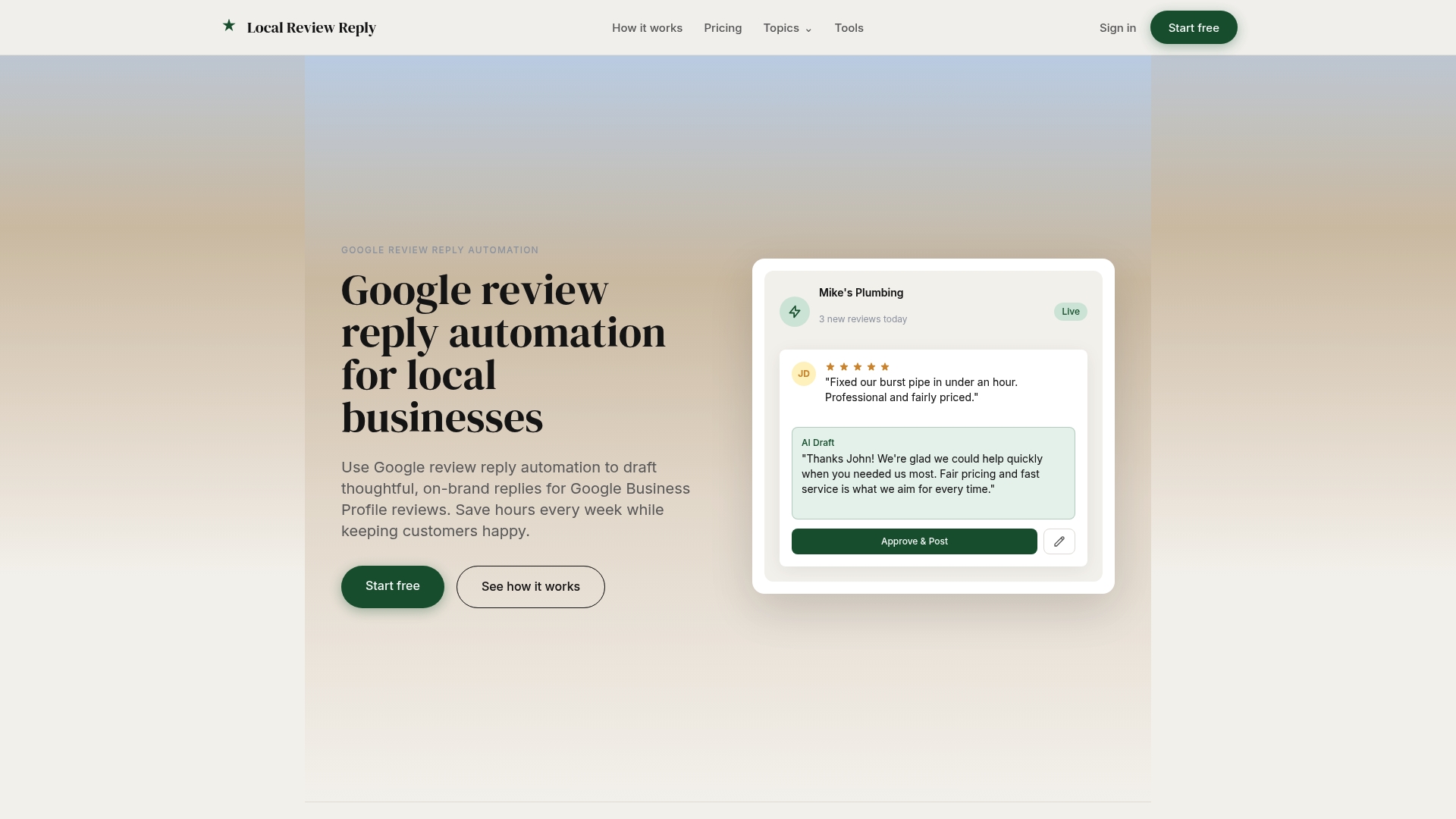
Local Review Reply is built around the exact split this article recommends: AI drafts a personalized, on-brand reply in seconds, and your approval gate stays fully in human hands for anything low star, legal-sounding, or otherwise flagged. The platform's approval controls and role permissions let you assign owners and approvers by location or region, so a 40-location franchise can route Critical tier reviews to a regional director while Standard tier reviews stay with the local manager, without anyone rebuilding the routing logic from scratch. Multi-location dashboards and analytics tracking surface approval lag and breach rates automatically, the same metrics this article recommends watching weekly.
If you're managing review replies across multiple locations or franchise sites, start with the free trial and test the approval workflow against one region before rolling it out everywhere. AI drafts the reply; your team still decides what goes public.
Sources
- Manage customer reviews - Google Business Profile Help
- Response time is a red herring: Reply quality beats reply speed — Happily research
- Voc