
A franchise review reply policy must guarantee three things: a consistent brand voice on every public reply, defined response times, and mandatory escalation for any review touching safety, legal exposure, or media risk. Corporate owns the standards; franchisees own execution inside those guardrails. Everything else in this guide explains how to build that structure without slowing your locations down.
TL;DR:
- Most franchise systems should limit review response policies to Google Business Profile and select secondary platforms, clarifying whether solicitation is included or not.
- Escalate reviews involving threats, discrimination, legal claims, press, or fraud before replying, gathering evidence and documenting the incident for rapid legal review.
- Set clear response time targets aligned with consumer expectations, monitor response coverage weekly, and address underperforming locations before issues escalate.
- Use a standardized set of templates with specific rules for customization, approval, and escalation, ensuring consistency while allowing local personalization within guardrails.
- Implement role-based permissions, an approval workflow, and monitoring tools to enforce response standards at scale across all locations.
Table of Contents
- What Does a Franchise Review Reply Policy Need to Cover?
- Which Reviews Require Escalation Before You Reply?
- How Fast Should Franchise Locations Respond to Reviews?
- How Do You Keep Brand Voice Consistent While Letting Locations Sound Local?
- Who Approves a Reply Before It Goes Live?
- How Do You Keep Response Quality Consistent as Staff Turn Over?
- Which Tools Actually Enforce a Franchise Reply Policy at Scale?
- How Do You Roll Out a New Review Reply Policy?
- Where Franchisors and Franchisees Actually Clash Over Reviews
- How Local Review Reply Fits Into Your Franchise Policy
- Sources
- FAQ
What Does a Franchise Review Reply Policy Need to Cover?
Before writing a single template, decide what the policy actually governs. Most franchise systems limit scope to Google Business Profile, since it drives the bulk of public review traffic, plus one or two secondary platforms like Facebook or Yelp where the brand has meaningful volume. Decide explicitly whether the policy also covers review solicitation (asking customers to leave reviews) or only response. Bundling both in one document usually causes confusion, since solicitation touches marketing compliance and response touches customer service and legal.
Ownership works best as a tag team. Corporate sets the guardrails, tone rules, and approval thresholds; the franchisee handles local facts, names, and personalization inside that frame. Practitioner accounts recommend exactly this split: franchisor supplies templates and oversight, franchisee supplies the local voice.
Accountability needs a paper trail. Your policy should spell out:
- Who has admin access to each location's Google Business Profile and how that access is granted or revoked when staff turn over.
- A signature or sign-off convention so a reader (and an auditor) can tell whether a reply came from a location manager or a corporate reviewer.
- A record of reply attribution, since disputes over "who said that" are far easier to resolve when every reply logs an author. A review response attribution system solves this cleanly.
Which Reviews Require Escalation Before You Reply?
Some reviews are safe for a local manager to answer inside five minutes. Others need a lawyer's eyes first. The line between those two categories is where most franchise systems get burned, usually because nobody wrote the line down.
Escalate immediately, before any public reply goes out, when a review involves:
- A threat to physical safety, including allegations of injury, unsafe conditions, or violence.
- Discrimination or harassment claims, including anything referencing a protected class.
- A stated or implied legal claim, such as "my lawyer will be in touch" or references to a lawsuit.
- Press attention or viral potential, meaning the review is tied to a news story, a large social following, or a coordinated pile-on.
- Suspected fraud or a systematic attack, such as a cluster of nearly identical negative reviews posted within hours of each other.
Categories one through four almost always require corporate or legal sign-off before any public response. Category five often just needs a flag to Google and a documentation trail, since it's a platform integrity issue rather than a legal one. Routine service complaints, wrong-order issues, and pricing gripes stay local and don't need to wait on anyone.
Before you escalate anything, collect the exact review URL, a screenshot with timestamp, any relevant transaction or order reference, a brief staff statement if employees were involved, and a short chronology of what happened and when. A packet like that turns a two-day legal review into a same-day one, because nobody has to chase down evidence after the fact.

Pro Tip: Build a one-page escalation form franchisees can fill out in under three minutes. If the form takes longer than that, people will skip it and reply anyway.
How Fast Should Franchise Locations Respond to Reviews?
More than half of consumers expect a business reply within a few days, which sets a reasonable floor for any network-wide SLA. Most franchise systems set prompt response times for standard reviews and prioritize immediate attention for critical low-star reviews. Higher-risk industries, like healthcare or childcare franchises, often tighten that window further, while low-risk categories with lighter review volume can stretch it without much downside.
Track a small set of numbers instead of dozens:
- Reply coverage rate: the percentage of reviews that got any response at all.
- Average response time, measured from posting to reply.
- Flagged escalations per month, broken out by category.
- Per-location performance, so underperforming stores are visible before they become a pattern.
Response coverage is the single number worth reviewing weekly across a franchise network, because a location that stops replying almost always has a deeper operational problem behind it. Set a trigger: if any location's coverage rate drops below a set threshold for two consecutive weeks, that's an automatic call from corporate, not a note in a monthly report. A marketing vendor SLA framework is a useful model for writing these thresholds down in plain, enforceable terms.
How Do You Keep Brand Voice Consistent While Letting Locations Sound Local?
Templates fail when they're too rigid or too loose. Too rigid, and every reply reads like it came from a script. Too loose, and one location's version of "friendly" turns into an off-brand mess. The fix is a small set of template types, each with clear rules for what a franchisee can and can't change.
Build five core templates:
- Thank-you for four and five-star reviews, with room for a personalized detail.
- Neutral for three-star reviews that need acknowledgment but no apology.
- Service-recovery for one and two-star reviews, always paired with an offline resolution path.
- No-comment holding language for reviews under active legal or safety escalation.
- Staff-matter for reviews naming an employee by name, positive or negative.
Franchisees should be able to edit customer names, specific product or service references, and local contact details. They should not be able to edit the apology language in service-recovery templates or add discount offers that weren't corporate-approved. A good edit adds "Mike in our Tuesday morning crew" to a thank-you template. A bad edit turns "We'd like to make this right" into "we'll refund you in full," a promise the franchisee may not have authority to make.
Who Approves a Reply Before It Goes Live?
Role clarity solves most of the friction here. Define four roles: the local drafter (usually a manager), a local approver (owner or regional lead), a corporate reviewer for flagged content, and a legal or PR contact for true escalations.
Set automated flags that force human review before anything posts:
- Any one or two-star review.
- Any reply containing specific keywords: "lawsuit," "lawyer," "discrimination," "unsafe," "sue."
- Multiple complaints about the same issue at the same location within a short window.
Every approval needs a log: who approved it, the timestamp, and an archived copy of the draft. This isn't just tidy record-keeping. If a dispute ever surfaces months later, that log is the difference between a five-minute lookup and a scramble through email threads.
Pro Tip: Archive rejected drafts too, not just approved ones. Seeing what got rejected and why is often the fastest way to train a new franchisee on brand tone.
How Do You Keep Response Quality Consistent as Staff Turn Over?
Franchise staff turnover is constant, so training can't be a one-time onboarding slide. New location managers need a short checklist covering platform access, template location, escalation categories, and who to call when something doesn't fit a template.
Run QA on a sample of replies each month, scored against a rubric covering tone, compliance, whether a resolution was offered, and how well the reply was personalized. That kind of scoring makes "on-brand" measurable instead of a vague gut call, and it tells you exactly where coaching will move the needle.
- Onboarding checklist covers access, templates, and escalation rules.
- Refresher training runs quarterly or after any policy update.
- Template review happens on the same cadence, since templates work best as living documents updated when recurring complaint themes show up.
- Escalation drills, even brief ones, keep the process from feeling foreign the first time it's actually needed.
Which Tools Actually Enforce a Franchise Reply Policy at Scale?
A written policy without enforcement tooling tends to decay within a quarter. The core capabilities worth requiring from any platform: monitoring across every location from one dashboard, role and permission controls that match your approval structure, a draft-and-approve workflow rather than one-click auto-posting, and reporting that surfaces per-location performance without manual spreadsheet work.
AI drafting speeds up the repetitive part of the job, drafting a first-pass reply to a routine review in seconds. But the policy still needs a human approval gate on anything flagged, whether that's a low-star review or one hitting an escalation keyword. Automation should draft; a person should approve anything with real risk attached.
A franchise review reply approval workflow case study shows what this looks like in practice: draft, route, approve, publish, log, without any step skipped for the sake of speed. Industry reporting on franchise reputation management backs up the same pattern: brands that keep reply rates high across hundreds of locations do it with monitoring tools and clear internal processes, not by hoping local managers remember to check.
- Multi-location dashboard visibility.
- Role-based permissions matching your approval chain.
- Draft-plus-approve workflow, never blind auto-posting.
- Reporting broken out by location and by escalation category.
How Do You Roll Out a New Review Reply Policy?
Move from draft policy to live enforcement in a sequence, not all at once:
- Audit current profile access and permissions across every location.
- Assign an owner for each role: policy owner, template owner, escalation contact.
- Publish templates and the escalation packet format.
- Set SLA targets by risk tier and platform.
- Enable monitoring and approval tooling before go-live, not after.
- Pilot with five to ten locations for two to four weeks.
- Measure coverage rate and flagged-escalation volume from the pilot.
- Roll out network-wide, then iterate quarterly.
Each step needs a named signoff, not just a checked box. Add a short policy summary to the operations manual, with a cross-reference note in the Franchise Disclosure Document section covering communication standards, since franchise agreements increasingly get scrutinized on exactly this point.
Where Franchisors and Franchisees Actually Clash Over Reviews
The real tension isn't policy versus no policy. It's speed versus control. Franchisees want to reply the moment a review lands; corporate wants every reply vetted for brand and legal risk. A tag-team model resolves most of this, since templates give franchisees speed while approval gates catch the small percentage of replies that carry real risk.
The franchisees worth watching are the two extremes: the ones who resist any oversight and post whatever they want, and the ones who over-personalize until every reply sounds like a diary entry. Both need direct coaching, not just a policy reminder. Centralize replies entirely only for the reviews that could become a news story or a legal matter. Everything else belongs local, with a fast approval layer behind it.
— Ryan
How Local Review Reply Fits Into Your Franchise Policy
Local Review Reply gives you the enforcement layer a written policy needs but can't provide on its own: AI-drafted replies for routine reviews, paired with a mandatory human approval step for anything flagged by star rating or risky language.
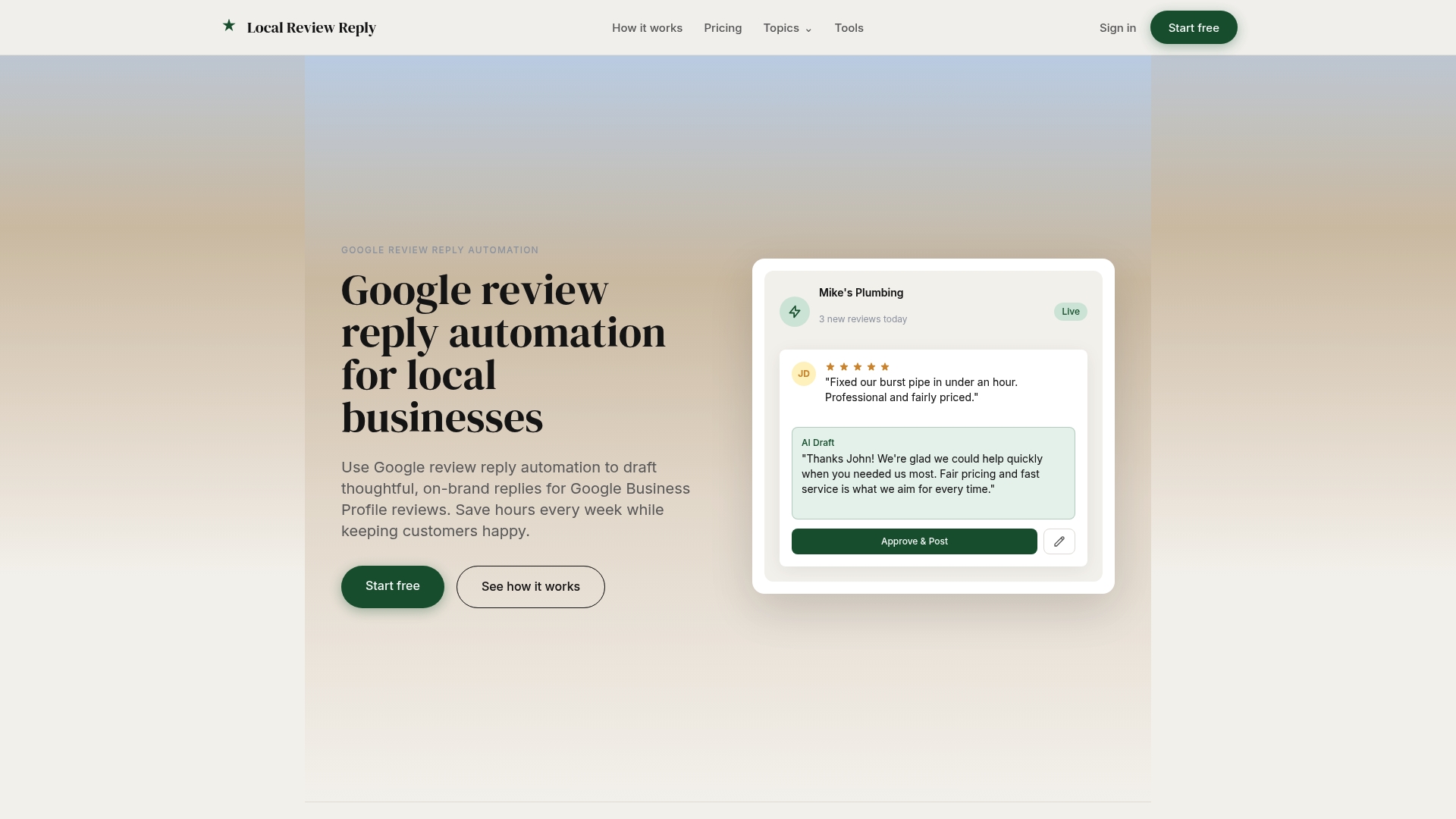
Instead of asking every location manager to remember escalation rules from memory, such a system routes low-star and flagged reviews to the right approver automatically, with per-location dashboards showing coverage and response time at a glance. Role-based permissions match typical drafter/approver/corporate-reviewer structures common in franchise systems. The franchise review reply approval workflow case study illustrates how such a draft-to-approval sequence runs in a live multi-location account.
If you're weighing whether your current process would survive an audit or a viral review, take a look at the franchise review reply features built for multi-location operators and start a trial to see the approval workflow on your own locations.
Sources
Google's review response policy governs what content is disallowed in public replies. The FTC's Franchise Rule guidance covers restrictions on non-disparagement clauses. FranchiseWire's ownership analysis explains the tag-team model in more depth.
- How franchises can manage Google reviews at scale — Zoho Reputation Pulse
- Who owns the franchise customer review strategy? — FranchiseWire
FAQ
Is Responding to a Google Review a HIPAA Violation?
Replying itself isn't a violation, but disclosing any patient-specific health detail in a public reply can be. Google's own policy warns against sharing private customer information in responses, so healthcare-adjacent franchises should stick to generic acknowledgment language and take specifics offline.
How Should You Reply to a Four-Star Review?
Thank the reviewer by name where possible, acknowledge one specific detail they mentioned, and invite them back. A four-star review rarely needs a service-recovery offer, since the customer was largely satisfied.
How Should You Reply to a Five-Star Review?
Keep it short, specific, and personal: reference something concrete from the review rather than a generic thank you. A reply like "Glad the team could get your AC fixed same-day, John, see you at the next service check" reads far better than a copy-pasted "Thanks for the kind words!"
What Does a Good Response to a Positive Review Look Like?
The strongest replies name a detail from the original review, thank the customer by name, and reflect the brand's actual tone rather than a corporate script. Tools like Local Review Reply's free response generator can draft a starting point that a local manager then personalizes before posting.
Who Should Have Final Approval on a Franchise's Review Replies?
Routine positive and neutral reviews can be approved locally. Anything flagged for low-star rating, legal language, or safety concerns needs corporate or legal sign-off before it goes public, following the escalation categories your franchise review reply policy defines.