
Human in the loop reviews means pairing AI-drafted replies to Google Business Profile reviews with a required human approval step before anything publishes. The operating principle is simple: let AI draft the routine, positive-review responses fast, and route anything sensitive, negative, or legally touchy through a person first. Done right, this keeps your brand voice intact and cuts the time spent per reply without handing over judgment calls to a machine.
TL;DR:
- Human-in-the-loop workflows are most effective for negative reviews, where AI drafts are refined by staff before publishing to avoid tone issues.
- High-risk replies involving refunds, legal issues, or employee accusations require full human review and approval before going live.
- Mid-risk reviews, such as vague complaints or minor grievances, can be managed with sampling-based approval, scaled according to potential impact.
- Establishing clear roles, training, and approval thresholds is essential to ensure compliance and maintain brand voice across multiple locations.
- Monitoring key metrics like edit and approval rates, response times, and escalation patterns helps optimize the workflow and reduce errors over time.
Table of Contents
- What Human-in-the-Loop Review Replies Actually Look Like
- When Does a Reply Actually Need Human Approval?
- Three Workflow Templates You Can Copy Today
- Who Approves What, and What They Need to Know First
- Metrics and Audit Trails That Prove the System Works
- Setting Up the Tooling Without Overengineering It
- Balancing Speed and Brand Safety at Scale
- Where Local Review Reply Fits Into This Workflow
- Sources
What Human-in-the-Loop Review Replies Actually Look Like
Scope matters here. Human in the loop reviews, in the context of Google Business Profile, refers specifically to a two-step workflow: an AI system generates a draft response, and a person reviews, edits, or approves it before it goes live. It is not a general AI research concept. It is a publishing control.
A randomized experiment on managerial responses to online reviews found something worth building a workflow around: negative reviews got the best outcomes when generative AI drafted a response and experienced staff refined it before publishing. Positive reviews, by contrast, often did just as well when professional staff handled them alone, no AI draft needed. That split has real operational consequences.
- Full automation is fast but risks tone-deaf replies to angry customers.
- Full human writing is safe but does not scale past a handful of locations.
- AI draft plus human refinement wins on negative reviews specifically, based on that experiment's findings.
- Positive, routine reviews rarely need AI help at all if staff already have time.
The trade-off isn't automation versus people. It's knowing which reviews need which mix.
When Does a Reply Actually Need Human Approval?
Not every review carries the same risk, so not every reply needs the same scrutiny. Four dimensions decide how much oversight a draft needs: reversibility (can you take it back once it's public?), legal or regulatory exposure, reputational stakes, and direct customer impact.
Some situations should trigger full human approval every time, no exceptions:
- Any reply implying a refund, credit, or compensation commitment.
- Reviews naming a specific employee in an accusation, positive or negative.
- Reviews touching safety incidents, injuries, or potential legal liability.
- Anything referencing contract terms, warranties, or service guarantees.
- Reviews from verified or high-visibility accounts likely to get wide attention.
Medium-risk cases, think three-star reviews with vague complaints, or four-star reviews with a minor gripe, are a good fit for sample-based review rather than checking every single one. A human-in-the-loop pattern framework recommends mapping AI outputs to review modes by risk tier: low-risk drafts get sampled at a lower rate, medium-risk drafts get checked more consistently, and high-risk drafts get full review every time. Approval strength should scale with reversibility and business impact, not with how busy your team is that week.
Low-risk positive reviews, four and five stars with generic praise and no specific claims, are reasonable candidates for auto-publish once your templates are tested and your team trusts the pattern.
You need a baseline before you can safely auto-publish anything.
Three Workflow Templates You Can Copy Today
Most teams do not need to invent a workflow from scratch. Three patterns cover almost every situation a local business or agency runs into.
Feed errors back into your template library so the same mistake does not repeat across locations.
Template B: Exception and escalation routing. Auto-tag incoming reviews by sentiment and keyword (refund, lawsuit, employee name, injury). Anything tagged gets pulled into a queue for a human before it's touched by AI drafting at all. Everything untagged flows through normal review.
Template C: Dual review for high-impact replies. Two named approvers, one local and one regional or brand-level, both sign off before publishing. Reserve this for anything with legal exposure or franchise-wide reputational risk.
SLA windows should track severity, not just star rating:
- One and two-star reviews: respond within 4 hours where staffing allows, never past 24 hours.
- Three-star reviews: respond within 24 hours.
- Four and five-star reviews: respond within 48 to 72 hours; batching is fine here.
- Reviews tagged for escalation: acknowledge internally within 1 hour, publish only after approval.
Faster response windows on low-star reviews matter enough that franchise reputation guidance treats immediate response to one and two-star reviews as a baseline expectation, not an aspiration.
Who Approves What, and What They Need to Know First
A workflow is only as good as the people running it. Four roles cover most multi-location setups: the local responder who handles day-to-day replies, the regional reviewer who audits samples and handles escalations, the brand or franchisor reviewer who signs off on anything reputational, and a legal or policy escalation contact for the rare case that needs it.
Access controls matter as much as the roles themselves. Franchise playbooks generally recommend restricting publish rights to trained staff only and using tiered escalation, local to regional to brand, rather than giving every location manager full publishing access on day one.
Before anyone gets publish rights, they need training on:
- Tone and phrasing that matches brand voice, not generic corporate language.
- A short list of prohibited phrases (admission of fault, specific compensation promises, anything defamatory).
- Clear escalation triggers so nobody guesses whether a review needs a second set of eyes.
- Basic privacy handling for reviews that mention personal details or medical information.
- How to log an approval so there's a record of who signed off and when.
Skipping training to move faster is exactly how a well-meaning reply turns into a policy violation.
Metrics and Audit Trails That Prove the System Works
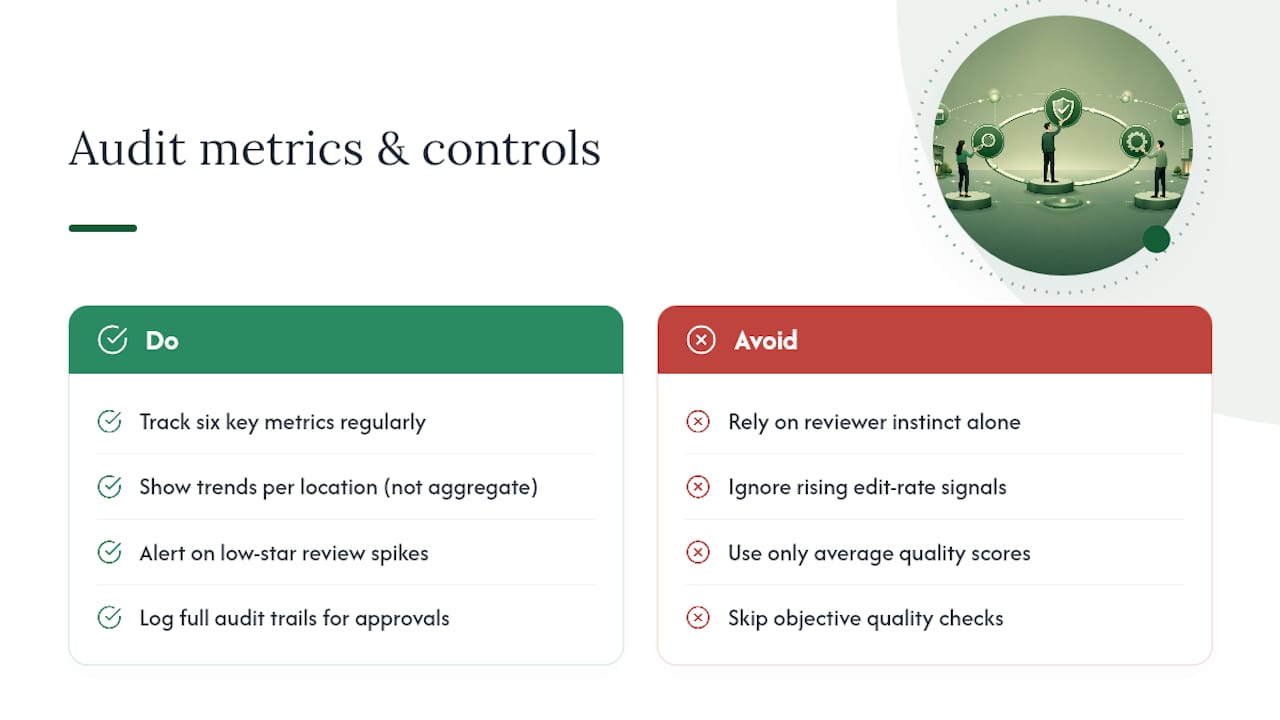
You cannot manage what you do not measure, and reviewer instinct alone will not catch drift across a dozen locations. Six numbers tell you if your human-in-the-loop setup is healthy: approval rate, edit rate (how often reviewers change the AI draft before publishing), time-to-publish, escalation rate, sampled-error rate, and reviewer override rate.
A rising edit rate is often the earliest warning sign that your AI drafts are drifting from brand voice, well before a bad reply actually goes public.
Your dashboard should show trends per location, not just an aggregate. Watch for a velocity alert on low-star reviews (a spike usually means something operational broke), reviewer workload balance, and a quality score distribution across your team, not just an average.
Every approval needs an audit trail: reviewer ID, timestamp, the pre-edit and post-edit text, and a retention policy that matches your company's records requirements. Policy guidance on human–AI collaboration recommends building in a quality-checking phase with objective scoring, not just a gut-check pass, so reviewers get consistent feedback and franchisors get something they can actually audit.
Setting Up the Tooling Without Overengineering It
Getting the connectors and rules right the first time saves you from a messy re-do a month in. Start with the basics before layering on complexity.
Integration checklist:
- Connect your Google Business Profile locations and confirm notification routing works before you touch anything else.
- Set up sentiment and keyword tagging so risky reviews get flagged automatically.
- Configure your approval workflow rules (who sees what, who can publish) before you turn on AI drafting.
- Test your reply templates with token fields (business name, staff name, service type) so drafts don't read generic.
Configuration and rollout:
- Set approval thresholds by risk tier, not by star rating alone; a four-star review naming an employee is still medium-risk.
- Build escalation routing so flagged reviews land with the right person automatically, not in a shared inbox nobody checks.
- Pilot with one to three locations first. Track edit rates and approval times weekly.
- Adjust thresholds based on pilot data, then scale to additional locations in batches.
| Rollout stage | What to track | Typical duration |
|---|---|---|
| Pilot (1–3 locations) | Edit rate, approval time, error samples | 2 to 4 weeks |
| Expansion | Reviewer workload, escalation volume | 4 weeks |
| Full scale | Auto-publish accuracy, audit completeness | Ongoing |
Best-practice vendor guidance on AI review responses is blunt about the risk of skipping the human step entirely: unreviewed AI drafts tend to read robotic, and they can misfire on nuance a real reviewer would catch in seconds. Treat every draft as a starting point, not a finished reply, and check for accuracy, tone, and any implied commitment before it ever gets seen by a customer.
Balancing Speed and Brand Safety at Scale
Hybrid workflows work because they match effort to risk instead of applying the same scrutiny to every review, whether it's a five-star compliment or a threat of legal action. Where they fail is almost never the AI. It's weak governance: no clear escalation path, no one accountable for the sample audit, approval logs nobody actually checks.
The fix isn't more caution. It's clearer rules. Decide upfront what counts as high-risk, write it down, and make sure whoever is on shift knows the escalation path without having to ask. Record every approval, not because you expect a problem, but because you'll want the data when you're deciding whether to loosen or tighten a threshold six months from now.
Start smaller than feels comfortable. Pilot one location, track your edit and override rates honestly, and let the numbers tell you when you're ready to widen the auto-publish criteria. Most teams tighten too late instead of too early.
— Ryan
Where Local Review Reply Fits Into This Workflow
Local Review Reply is built around the exact workflow this article describes: AI drafts the reply, you decide who needs to see it before it publishes. The software drafts personalized replies for Google Business Profile reviews, offers approval controls for sensitive or low-star reviews, and supports multi-location and franchise structures.
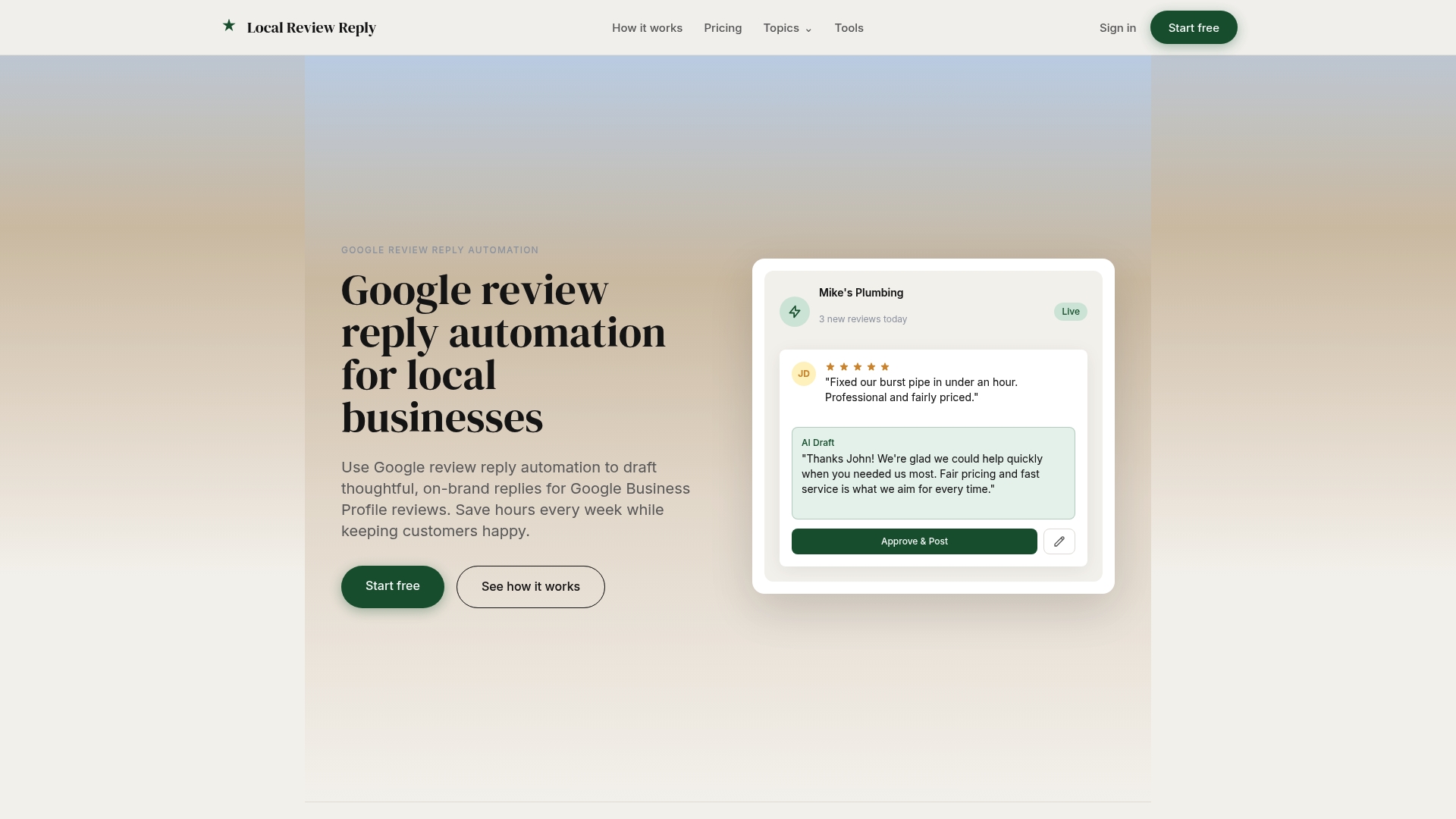
Instead of building your risk-tiering and escalation rules from scratch, you configure them inside a dashboard with role-based permissions, per-location tracking, and analytics showing approval and edit rates. For agencies managing multiple accounts or franchise operators running review replies across many locations, that structure supports scalable workflows.
If the templates and thresholds in this article sound like what your team needs but not what your team has time to build, explore the platform's approval workflow features or try the free AI review response generator on a handful of real reviews to see how the draft-and-approve step actually feels in practice.
Sources
- Blending minds and machines in service operations: enhancing managerial responses to online reviews through human-generative AI collaboration
- Joining forces for online feedback management: policy recommendations for human–AI collaboration
- Human-in-the-Loop AI Review Patterns for 2026 | AI Charcha
- AI review response generator: a workflow guide