The moment a one or two star review lands, the owner of record has one job: acknowledge it publicly within a couple of hours with a short, calm reply, then open an internal ticket so someone owns the private follow up on a set deadline. Low star review escalation starts with containment, not persuasion. The goal in hour one is to stop the review from spreading unanswered while your team collects the facts needed to fix it.
TL;DR:
- Address negative reviews publicly within two hours with a brief, professional acknowledgment and log the review details to prevent evidence loss.
- Escalate reviews based on content and intent, routing them to the correct owner within set SLAs, especially for safety threats or legal issues.
- Monitor all review platforms through a unified dashboard, automate review tagging, and trigger immediate alerts for high-risk keywords or profiles with large followings.
- Use a documented escalation matrix with clear ownership tiers and response deadlines to prevent rushed and damaging responses.
- Focus on fast, private resolutions, asking for review updates only after confirming the issue has been genuinely fixed to avoid legal or reputation risks.
Table of Contents
- What Are the First-Hour Steps in Low Star Review Escalation?
- Why a Single Bad Review Can Cost More Than One Customer
- Detect and Monitor: Bringing Every Platform Into One View
- Triage and Escalation Matrix: Who Owns What, and by When
- The Public Reply and Private Resolution Playbook
- When Does a Bad Review Signal a Fake or Coordinated Attack?
- Automation and Tooling: Where to Let Software Work and Where to Keep a Human
- Metrics That Prove Your Escalation Process Is Working
- Closing the Loop: From One Complaint to a Real Fix
- Training Guidelines for Staff Who Handle Escalations
- What Successful Escalations Actually Look Like
- Managing the Toll Low-Star Reviews Take on Your Team
- Governance Trade-Offs for Multi-Location Operators
- How Local Review Reply Puts This Workflow on Autopilot
- Sources
What Are the First-Hour Steps in Low Star Review Escalation?
Every location needs the same six moves, done in order, every time. Consistency here matters more than speed alone, because a rushed but sloppy response can do more damage than a slightly delayed but accurate one.
- Capture the evidence. Screenshot the review, log the URL, note the exact date and time, and pull up the reviewer's profile before anything changes or disappears.
- Post a brief public acknowledgment. Keep it short, name the issue in general terms, and say you'll follow up privately.
- Match the reviewer to your records. Cross-check the name, order number, or service date against your CRM or point-of-sale system, then classify the intent (service complaint, billing dispute, safety concern, or something that looks fabricated).
- Open an internal ticket. Route it to a named owner with a clear service-level agreement (SLA) attached, not a vague "someone will handle this."
- Escalate anything with safety or legal language immediately. A senior manager needs eyes on this within the hour, not by end of day.
- Schedule the follow-up and log the outcome. Whether the customer responds or not, the ticket needs a closing note for pattern tracking later.
Skipping step one is the most common mistake. Reviews get edited or removed, and without a screenshot and timestamp, you lose your evidence trail for both internal analysis and any platform report you might need to file later.
Why a Single Bad Review Can Cost More Than One Customer
A stray one-star review rarely stays isolated in its damage. Recency carries real weight with consumers: A majority of consumers say they trust reviews written recently more than older ones, according to Sprinklr's review management research. That means an unanswered negative review sits at peak influence for weeks before it starts fading, and every day it sits unaddressed is a day it's actively shaping first impressions.
A dropping average rating also erodes click-through rates on your Google Business Profile before a prospective customer ever reads a word of text. The rating number alone does a lot of the persuading.
The harder judgment call is deciding whether one bad review is noise or signal:
- One vague complaint from a reviewer with no other activity and no matching internal record often points to a bad match, a misunderstanding, or occasionally a fake review.
- Multiple reviews citing the same specific problem (a technician's attitude, a billing error, a wait time) across different customers and dates points to a systemic issue that needs an operational fix, not just a reply.
That second pattern is the one that should trigger a broader review, not just a one-off response.
Detect and Monitor: Bringing Every Platform Into One View
You cannot escalate what you don't see, and reviews rarely stay confined to one platform. A restaurant might get hit on Google Business Profile, Yelp, and Facebook in the same week; a service business might also need to watch industry-specific directories or an app store if it has a mobile app.
The platforms worth monitoring, at minimum:
- Google Business Profile — the highest-traffic surface for most local searches and usually the first place a rating drop shows up.
- Yelp — smaller audience for many categories but disproportionately influential for restaurants and personal services.
- Facebook — recommendations and reviews still drive referral traffic, especially for community-based businesses.
- Industry-specific sites — think Angi for home services, Healthgrades for medical practices, or G2 for B2B software.
- App stores — if you have a mobile app, App Store and Google Play reviews behave like public support tickets.
Checking each platform manually, location by location, doesn't scale past two or three sites. The practical fix is aggregating them into a single dashboard with real-time alerts, a step Sprinklr's guide to review management treats as foundational rather than optional. Once a review lands in that dashboard, enrich it automatically with a screenshot, the reviewer's posting history, and a pull from your own order or service records so the person triaging doesn't start from zero.
Set priority rules so the system, not a person's judgment in the moment, decides what jumps the queue. A reviewer with a large following, any mention of injury or safety, or language that reads like a legal threat should trigger an immediate alert to a manager, not sit in a normal queue.
Pro Tip: Build your alert rules around keywords, not just star ratings. A three-star review that mentions "lawyer" or "health department" needs faster attention than a one-star review that just says the wait was too long.
Triage and Escalation Matrix: Who Owns What, and by When
An escalation matrix is the single most useful document a multi-location operator can build before the next bad review hits, not after. Without one, every low-star review becomes an improvised decision, and improvised decisions under pressure tend to produce defensive, rushed replies that make things worse. Practitioners who study review response patterns consistently point to a documented matrix with clear SLAs as the fix for panic replies that damage reputation.
A workable structure has four ownership tiers:
- Frontline responder (shift lead or front desk manager): handles routine one- to three-star service complaints with an approved template, acknowledges publicly within one to two hours, and opens the internal ticket.
- Local manager: owns anything requiring a real apology, a refund decision, or a service correction, with a target of making private contact within 24 hours of the review posting.
- Operations or product lead: gets looped in when three or more reviews cite the same root cause within a short window, since that's a signal for an operational fix, not just a series of individual replies.
- Legal counsel plus senior leadership: takes anything involving safety allegations, discrimination claims, or extortion attempts, and takes it immediately, not on the normal SLA clock.
Route by intent, not just by star rating. A billing complaint goes to finance for verification before anyone drafts a public reply. A service quality complaint goes to the location manager. A safety or legal signal skips every other tier and goes straight to ownership and counsel. Mobile app playbooks apply the same logic for security or data complaints, routing them straight to engineering and legal rather than customer support.
Document the matrix in a shared, living page (not a slide deck nobody opens again), and assign a backup owner for each tier so a manager's day off doesn't stall the SLA clock.
Pro Tip: Give each tier a maximum response window in writing, not just a name. "Local manager owns private contact within 24 hours" is enforceable. "The manager will handle it" is not.
The Public Reply and Private Resolution Playbook
The public reply has one job: show competence and invite the conversation offline. It is not the place to resolve the dispute. The formula that works across most categories is short: acknowledge the reviewer by name, apologize for their experience without admitting fault or liability, and give a clear path to continue privately. Keep the whole thing under 60 to 90 words. A rushed, overly defensive, or legally sloppy public reply almost always causes more damage than the original review, which is why operator field guides recommend a brief cooling-off period, even just an hour, before anyone hits publish.
Short templates by severity:
- One-star, angry tone: "Hi [Name], we're sorry your visit didn't meet the standard we hold ourselves to. We'd like to make this right. Please reach us at [contact] so we can look into what happened."
- Two-star, specific complaint: "Thanks for the honest feedback, [Name]. We want to understand what went wrong with [specific issue]. Can you email us at [contact] so we can follow up directly?"
- Three-star, mixed experience: "We appreciate you taking the time to share this, [Name]. It sounds like part of your visit didn't go as planned, and we'd like to hear more. Reach out at [contact] when you have a moment."
Industry-specific phrasing helps here; home services businesses can lean on templates built for that category rather than starting from a blank page.
Once the conversation moves private, the sequence is verify, fix, confirm, ask. Verify the details against your internal records, fix the underlying issue, confirm with the customer that it's resolved, and only then ask, politely and without pressure, whether they'd consider updating their review. Never offer a refund, discount, or credit explicitly in exchange for a review change. The FTC's final rule banning fake reviews and testimonials makes incentivized review edits a real legal exposure, not just a bad look.
Pro Tip: Ask for the update after you've confirmed the fix worked, not while you're still investigating. Asking too early reads as pressure, even when you mean well.
When Does a Bad Review Signal a Fake or Coordinated Attack?
Some low-star reviews aren't customer complaints at all. Watch for a cluster of reviews posting within minutes or hours of each other, generic language that could apply to any business in your category, reviewer profiles created the same week with no other activity, or a direct demand for payment in exchange for removing the review, which is extortion, not feedback.
Document everything before you report anything:
- Screenshot each suspicious review individually, with timestamps visible.
- Pull the reviewer's full posting history if it's public.
- Cross-reference against your internal transaction records to confirm no matching customer exists.
- Save any direct messages, especially anything resembling a payment demand.
Each platform has its own reporting mechanism, and using it correctly matters more than most businesses assume. The UPS Store's small business guidance recommends collecting evidence before filing, since a report without documentation is far more likely to get dismissed. Expect platform review of a flagged post to take anywhere from a few days to a couple of weeks, and expect to be asked for supporting evidence during that process.
Bring in legal counsel when a review contains a specific extortion demand, repeats defamatory claims after you've already reported it once, or involves a former employee posting confidential information. Prepare a case file in advance: the original reviews, your reports to the platform and their responses, and a clear timeline. Counsel can move much faster with that file already assembled.
Automation and Tooling: Where to Let Software Work and Where to Keep a Human
Detection, sentiment triage, and routing are the tasks best suited for automation. A system can watch every platform continuously, tag a review's likely intent, and route it to the right owner faster and more consistently than a person checking five different dashboards between other tasks. What automation should not do on its own is publish a reply to a high-visibility or legally sensitive review. Guidance on automating review workflows is consistent on this point: automation removes the manual drudgery of monitoring and classification, but human approval stays essential for high-stakes cases.
Where this plays out in practice:
- Automate: pulling reviews from every platform into one dashboard, flagging sentiment, tagging likely intent, and routing to the assigned owner.
- Keep human: approving the actual public reply on anyone or two star review, and especially anything involving safety, legal language, or a reviewer with a large following.
- Guardrails that make this safe: tiered approval workflows tied to star rating and keyword triggers, role-based permissions so frontline staff can't publish a reply to a legal threat, and an audit log showing who approved what and when.
That audit log matters more than it sounds. When a franchise owner or agency needs to prove SLA compliance across dozens of locations, a timestamped approval trail is the difference between a defensible process and a guess.
Pro Tip: Set your approval workflow to require sign-off from a location manager (not just the frontline responder) on anything below two stars. That single rule catches most of the replies that would otherwise need to be walked back later.
Metrics That Prove Your Escalation Process Is Working
Two categories of numbers matter here, and mixing them up leads to tracking the wrong things. Operational KPIs measure whether your process runs on time. Outcome KPIs measure whether it actually helps the business.
Operational metrics to track weekly:
- Time to first public acknowledgment (target: under two hours during business hours).
- Time to first private contact after acknowledgment (target: under 24 hours).
- Percentage of reviews assigned to a named owner within the SLA window.
- Overall SLA compliance rate across all locations.
Outcome metrics to track monthly:
- Resolution rate: what share of escalated reviews reach a confirmed fix.
- Review-update conversion: what share of resolved reviewers later change their rating. Informal operator tracking cited by Search Engine Land puts this figure around 30% for resolved one-star reviewers, higher when the update request comes after a confirmed fix.
- Rolling average rating trend by location, tracked over 90-day windows rather than day to day.
Run a monthly retrospective across locations to spot patterns a single manager would never see alone, and use low-star analytics to catch recurring root causes before they show up as a fourth or fifth similar complaint.
Closing the Loop: From One Complaint to a Real Fix
Every escalation has two jobs running at once. The inner loop is the individual recovery: fix this customer's problem, document what happened, and confirm they're satisfied. The outer loop is pattern recognition: does this complaint match three others from the past month, and if so, does it need to go to product, operations, or training rather than just another reply.
Set a concrete threshold for when the outer loop kicks in, such as three or more mentions of the same specific issue within 30 days across any location. Practitioners who study feedback workflows describe this as integrating review management directly with support and product teams, so feedback drives actual fixes, not just replies. A separate breakdown of inner-loop and outer-loop mechanics treats this split as the core structure of any functioning feedback system, not an optional refinement.
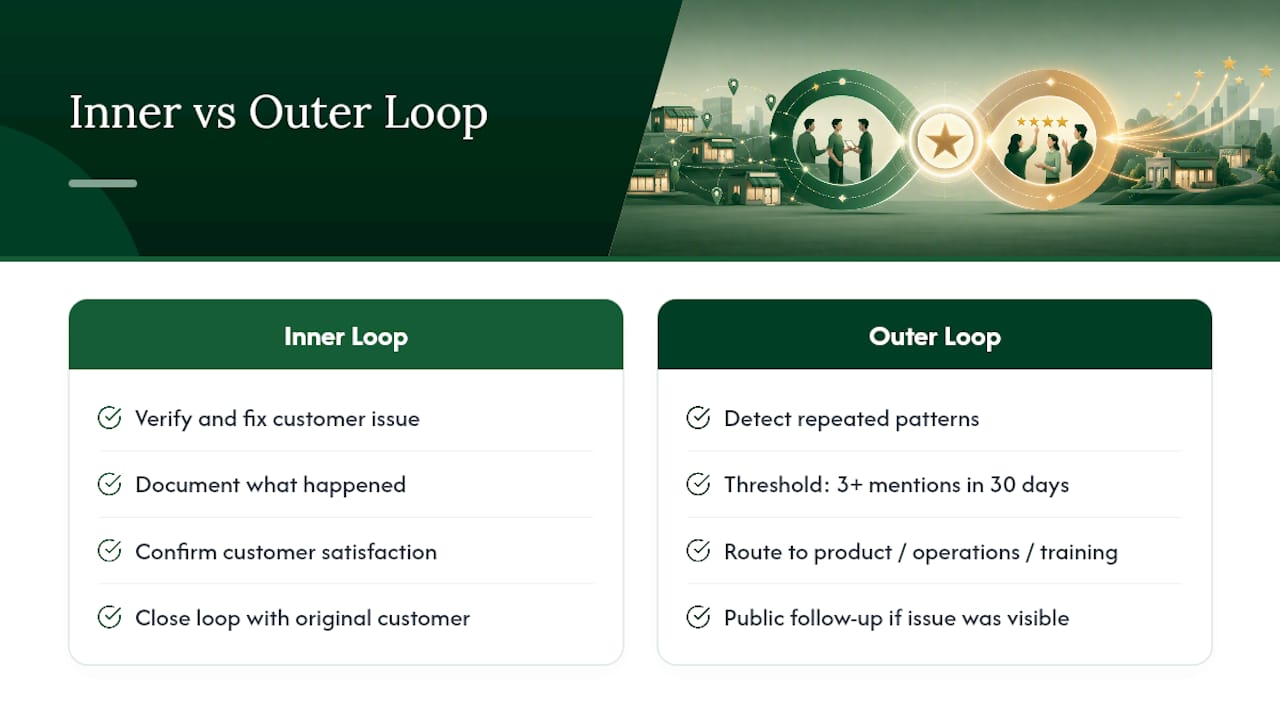
Once a fix genuinely ships, close the loop with the original customer directly. If the issue was public and visible enough, a short public follow-up note ("we've since changed our process for X") signals to future customers that complaints lead somewhere, which matters more for your reputation than any single reply ever will.
Training Guidelines for Staff Who Handle Escalations
Frontline staff need two things before they touch a live review: an approved template library and clear boundaries on what they're allowed to decide alone. Give them scripts for the routine cases and an unambiguous rule for everything else: anything below two stars, anything mentioning safety or legal terms, and anything from a high-follower reviewer gets escalated up, no exceptions.
Run a short simulation during onboarding rather than relying on a written policy alone. Have new hires draft replies to three or four sample reviews, then review those drafts with a manager before anyone touches a real one. This surfaces tone problems early, before they show up in public.
Refresh training quarterly, not just once at hiring. Review categories shift, new platforms show up, and the FTC's rules on incentivized reviews mean staff need periodic reminders about what they can and cannot offer in a private resolution. A staff member offering a discount "if you update your review" is a compliance risk your training needs to explicitly rule out.
Finally, give every staff member handling escalations a named backup and a clear point of contact for anything above their authority level. The worst outcome in training is a well-meaning employee who improvises a response to a legal threat because they didn't know who to call. That single gap causes more damage than any template ever could.
What Successful Escalations Actually Look Like
The pattern behind a well-handled escalation is almost always the same: fast acknowledgment, a genuine private fix, and a specific, permission-based ask for a review update.
The lessons that repeat across these cases matter more than any single story. Speed to private contact correlates strongly with willingness to update a review; customers who wait days for a response have often already moved on emotionally by the time anyone reaches out. Specificity in the apology beats a generic one; naming the actual problem ("we're sorry the technician arrived two hours late") reads as sincere in a way "we're sorry for your experience" never does. And asking for the update only after confirming the fix, never before, avoids the appearance of pressure that can backfire into a worse review.
The failure pattern is just as consistent: a public reply written in anger, no private follow-up at all, or an update request made before the underlying issue was actually fixed. Any one of those three mistakes tends to turn a recoverable one-star review into a permanent one.
Managing the Toll Low-Star Reviews Take on Your Team
A steady stream of one and two star reviews wears on people, not just processes. Frontline staff who read harsh public criticism about their own work, sometimes naming them directly, can start dreading the review dashboard the same way they'd dread an angry phone call. That stress is real, and pretending otherwise leads to burnout or defensive replies that make the underlying problem worse.
A few practices help keep this manageable. Rotate who handles review response duty rather than assigning it permanently to one person; sustained exposure to criticism, even legitimate criticism, has a cumulative effect. Separate the review from the reviewer's tone in team debriefs: a poorly worded, angry review can still point to a real problem worth fixing, and treating every harsh review as noise to dismiss teaches staff to stop listening to feedback that matters.
Build in a short cooling-off period before anyone responds to a review that stings personally, the same one-hour buffer recommended for avoiding defensive public replies. That pause protects the customer relationship and the employee's composure at the same time.
Managers should also normalize talking about the volume, not just the content, of criticism a team absorbs. A location fielding fifteen reviews a week carries a different emotional load than one fielding two, and staffing the escalation process accordingly, rather than leaving it to whoever happens to be free, keeps the workload from concentrating on one person.
Governance Trade-Offs for Multi-Location Operators
Centralize escalations when brand consistency matters most, high-visibility risk, legal exposure, franchise-wide reputation. Delegate to local managers when speed matters more than uniformity, most routine service complaints fall here. The mistake I see most often is operators picking one model for everything, which either slows down simple fixes or lets untrained staff handle reviews that needed legal eyes. Build tiered approval into your matrix from day one, train staff on the boundary between their authority and the next tier's, and never let the push for a fast public reply outrun the time it takes to actually collect the facts.
— Ryan
How Local Review Reply Puts This Workflow on Autopilot
Building the escalation matrix on paper is one thing. Running it across ten, fifty, or two hundred locations without a system behind it is where most operators lose the thread. A certain AI-powered tool drafts personalized, on-brand replies to Google Business Profile reviews in seconds, but it doesn't publish anything without the approval step set by users.
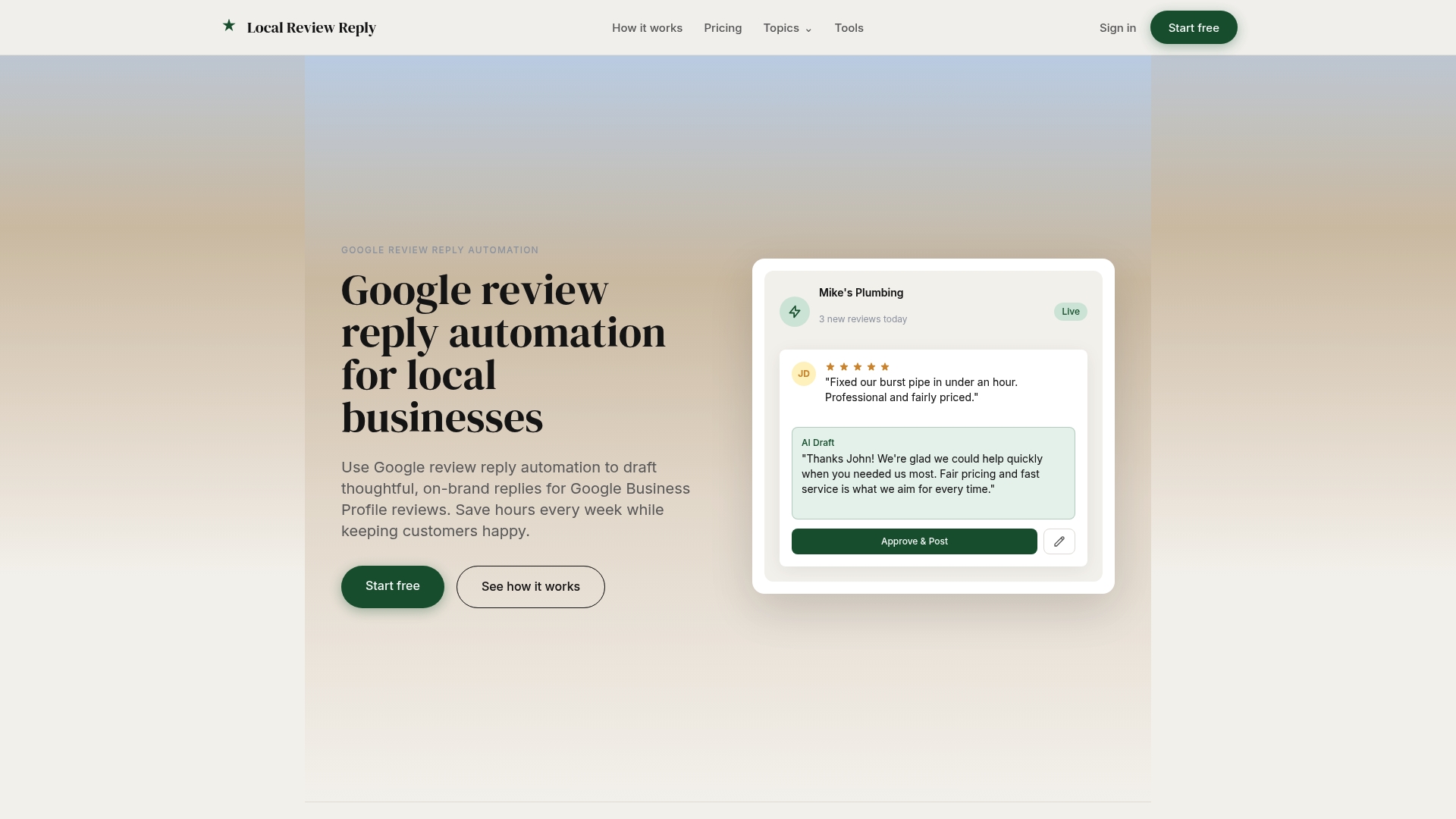
You set the rules, low-star reviews route to a manager for sign-off, routine four and five star reviews can move faster, and every location follows the same escalation logic instead of improvising one location at a time. The approval workflows and role-based permissions keep a human in the loop on anything sensitive while cutting the drafting time that eats up a manager's afternoon. Multi-location operators and agencies get a shared dashboard instead of ten browser tabs, plus low-star analytics that surface recurring complaints before they become a pattern nobody caught in time.
If your team is still handling escalation matrix logic by memory and group chat, start with the Google review management software built for multi-location operators and see how the approval controls fit your existing SLA structure.
Sources
- Federal Trade Commission announces final rule banning fake reviews, testimonials
- Review Management: The Complete Guide for 2026 | Sprinklr
- How to respond to bad Google reviews, the operator's field guide | GoodMarks
- How to handle negative Google reviews | Search Engine Land