
Assign one owner, then turn on AI-assisted drafting with a mandatory human approval gate for any review at three stars or below, or flagged for legal or employee-name content. That single move creates working quality control before you write another policy page. From there, set a response SLA, define hold-for-approval rules, and pick one location to pilot the workflow for a month before rolling it out further.
TL;DR:
- Auto-post reviews with four or five stars that contain no flagged keywords, while all others require human approval to prevent inappropriate responses.
- Placement of approval responsibilities should be streamlined through clear roles: a drafter, approver, escalator, and owner, with routing rules based on location tags.
- Before posting, verify review facts, reference specific issues, and avoid promising quick resolutions if they cannot be guaranteed within the week.
- Human review must follow strict rules: never invent facts, avoid public compensation offers, and only post after confirming accuracy and appropriateness.
- Measure reply quality using response speed, factual accuracy, tone, and rejection rates, aiming for a tight feedback loop to improve online reputation gradually.
Table of Contents
- What Is Review Reply Quality Control?
- A Compact Quality-Control Framework: Roles, Gates, and SLAs
- Checklist: What to Verify Before Any Public Reply
- AI Drafting Plus a Human Gate: Exact Rules and Escalation Triggers
- Training, Templates, and a Minimal Playbook
- Metrics and Audit Plan: Measuring Reply Quality
- What This Framework Trades Off, and How to Roll It Out
- How Local Review Reply Fits This Quality-Control Playbook
- Sources
- FAQ
What Is Review Reply Quality Control?
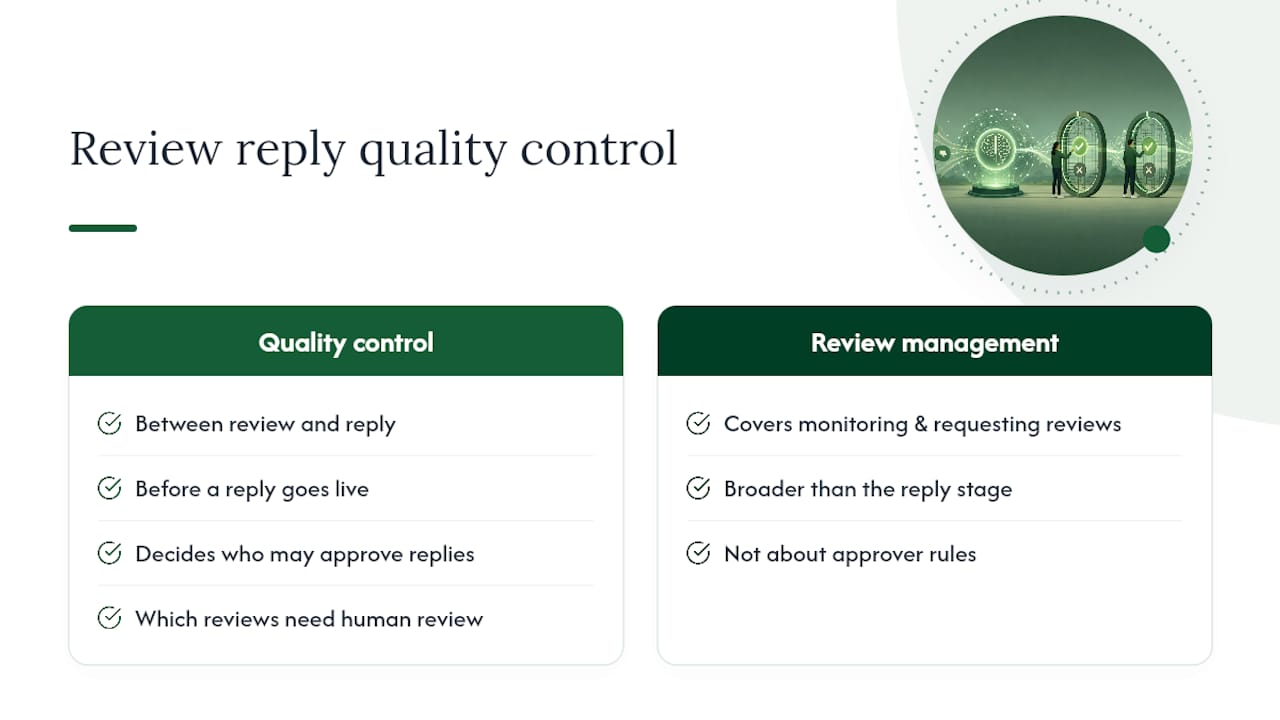
Review reply quality control is the set of roles, rules, and checks that decide who can approve a public reply, which reviews require human review before posting, and how you measure whether those replies are actually good. It is different from customer review management broadly, which covers monitoring and requesting reviews. Quality control is specifically about what happens between "a review appeared" and "a reply went live," and whether that reply was accurate, on brand, and unlikely to get rejected by the platform.
Most operators skip straight to templates and skip the framework. That is backwards. A great template posted by the wrong person at the wrong time still creates a mess.
A Compact Quality-Control Framework: Roles, Gates, and SLAs
You need four roles, not fourteen. A drafter (AI tool or staff member) writes the first version. An approver reviews anything that doesn't qualify for auto-post. An escalator handles legal, safety, or reputational risk. An owner watches the whole system and adjusts the rules.
Auto-post versus hold rules should follow star rating and content flags, not gut feeling:
- Auto-post: 4 and 5-star reviews with no flagged keywords (refund, lawsuit, employee name, injury, discrimination).
- Hold for human approval: any review at 3 stars or below, regardless of content.
- Hold for human approval: any review containing a flagged keyword, even at 4 or 5 stars.
- Immediate escalation, no auto-post ever: legal threats, named-employee complaints, data breach mentions.
Set an approval SLA that matches your review volume — this practical approach is detailed in a helpful restaurant employee scheduling guide: automation & best practices. A single location might target same-day human review. A franchise group processing hundreds of weekly reviews across locations needs a queue with a two-hour internal target for anything held, so a bad review doesn't sit unanswered for three days while an approver catches up. Route each held reply to the manager or franchise owner tied to that specific location, not to a shared inbox where accountability disappears.
Pro Tip: Build the routing rule around location tags before you build anything else. If a held reply can't reach the right human automatically, your SLA is just a number on a slide.
Checklist: What to Verify Before Any Public Reply
Before anything goes live publicly, run through a short checklist. Skipping this is how businesses end up apologizing for a refund they never actually issued.
- Confirm the facts. Check the customer's order, appointment, or service record before referencing anything specific. Never invent a refund, a fix, or a timeline that hasn't actually happened.
- Reference the actual complaint. Reviews that name a specific issue and a specific resolution read as authentic; generic phrases like "we value your feedback" are a common trigger for platform rejection, since templated AI boilerplate is a frequent cause of moderation rejections.
- Confirm the fix is deliverable this week. If you can't actually resolve it that fast, don't promise it in a public reply. Offer a phone number or email instead.
- Decide public-first or private-first. Sensitive complaints (billing disputes, safety concerns) often warrant a private outreach attempt first, with a short public acknowledgment.
- Check the platform's constraints. Google Business Profile allows replies up to 4,000 characters, but other platforms cap far tighter, and Google Play limits responses to roughly 350 characters.
The strongest performing structure in practice is short: a 60 to 90 word reply that acknowledges the specific complaint, offers a private resolution path, and signs off with a real first name. Anything longer starts to read as defensive rather than helpful.
AI Drafting Plus a Human Gate: Exact Rules and Escalation Triggers
An AI drafting tool can write a serviceable first draft in seconds, but the rules for what it's allowed to post on its own need to be explicit, not implied.

Auto-post scenarios should stay narrow: short positive reviews with no names, no complaints, and no special requests. Everything else drafts and holds. The clearest published design for this comes from an AI review response agent blueprint that auto-posts straightforward positive replies, drafts and holds negative ones for human sign-off, and routes legal, named-employee, or data-breach mentions straight to a person without posting anything.
When a reply escalates, the human reviewing it needs a short brief, not a raw review dump:
- Who is complaining, and which location or service is involved.
- What the core complaint is, in one sentence.
- Star rating and any flagged keywords that triggered the hold.
- Current CRM or ticket status, if the issue was already reported elsewhere.
The agent itself should follow three hard rules: never invent a fact it can't verify, never offer compensation publicly, and only post once a human or system has confirmed the details are accurate. Audit escalation accuracy weekly with a small sample, ideally 15 to 20 held replies, checking for both false negatives (risky content that slipped into auto-post) and false positives (harmless reviews that got needlessly held up).
Pro Tip: Track false negatives more aggressively than false positives. A harmless review sitting in a queue for an extra hour costs you nothing. A named-employee complaint that auto-posts without review can cost a lot more.
Training, Templates, and a Minimal Playbook
Staff need a fast way to diagnose what kind of complaint they're dealing with before they pick a tone. Distinguishing procedural complaints (wrong order, late delivery) from interactional ones (rude staff, dismissive service) changes what a good reply looks like, and getting that diagnosis right tends to improve how the customer talks about you afterward.
A workable practitioner method here is L.A.S.T.: Listen, Apologize, Solve, Thank. It's a simple enough sequence that new hires can memorize it in one shift, and it keeps replies from turning defensive.
- Use short template shells with variable slots (customer name, specific issue, resolution offer), never full-copy templates repeated word for word.
- Maintain a running "do not say" list: no admissions of legal fault, no specific compensation amounts, no private customer data in a public reply.
- Run a daily or weekly calibration review, comparing three approved replies against three that got rejected or held, and discuss why.
- Sign replies with a first name and role ("Jamie, Manager") rather than a generic business signature. It reads as more human, without exposing anything private.
A repository of Google review response templates or industry-specific shells for home services gives staff a starting structure without locking them into robotic language.
Metrics and Audit Plan: Measuring Reply Quality
Four numbers matter more than any others: response rate within SLA, response quality score, moderation rejection rate, and escalation accuracy.
Response quality score isn't one number pulled from a platform. Build it from four components you can actually check by hand during a sample audit.
| Component | What it checks |
|---|---|
| Tone match | Does the reply match the complaint's severity and category (procedural vs. interactional)? |
| Specificity | Does it reference the actual issue, not a generic acknowledgment? |
| Verified facts | Was every claim (refund, fix, timeline) confirmed before posting? |
| Brand voice | Does the signature, phrasing, and length match your house style? |
Track moderation states directly, since Google now marks each reply PENDING, APPROVED, or REJECTED, and logging rejection reasons has become part of basic reputation hygiene since the 2026 moderation changes. Run a weekly sample audit, pull 20 to 30 recent replies, score them against the table above, and route problems back into either retraining, template edits, or a workflow rule change. Businesses that keep this loop tight and respond consistently to negative reviews have seen ratings climb by roughly 0.12 stars on average alongside a 12% increase in total positive reviews, which is a reasonable benchmark for whether your quality-control effort is paying off.
What This Framework Trades Off, and How to Roll It Out
Speed and brand safety pull against each other, and approval gates exist to buy back the safety side without freezing your response time entirely. Start with one review category, tune your hold rules for four weeks at a single location, then extend the same rules to comparable locations. The most common friction point is approver backlog. Fix it by adding a second approver or tightening auto-post rules, not by loosening the gate on risky reviews.
— Ryan
How Local Review Reply Fits This Quality-Control Playbook
The platform is built around a gate where AI drafts personalized, on-brand replies quickly, and sensitive or low-star reviews route to a human for approval before anything goes public. For a franchise group or agency managing dozens of locations, that means one team can maintain the auto-post and hold-for-approval rules above without a person manually reading every single review that comes in.
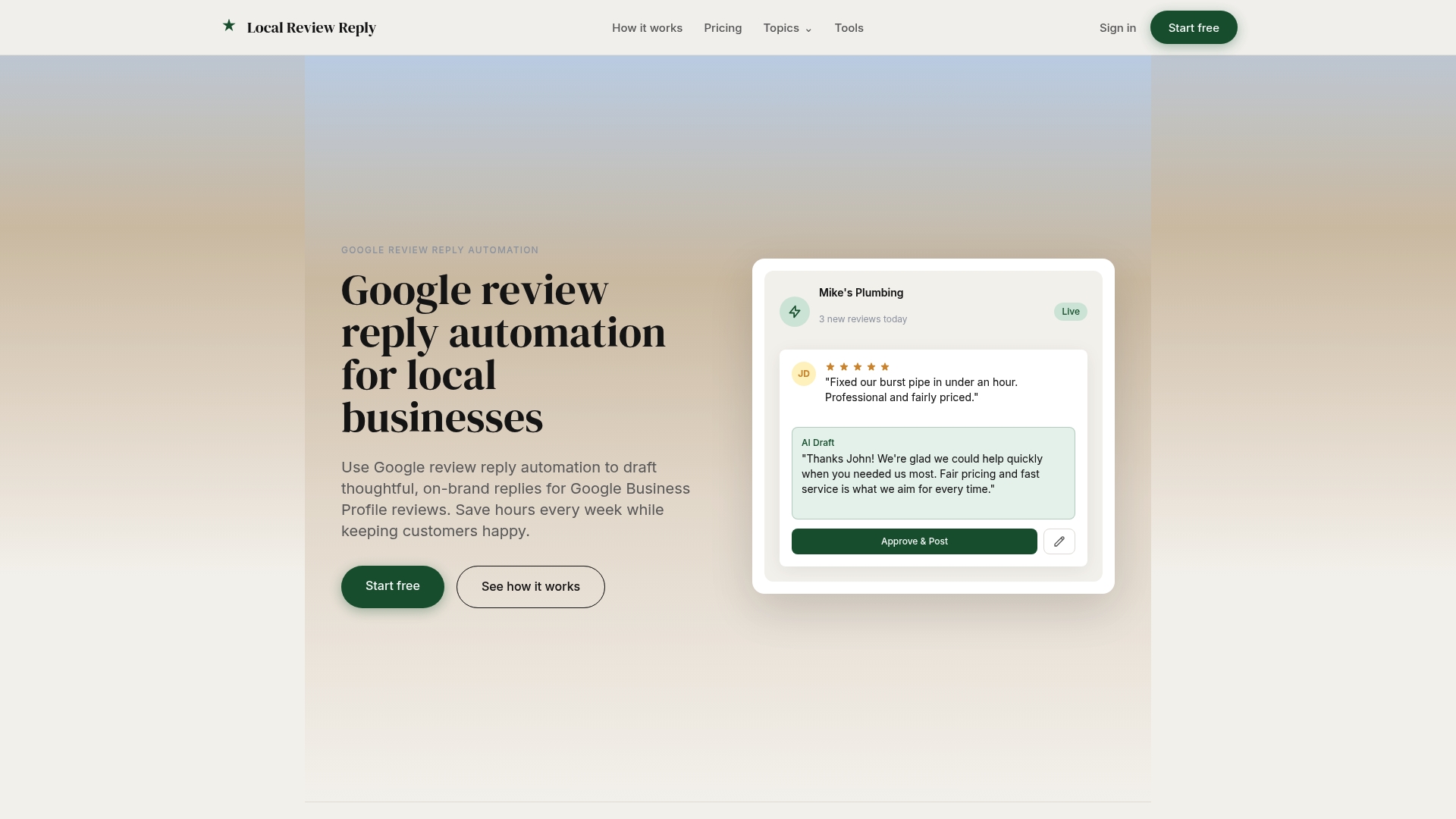
The platform supports multi-location controls so each held reply routes to the right local manager, and its feature set covers the approval workflows, team permissions, and audit trail this playbook depends on. If you're running the pilot-then-scale rollout described above, start by checking the pricing page to match a plan tier to your location count and monthly reply volume, then set your hold rules on day one rather than after your first moderation rejection.
Sources
- How review responses affect online reputation management
- Review Response Strategy — How to Reply to Reviews (ISR research summary)
- AI Review Response Workflow: Replies That Pass Google's 2026 Moderation | AI Tools Guidebook
- How to Respond to Bad Reviews — Operator's field guide
- AI Review Response Agent: A Build Blueprint for Public Review Management (2026)
FAQ
What Is a Review Reply Approval Gate?
An approval gate is a rule set that forces certain replies, typically ones at three stars or below or containing flagged keywords, to pass through human review before they post. It stops AI-drafted or templated replies from going live unchecked on high-risk reviews.
How Fast Should You Respond to a Negative Review?
There's no universal legal deadline, but operators generally target same-day acknowledgment, with a 60 to 90 word structured reply that confirms the issue and offers a private resolution path. Longer delays increase the odds the customer escalates elsewhere before you respond at all.
Does Local Review Reply Support Human Approval for Sensitive Reviews?
Yes. Local Review Reply drafts replies with AI but includes approval controls specifically for sensitive and low-star reviews, so a human signs off before anything posts publicly. Current pricing and plan tiers are listed on the pricing page.
Why Do Some AI-Drafted Replies Get Rejected by Google?
Generic, templated language is a frequent trigger for moderation rejection, since Google's review moderation flags boilerplate phrasing more often than specific, fact-referencing replies. Referencing the actual complaint and a concrete resolution path reduces that risk.
What Metrics Should You Track for Reply Quality?
Track response rate within your SLA, a response quality score built from tone match and factual accuracy, moderation rejection rate, and escalation accuracy. Weekly sampling of 20 to 30 replies against these four measures catches drift before it becomes a pattern.