
Reply first to accurate 1 and 2 star reviews and neutral 3 star posts that contain a specific complaint or public question, since these carry the most reputational risk and the best chance of resolution. The simplest way to rank your queue is impact times urgency times fixability: how visible the review is, how urgent the underlying issue is, and how quickly you can actually fix it. A fast, public reply limits damage and can sometimes lead a reviewer to update their rating.
TL;DR:
- Score each review from 1 to 3 for visibility, urgency, and fixability, then multiply the scores; a top score is 27.
- Route refund, safety, or named employee complaints to a manager for approval; send allegations of injury, fraud, or discrimination to legal.
- Set targets: answer one and two star reviews within 24 to 48 hours, public questions within 48 to 72 hours, and praise within a week.
- Track response times by tier, reviewer rating changes, sentiment, and escalations weekly, comparing locations so one slow site does not disappear in averages.
- Treat duplicate complaints across platforms as one issue, and flag suspicious review bursts for investigation while replying factually without trying to suppress legitimate criticism.
Table of Contents
- How to rank review types from most to least urgent
- Scoring reviews and assigning ownership across your team
- Setting realistic response time windows by priority tier
- Templates you can adapt for negative, neutral, and positive reviews
- Measuring whether your prioritization is actually working
- Handling multiple reviews from the same customer or coordinated campaigns
- Tracking what happens after you reply
- Author perspective: trade-offs and implementation tips
- How Local Review Reply fits into a prioritized response workflow
- FAQ
- Sources
How to rank review types from most to least urgent
Not every review deserves the same attention, and treating them all equally wastes time you could spend on the ones that actually move the needle. A four-tier system keeps your team focused on what matters without ignoring the reviews that build long-term trust.
- Top priority: one and two star reviews naming a specific service failure, a safety concern, or a refund request.
- High priority: three star reviews describing an unresolved issue, a direct question, or posted on a platform with heavy local traffic.
- Medium priority: detailed, high-visibility positive reviews worth amplifying for social proof.
- Low priority: short, generic praise with nothing specific to respond to.
A one star review that says "the technician never showed up and charged us anyway" belongs at the top of the queue. It names a concrete failure, implies a billing dispute, and will sit on your profile until you address it. A three star review asking "do you service apartments or only single family homes?" sits in the high tier: it is a public question that is actively costing you leads if it goes unanswered. A five star review that describes a specific technician by name and praises a same-day fix deserves a thoughtful reply because it reinforces that detail for future readers, but it will not hurt you if it waits a day. A five star review that just says "great job!" can get a brief thank you whenever time allows.
- Reviews with safety, fraud, or legal language jump the queue regardless of star rating.
- Reviews from verified customers with order or appointment details attached are easier to resolve and should be answered before vague, unverifiable complaints.
- Reviews on your most visible location or your highest-traffic platform profile get priority over a lower-traffic secondary listing.
This tiering works whether you manage one location or fifty. The ranking logic stays the same; only the volume changes, which is why the next section turns these tiers into a scoring system your team can apply consistently.
Scoring reviews and assigning ownership across your team
A ranked list only works if everyone on your team applies it the same way, which means you need a scoring method, not just a gut feeling. Score each review on three factors from 1 to 3: impact (how visible is this review, and on which platform), urgency (does it involve safety, a refund, or a direct accusation), and fixability (can we resolve or clarify this in one reply). Multiply the three scores together. A review that scores a 3 on all three factors (a visible, urgent, fixable complaint) lands at 27, the top of your queue. A review that scores 1 across the board barely registers and can wait.
- Frontline responder: handles medium and low tier reviews and drafts replies for high tier ones.
- Shift or location manager: reviews and approves drafts for anything involving a refund, a safety claim, or a named employee complaint.
- Legal or policy reviewer: steps in only when a review alleges discrimination, injury, fraud, or threatens legal action.
Manual approval should be mandatory, not optional, whenever a review accuses staff of misconduct, references an injury, or requests compensation. These are exactly the cases where a rushed reply creates more risk than the original review did. Capturing metadata when a review comes in, which platform, which location, the star rating, and a short tag like "billing" or "safety", lets you route reviews automatically and report on patterns later instead of rediscovering the same complaint type every month.
Pro Tip: Tag every incoming review with a one word category the moment it arrives; it turns a pile of individual replies into a searchable record of recurring problems.
Setting realistic response time windows by priority tier
Speed matters, but it matters differently depending on the tier; learning how to automate Google reviews can help your team manage timely responses effectively. A reasonable framework:
- Top priority (1 and 2 star, specific complaint): reply within 24 to 48 hours.
- High priority (3 star, unresolved or public question): reply within 48 to 72 hours.
- Medium priority (detailed positive reviews): reply within about a week.
- Low priority (generic praise): reply as capacity allows, batched weekly.
Google's own guidance recommends replying when you have something substantive to add, keeping the response short and personal, and moving complex issues offline rather than litigating them in public. That guidance also notes a timely, constructive reply can sometimes prompt a reviewer to revise their rating, which is the clearest business case for prioritizing the top tier over everything else.
Sometimes slower is better. A review alleging a safety incident or threatening legal action is worth a short holding reply ("we take this seriously and are looking into it") followed by a fuller response once your manager or legal reviewer has weighed in. Set alert thresholds so one and two star reviews trigger an immediate notification, keep a weekday monitoring schedule for everything else, and route anything flagged as sensitive straight into an approval draft rather than letting a frontline team member publish it directly.
Templates you can adapt for negative, neutral, and positive reviews
Having a structure ready for each tier saves time without making every reply sound identical. Our review response guidelines cover the full set of best-practice phrasing if you want more variations beyond these three.
- One or two star reply: "Thank you for the detailed feedback. We're sorry your experience with [service/issue] didn't meet what we aim for. We'd like to make this right, please reach out to [contact] so we can resolve this directly."
- Three star reply: "Thanks for taking the time to share this. It sounds like [specific issue] wasn't fully resolved, could you tell us more at [contact] so we can follow up properly?"
- Positive reply worth amplifying: "Thank you for the kind words about [specific detail, e.g. 'how quickly Sam got your AC running again']. We'll pass this along to the team and hope to see you back."
A Google reply tends to read better short and specific, two to three sentences, since it sits directly under the review for anyone searching your business. A Facebook reply can run slightly longer and more conversational, since the platform's tone skews more casual. Either way, match the length of your reply loosely to the length and seriousness of the review itself; a one line complaint rarely needs a paragraph in response.
Pro Tip: Never repeat private details, like a phone number, address, or account number, back into a public reply, even if the reviewer posted it themselves.
A few dos and don'ts matter regardless of tier: never admit fault or liability in a public reply, never publish a customer's personal information, and move anything resembling a dispute, a refund negotiation, or a legal threat to a private channel immediately. Our anonymous review response guide walks through SLA and template specifics for franchise teams managing this across several locations at once.
Measuring whether your prioritization is actually working
Picking the right reviews to answer first only matters if you can tell whether it is improving anything. Five KPIs cover most of what you need: response rate (percent of reviews answered), average response time by tier, reviewer update rate (how often a reply leads to a revised rating), sentiment trend over time, and number of escalations requiring manager or legal review.
- Set tighter time targets for top priority tiers and looser ones for low priority, then track actual performance against those targets weekly.
- Compare response rate and time across locations, not just in aggregate, since a single underperforming location can hide in a franchise-wide average.
- Use approval controls and a shared template library to keep tone consistent across reviewers and locations, which matters more as team size grows.
One of the more useful signals available to any team running this process is reviewer update rate. A timely, constructive reply can sometimes prompt a reviewer to revise their original rating, which makes update rate a meaningful proxy for reply quality, not just reply speed.
A simple experiment: change one template or SLA target in a single region, then track reviewer update rate and sentiment trend over 30 to 60 days against a region you left unchanged. That comparison tells you whether the change is worth rolling out everywhere or whether it needs more adjustment first.
Handling multiple reviews from the same customer or coordinated campaigns
A single frustrated customer sometimes posts the same complaint across Google, Facebook, and a third platform within the same day. Treat these as one issue, not three. Reply with consistent facts on each platform, but avoid copy-pasting identical language word for word, since that can read as scripted to anyone comparing the posts.
Coordinated review campaigns, a burst of similar negative reviews posted within a short window, often from accounts with no other review history, are a different problem. These sometimes reflect an organized attempt to damage a business rather than genuine individual complaints. Flag a sudden cluster of similar reviews for your shift manager or legal reviewer rather than responding to each one as a standalone complaint; the pattern itself is the signal worth investigating.

The FTC's final rule on consumer reviews and testimonials prohibits businesses from suppressing or manipulating reviews, including pressuring platforms to remove legitimate negative feedback. That cuts both ways: you cannot try to bury a coordinated negative campaign through improper means, but you also are not obligated to treat every suspicious cluster as individually credible. The right response is a calm, factual public reply on each post paired with a flag to the platform if the pattern looks like policy-violating behavior, not silence and not a legal threat in the comments.
Tracking what happens after you reply
A reply is not the end of the process, it is the start of a follow-up loop that most teams skip. Once you have replied to a top or high priority review, log whether the customer responded privately, whether the issue got resolved, and whether the public rating changed afterward.
A simple shared tracker, even a spreadsheet tagged by review ID, location, and status (open, in progress, resolved), keeps complaints from falling through the cracks between a public reply and an actual fix. For sensitive cases routed through manager or legal approval, add a follow-up date so someone checks back within a set window rather than assuming the private conversation resolved itself.
This tracking also feeds your KPI reporting directly: reviewer update rate only means something if you can tie a specific reply to a specific outcome days or weeks later. Our practical playbook for Google review responses includes a workflow structure for this kind of follow-up tracking if you want a starting template rather than building one from scratch.
Author perspective: trade-offs and implementation tips
Speed and caution pull against each other. The biggest failure mode I see is not slow replies, it is inconsistent ones: a great template used once and forgotten. Roll out changes to one region first, watch the KPIs, then expand.
— Ryan
How Local Review Reply fits into a prioritized response workflow
Our software is designed to draft AI replies that match your voice for medium and low tier reviews, while approval controls hold anything sensitive, including a refund claim, a safety accusation, or a named staff complaint for manager sign-off before posting. Multi-location and franchise teams get the same template library and routing logic across every site instead of reinventing tone store by store.
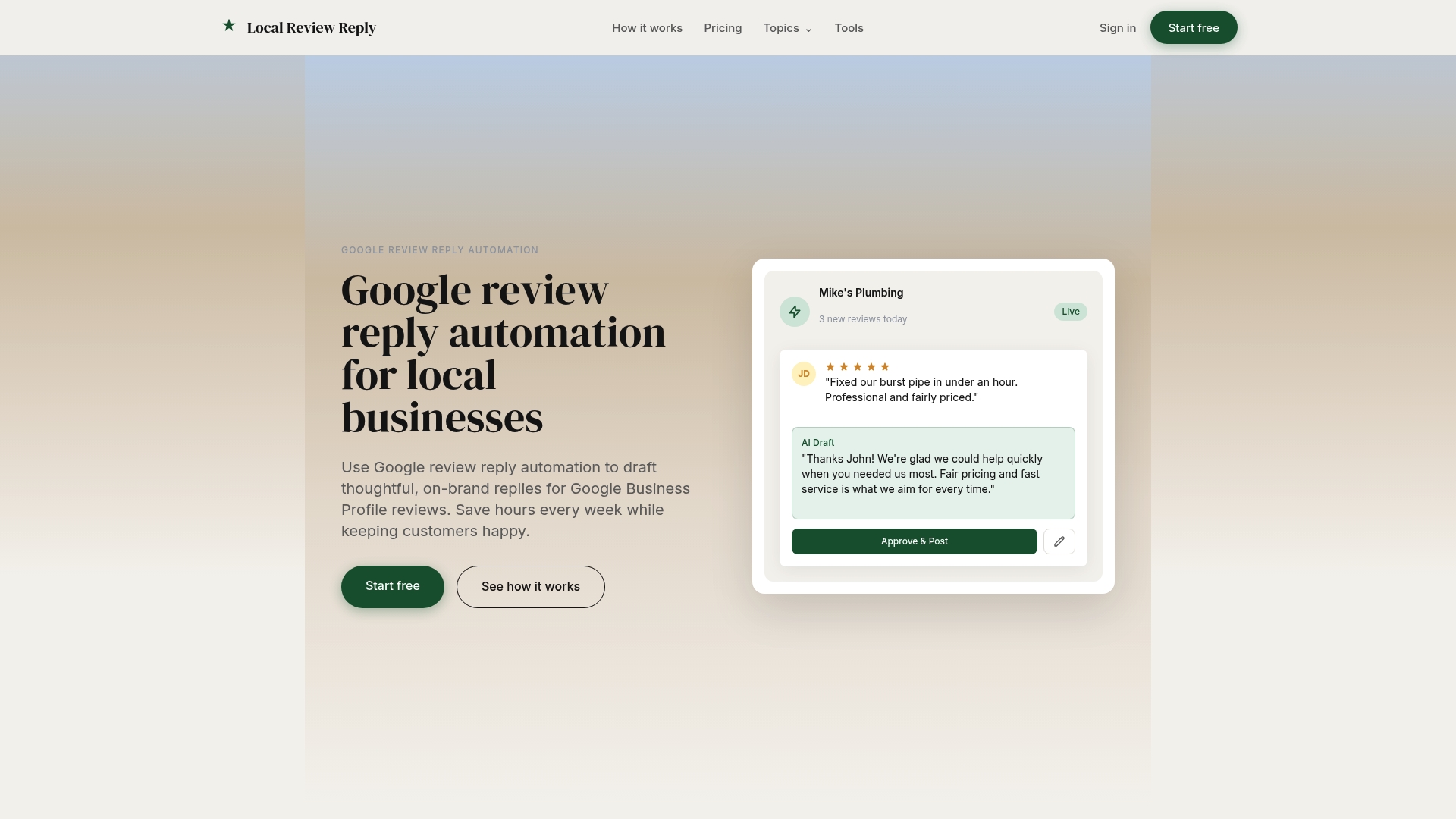
- The software drafts replies quickly, freeing your team to focus on the top and high priority tier.
- Approval workflows require human sign-off before any sensitive low-star reply goes live.
- Multi-location dashboards help keep brand voice consistent across multiple locations.
If your queue is already backing up, our pricing plans start with a free tier and scale up through Starter, Growth, Scale, and Custom options as your location count and reply volume grow. Teams evaluating other tools can also see how our approach compares to Podium before deciding.
FAQ
What are some good responses to reviews?
A good response is short, specific, and matches the tone of the original review: thank genuine praise with a concrete detail, and acknowledge a complaint without admitting fault before inviting the customer to continue the conversation privately. Google's guidance recommends keeping replies professional, relevant, and brief rather than defensive or generic.
What are 5 star positive reviews examples?
A strong five star review usually names a specific employee, service, or outcome, such as praising a technician by name for a same-day repair, rather than offering vague praise. These detailed positive reviews are worth a personalized reply since they double as social proof for future customers browsing your profile.
What are some examples of positive feedback responses?
An effective reply thanks the customer by referencing the specific detail they mentioned, such as a fast turnaround or a particular staff member, and invites them back. Keeping it to two or three sentences works well on Google, while a slightly longer, more conversational reply tends to fit Facebook's tone better.
How to reply to reviewer comments?
Start by acknowledging what the reviewer said directly, then respond to the specific point rather than a generic script, and move any complex issue, refund request, or dispute to a private channel. For one and two star reviews, avoid admitting fault publicly and instead invite the reviewer to continue the conversation through a direct contact method.
How quickly should a business respond to a negative review?
Top priority negative reviews involving a specific complaint, safety issue, or refund request are best answered within 24 to 48 hours, since a prompt, constructive reply can sometimes lead a reviewer to update their original rating. Lower priority reviews with vague or generic language can wait longer without meaningful risk.
Sources
- Tips to get more reviews - Google Business Profile Help
- Trade Regulation Rule on the Use of Consumer Reviews and Testimonials