
A crisis review response is a short, calm public reply, posted quickly, that acknowledges the concern, avoids admitting anything unverified, and moves the details to a private channel. During a real surge of negative reviews, the work is less about clever wording and more about process: decide how serious it is, split the reviews into groups, give sensitive ones a second pair of eyes, and keep every location saying the same thing. This guide walks through that process step by step, with reply structures you can adapt.
TL;DR
- Size the problem first: reach, intensity and how long the spike lasts separate a bad week from a true crisis.
- Reply publicly, briefly and without defensiveness, then move the details to a phone number or email.
- Sort reviews into three piles: real complaints to answer, policy violations to report, and sensitive cases that need management or legal review before anything posts.
- Pre-approve reply structures and a response matrix before you need them, so multiple locations stay consistent.
- Debrief within a week and fix the cause, or the next spike will look the same.
Table of Contents
- What counts as a review crisis
- Why replying beats staying silent
- The first hour: contain, sort, assign
- What a crisis reply should say
- Take it offline, and know when to escalate
- Staying consistent across locations
- Our perspective: speed with a human gate
- Where Local Review Reply fits
- After the spike: monitor, debrief, fix
- Mistakes that make a crisis worse
- FAQ
- Sources
What counts as a review crisis
One angry one-star review is a complaint. A crisis is a pattern: many reviews in a short window, often triggered by an incident, a viral post, a news story or a coordinated campaign.
Researchers who study online firestorms describe them along three dimensions: width (how far it spreads), height (how intense the sentiment is) and the duration of peak activity. That is a useful scorecard for a local business, translated like this:
| Dimension | Question to ask | Lower severity | Higher severity |
|---|---|---|---|
| Width | Where are the reviews appearing? | One profile, one location | Several platforms, several locations, local media |
| Height | How hot is the language? | Specific, factual complaints | Accusations, threats, personal attacks |
| Duration | How long has the peak lasted? | A day or two, then fading | Still accelerating after several days |
Two more checks matter. Are the reviewers actual customers? If not, you may be looking at review bombing or fake reviews, which call for a different response. And does the underlying allegation involve safety, discrimination, a legal claim or a named employee? If so, treat it as sensitive from the first minute.
Why replying beats staying silent
You are writing for two audiences. The American Veterinary Medical Association makes the point plainly: a negative review is read by the reviewer and by prospective customers, so the reply should show professionalism and problem-solving even if the reviewer will never be satisfied.
The numbers support that. The Better Business Bureau reports that 97% of consumers read company responses to reviews, and that prospective customers often treat the newest reviews as the most relevant. Its guidance adds that silence can suggest indifference. The American Marketing Association goes further on viral negativity: not responding is the worst choice, because replies can be shaped to limit how far a story spreads.
No reply guarantees a rating recovery, and none should be promised internally. The goal is a profile that shows a business paying attention.
The first hour: contain, sort, assign
Before anyone writes a word, do four things.
- Name one owner. One person runs the response and decides what posts. Everyone else routes questions to them.
- Pause the cheerful content. During an unfolding crisis, cancel scheduled social posts so a promotional message does not land beside an angry thread and look tone-deaf.
- Collect the facts. Pull the order, visit or appointment records behind the complaints. You cannot reply honestly to what you have not checked.
- Sort the reviews. Use the three piles below.
Pile 1: genuine complaints
These describe a real experience, even if exaggerated. They get a public reply and an offer to resolve privately. This is the largest pile and the one that shapes how readers see you.
Pile 2: policy violations
The BBB notes that the Consumer Review Fairness Act protects honest customer reviews, but not abusive, vulgar or threatening reviews, or those revealing sensitive information about a business or its employees. Reviews like that can be reported to the platform. Our 48-hour flow for profanity in reviews covers the reply-or-report decision, and the Google review policy overview explains what Google's rules mean for your profile. Reporting a review does not remove the need to watch it; it may stay up for a while.
Pile 3: sensitive cases
Allegations of injury, discrimination, fraud, harassment, a named staff member, a medical or legal matter, or anything that sounds like a claim. These do not get a quick reply from whoever is on shift. More on that below.
What a crisis reply should say
Guidance from the BBB recommends acknowledging the concern, apologizing for mistakes, avoiding denials or excuses, offering a resolution where applicable, and giving a direct contact route for one-to-one follow-up. A legal-reputation firm adds a guardrail for harmful reviews: a good public response is short, acknowledges the concern without admitting unverified allegations, invites private resolution and avoids personal data.
Combine those and you get a structure of five short parts:
- Thank them for raising it, by name if the profile shows one.
- Acknowledge the experience they describe, without confirming disputed facts.
- Apologize for the part that is clearly true (the wait, the missed call), not for the whole allegation.
- Name one next step and a direct contact.
- Stop. No debate, no marketing line.
Example: a service failure you have confirmed
Thank you for telling us, Dana. A technician arriving three hours late is not the service we want to deliver, and we're sorry for the lost afternoon. Our service manager would like to make this right. Please call 555-0100 or email care@example.com so we can look at your job directly.
Example: an allegation you have not verified
Thank you for the feedback. We take concerns like this seriously and are reviewing what happened. We can't discuss individual cases in a public forum, but we'd like to hear your full account. Please contact our owner directly at 555-0100 so we can look into it.
Notice what is absent: no names of employees, no account details, no "we have no record of you", no accusation that the reviewer is lying. Research on online firestorms published in the Journal of Marketing suggests more explanatory, engaging replies work best when the original message carries high-arousal negative emotion, so a reply that shows you understand what happened beats a one-line apology. Keep it explanatory, not long.
The AVMA also recommends addressing the underlying complaint before putting energy into removing or changing the post, and sums up the tone as competent, confident and compassionate. That is a good test for any draft: does it read as all three?
For wording you can adapt, see our review response guidelines and the Google review response templates.
Take it offline, and know when to escalate
Public back-and-forth rarely helps. Limit the exchange on the review site and ask the customer to share contact details by private message or email for anything detailed. The AVMA's guidance is to respond publicly on the same platform in most cases and then take the conversation offline.
Some reviews need more than a private channel. Escalate before replying when:
- the review alleges injury, illegal conduct, discrimination or harassment;
- it names an employee or reveals customer or patient information;
- a complaint to a licensing body or a claim seems likely;
- the star rating is low and the content is about money, safety or health.
For those, the AVMA advises following your usual protocol for notifying your liability insurance carrier and legal counsel if a complaint against your license is anticipated. The legal-reputation firm cited earlier recommends that sensitive responses be drafted by management and reviewed by legal counsel. If you work in a regulated field, our guides on law firm review responses and real estate review responses show how approval steps fit those professions. When the reviewer is unidentifiable, see anonymous review responses.
Staying consistent across locations
Crises are where multi-location brands diverge. One manager apologizes, another argues, a third goes quiet. The fix is built before the spike.

The AMA recommends a social media response matrix that maps likely scenarios to planned responses, keeping replies consistent, organized and accountable. Zendesk suggests preapproving reactive statement templates so you can answer quickly when something breaks.
A workable matrix for a local service brand has four columns:
| Scenario | Who drafts | Who approves | Target reply time |
|---|---|---|---|
| Late arrival, rude staff, billing dispute | Location manager | Location manager | Same business day |
| Repeated complaint about the same issue across locations | Regional lead | Regional lead | Within 24 hours |
| Safety, discrimination or legal allegation | Owner or head office | Owner plus counsel | Hold until cleared |
| Profanity, spam or suspected fake | Anyone on team | Reviewer of the report | Report first, reply only if needed |
The reply times are suggestions to set for your own business, not an industry standard. Our 24 to 48 hour playbook for review bombs uses a similar window. Train the people who will use the matrix: review response training can be done in hours, and the matrix gives a trainee something concrete to follow.
Our perspective: speed with a human gate
We build Google review reply software, so we see the same failure in two directions. Teams that reply by hand during a crisis burn hours, and tired people write defensive replies. Teams that automate everything risk posting a cheerful, generic reply under an accusation of serious harm.

Our view is that drafting and approving are different jobs. Drafting can be fast and automated, and a draft in your brand voice saves the first twenty minutes of every reply. Approving should stay human wherever the stakes are high. That is why Local Review Reply is designed so that sensitive and low-star reviews can require manual approval before anything posts, and why team roles and permissions decide who may publish what.
A tool will not decide whether an allegation is true, whether your lawyer should read the reply, or whether a customer deserves a refund. It can make sure the right person sees the review quickly, that the draft sounds like your business, and that every location follows the same rules. It cannot promise a rating recovery, and we would distrust any vendor that does.
— Ryan
Where Local Review Reply fits
If your bottleneck is volume, such as a spike across several locations or an agency covering many client profiles, drafting is where software helps most. Local Review Reply drafts on-brand replies for Google Business Profile reviews, holds sensitive and low-star reviews for approval, and gives teams roles, permissions and dashboards for managing locations at scale.
The Free plan includes basic functionality. Paid plans are Starter at 5 AUD per month, Growth at 19 AUD per month and Scale at 49 AUD per month, with a Custom option for larger needs. Plans scale with location count and monthly reply volume; see the pricing page for what each includes.
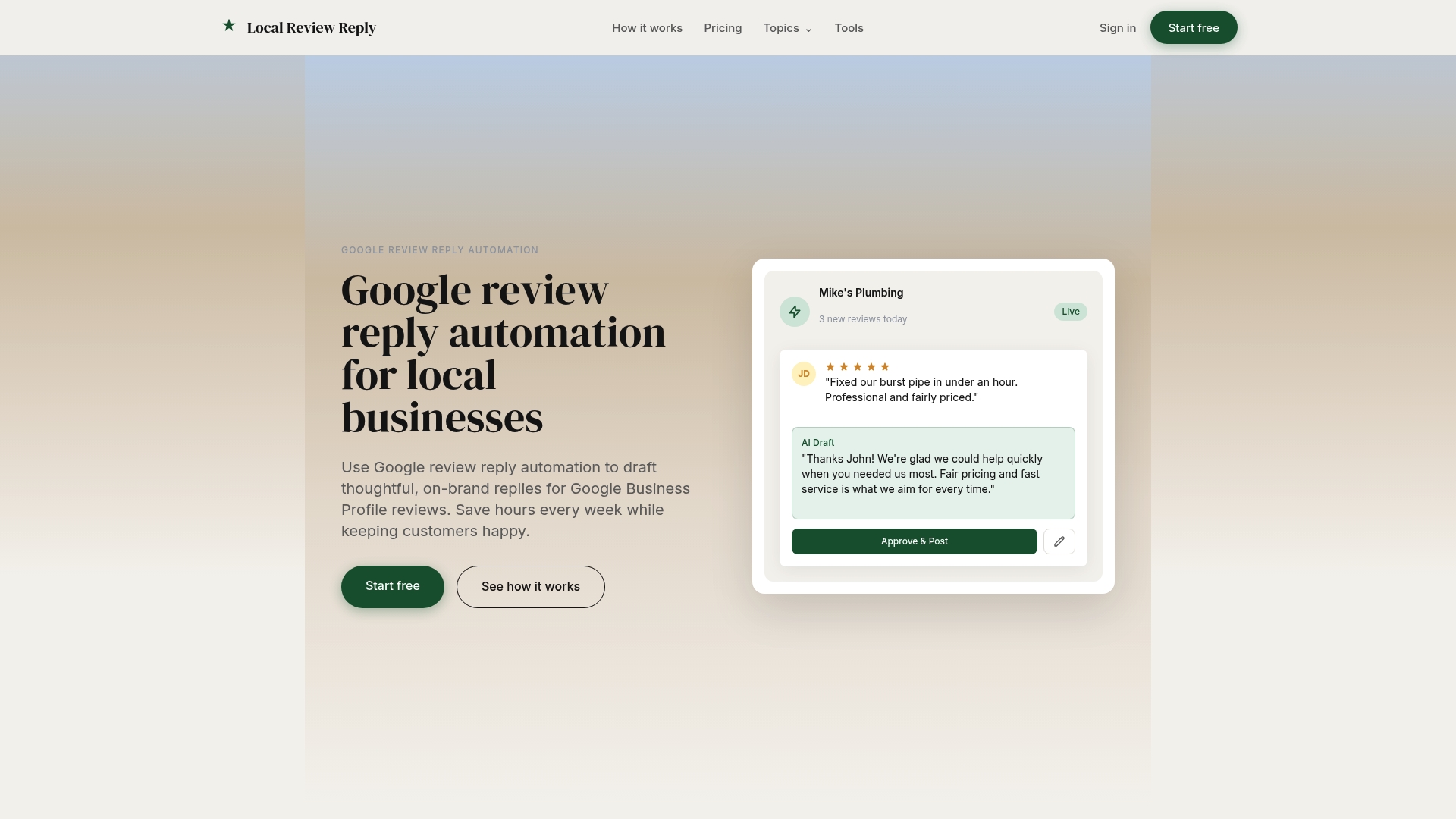
You can start from the Local Review Reply site and set approval rules before you need them, which is the part most teams skip.
After the spike: monitor, debrief, fix
A crisis does not end when the reviews stop. Researchers at the University of Central Florida describe crisis communication as a cycle: listen, identify audiences, engage, monitor, interact and implement changes, with listening continuing after the immediate event.
In practice:
- Keep watching for several weeks. Late reviews and follow-ups often arrive after the peak.
- Hold a debrief within a week of things stabilizing. The Public Relations Society of America recommends a cross-functional debrief involving PR, legal, HR, customer service and leadership. A small business can shrink that to the owner, the manager involved and whoever handles customer calls.
- Look for the root cause. If twelve reviews mention the same booking problem, the fix is operational, not verbal.
- Update the matrix and templates. Add the scenario you just lived through.
- Ask happy customers for honest reviews in the normal way. Do it as part of your regular process, never with incentives or pressure, and never as a crisis tactic that breaks platform rules.
The Harvard Business Review's research-based principles for responding to reviews point to a systematic rather than purely reactive approach, because manager replies shape how future readers interpret both the business and the review. A debrief is how you build that system.
Mistakes that make a crisis worse
- Arguing facts in public. Even when you are right, a rebuttal reads as hostility to the next customer.
- Copy-pasting the same reply under every review. Readers see the repetition. Keep the structure, change the specifics.
- Revealing details. Confirming that a reviewer was a customer, or what they bought or were treated for, can create a privacy problem.
- Offering compensation publicly. Keep refunds and credits in the private conversation.
- Hiding behind a script. Pre-approved language is a starting point. If a reply could fit any complaint, rewrite it.
- Replying while angry. Draft, wait, have a second person read it.
FAQ
What is a crisis review response?
It is a public reply written during a spike of negative reviews, usually after an incident. It is short, calm and empathetic, avoids confirming unverified claims, and points the customer to a private contact for resolution. It is written for the reviewer and for everyone else reading the profile.
Should I reply to every review during a crisis?
Reply to the genuine complaints, prioritizing the newest, since prospective customers tend to read recent reviews first. Report abusive or policy-violating reviews to the platform instead of debating them. Hold sensitive allegations for management or legal review before replying.
Can I use templates in a crisis?
Yes, as a framework. Preapproved structures speed up replies and keep locations consistent, but each reply should reference something specific to that review. Identical text under many reviews looks automated and can make readers more skeptical.
Should AI write replies to angry or serious reviews?
AI can draft, which saves time, but a person should approve anything involving low ratings, safety, legal exposure or named staff. Treat the draft as a first version and the approver as the one accountable for what posts.
How do I know the crisis is over?
Look at the three dimensions: new review volume has returned to normal, the language has cooled, and mentions outside your profile have faded. Keep monitoring for a few weeks, then run the debrief and update your playbook.
Sources
- Developing a social media firestorm scale (Journal of Marketing Analytics, 2025)
- BBB Business Tip: How to handle negative reviews
- How to Extinguish an Online Brand Firestorm (American Marketing Association)
- Responding to complaints and criticism (American Veterinary Medical Association)
- How To Respond To A Harmful Google Review (pimlegal)
- A tactical guide to preventing and surviving a social media crisis (Zendesk)
- The do's and don'ts of responding to online reviews (Zendesk)
- How to Create a Social Media Response Matrix (American Marketing Association)
- Social listening during crises: A practitioner guide (University of Central Florida)
- Social Media Crisis Management: Real-Time Response Strategies (PRSA)
- 5 Principles for Responding to Customer Reviews (Harvard Business Review)